


Taiwanese women spent more than three hours per day on average providing unpaid care in 2024, only slightly less than five years before, with married and partnered women doing more housework than others, Ministry of Health and Welfare (MOHW) data showed.
Taiwanese society has been increasingly aware of gender equality, with these concepts taking root from a young age and hopefully influencing society from the bottom up, the ministry said.
However, traditional division of labor within families remains, with women providing more care for family members and doing more housework, it added.
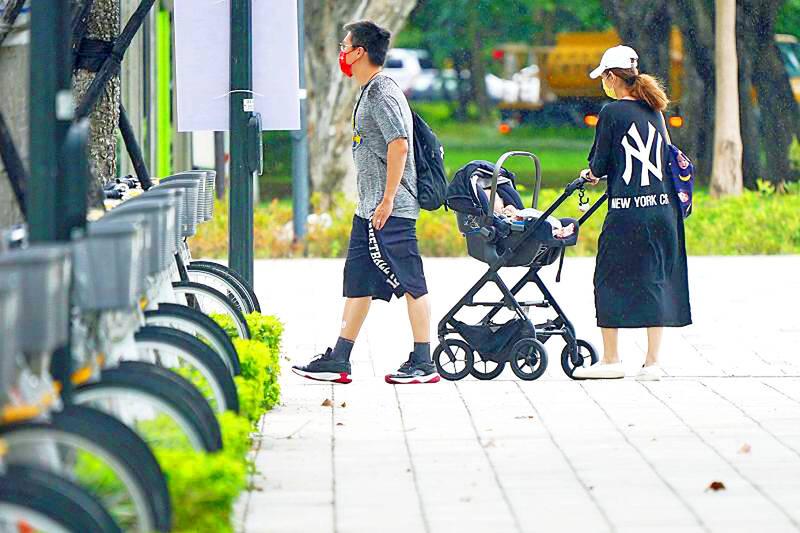
Photo: CNA
Following international standards, the ministry defined this type of work as “unpaid care” in its 2024 survey of women aged 15 to 64.
Women spent an average of three hours and two minutes a day providing unpaid care, with an average of one hour and 31 minutes spent doing housework, one hour and 29 minutes spent caring for family members, neighbors or friends, and three minutes spent doing other chores, the survey showed.
This is only nine minutes less than the average time women spent providing daily unpaid care in 2019, the ministry said.
Women who are married or living with a partner spent the longest time providing unpaid care, an average of four hours and 25 minutes daily, with their spouses or partners only providing an average of 15 more minutes of daily unpaid care compared with five years before, the data showed.
Married and partnered women spend 2.6 times more time on unpaid care than their spouses or partners, primarily on childcare and housework.
Women spend the most time on housework, with the 86.5 percent of women who need to do such work spending an average of one hour and 45 minutes per day on it.
The 93.9 percent of married and partnered women who need to do housework spend an average of two hours and eight minutes per day on it.
In addition, 39.4 percent of these women believe the best way to encourage their partners to do more housework is to eliminate traditional gender roles and stereotypes, the ministry said.
With generational change, women would continue to spend less time providing unpaid care, Social and Family Affairs Administration Acting Director Chou Tao-chun (周道君) said.
For a long time, society has generally expected a more equitable distribution of household responsibilities, with men sharing more of the burden, Chou said.
The younger generation’s views in this regard are trending toward equality, but there is still room for improvement, he said.
The ministry would continue to promote gender equality in families and advocate for women through International Women’s Day, Girl’s Day and school events, Chou said.
For example, it would continue partnering with theater troupes to bring plays about familial gender roles to schools, encouraging young people to think about gender issues, he said.
Additional reporting by CNA

Actor Darren Wang (王大陸) was sentenced to six months in prison, commutable to a fine, by the New Taipei District Court today for contravening the Personal Data Protection Act (個人資料保護法) in a case linked to an alleged draft-dodging scheme. Wang allegedly paid NT$3.6 million (US$114,380) to an illegal group to help him evade mandatory military service through falsified medical documents, prosecutors said. He transferred the funds to Chen Chih-ming (陳志明), the alleged mastermind of a draft-evasion ring, although he lost contact with him as he was already in detention on fraud charges, they said. Chen is accused of helping a

SECURITY: Starlink owner Elon Musk has taken pro-Beijing positions, and allowing pro-China companies to control Taiwan’s critical infrastructure is risky, a legislator said Starlink was reluctant to offer services in Taiwan because of the nation’s extremely high penetration rates in 4G and 5G services, the Ministry of Digital Affairs said yesterday. The ministry made the comments at a meeting of the legislature’s Transportation Committee, which reviewed amendments to Article 36 of the Telecommunications Management Act (電信管理法). Article 36 bans foreigners from holding more than 49 percent of shares in public telecommunications networks, while shares foreigners directly and indirectly hold are also capped at 60 percent of the total, unless specified otherwise by law. The amendments, sponsored by Chinese Nationalist Party (KMT) Legislator Ko

‘SAME OLD TRICK’: Even if Beijing resumes individual travel to Taiwan, it would only benefit Chinese tourism companies, the Economic Democracy Union convener said China’s 10 new “incentives” are “sugar-coated poison,” an official said yesterday, adding that Taiwanese businesses see them clearly for what they are, but that Beijing would inevitably find some local collaborators to try to drums up support. The official, speaking on condition of anonymity, made the remark ahead of a news conference the General Chamber of Commerce is to hold today. The event, titled “Industry Perspectives on China’s Recent Pro-Taiwan Policies,” is expected to include representatives from industry associations — such as those in travel, hotels, food and agriculture — to request the government cooperate with China’s new measures, people familiar with

The eastern extension of the Taipei MRT Red Line could begin operations as early as late June, the Taipei Department of Rapid Transit Systems said yesterday. Taipei Rapid Transit Corp said it is considering offering one month of free rides on the new section to mark its opening. Construction progress on the 1.4km extension, which is to run from the current terminal Xiangshan Station to a new eastern terminal, Guangci/Fengtian Temple Station, was 90.6 percent complete by the end of last month, the department said in a report to the Taipei City Council's Transportation Committee. While construction began in October 2016 with an


 RSS
RSS