


National security intelligence suggested China has set out four prerequisites and four corresponding commitments for a summit between Chinese President Xi Jinping (習近平) and South Korean President Lee Jae-myung, including requiring Seoul to publicly reiterate the “one China” principle, sources said on Saturday.
Xi is hosting Lee on a state visit starting yesterday.
According to a Taiwanese national security official who declined to be named, intelligence suggested the four prerequisites include: Lee publicly reiterating that South Korea would comply with the “one-China principle” and release a statement, and committing to not utilize products made in cooperation with the US defense industry, such as military vessels, in the Indo-Pacific region.
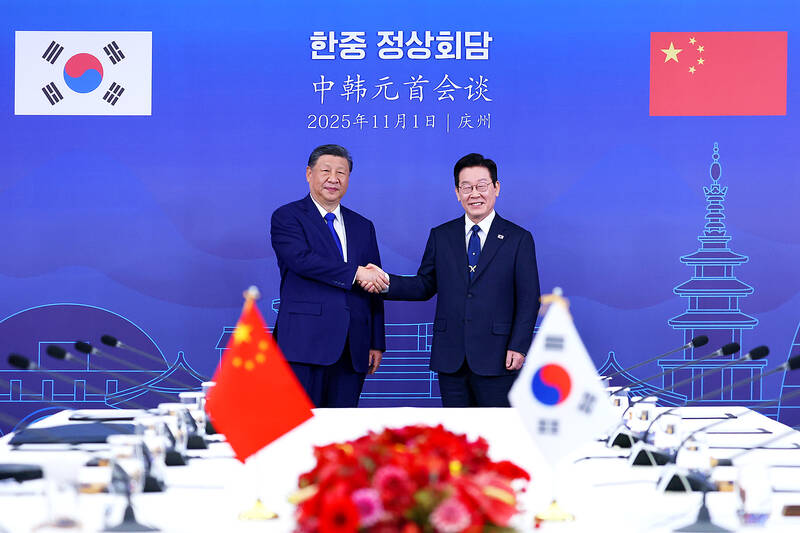
Photo: AP
They also include committing to refuse cooperation in deploying the Typhon missile system and to oppose the expansion US Forces Korea’s missions in the region.
Since mid-November last year, China has continuously tried to establish substantial dominance in the Indo-Pacific and the island chains, the official said.
China also has been testing the US’ resolve in maintaining Indo-Pacific security following the publication of Washington’s National Security Strategy, they said.
However, after China failed in pressuring Japan and provoking the Philippines, it launched targeted military exercises against Taiwan without securing compromise or substantial strategic gains, so it rapidly turned to target South Korea to find a “weak link” in the Indo-Pacific strategic framework, they said.
As Russia on Thursday last week began one-month-long large-scale military drills near Japan’s northern territories, China is using every possible tool to obstruct the newly announced defense industry cooperation between the US and South Korea, they said.
Following the release of its National Security Strategy, Washington has been stressing that nations in the Indo-Pacific region and the island chains should fulfill their regional responsibilities, they said.
China wants to prevent South Korea from assuming a more active role in the region, so it intends to use the Xi-Lee summit to define China-South Korea relations as a “strategic partnership,” weakening the US-Japan-South Korea trilateral alliance and the Indo-Pacific democratic alliance, they said.
Corresponding to its four prerequisites, China would offer four commitments, including removing sanctions against the Hanwha Group’s subsidiaries, and lifting the “Korean culture ban” to allow South Korean entertainers to perform in China, the source said.
They also include committing to increase the number of Chinese tourists visiting South Korea to reach three times last year’s levels in the first half of the year and five times in the second half, as well as committing to facilitate dialogue with North Korean leader Kim Jong-un, they said.
Under the “CRINK” framework (referring to the alignment of autocracies China, Russia, Iran and North Korea), intensified unrest has broken out across Iran, the source said.
While Chinese news reports characterized the situation in Iran as the Iranian government suppressing the revolt, Chinese social media users see it as young people resisting injustice.
The situation in Iran has placed pressure on China’s internal stability, so Beijing is trying to co-opt South Korea, and use it to manage and counterbalance North Korea, they said.
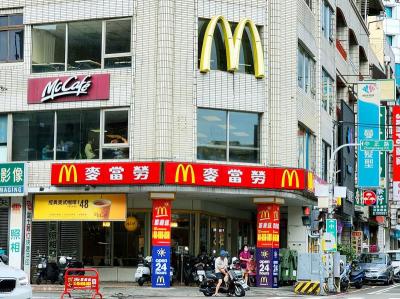
Fast food chain McDonald's is to raise prices by up to NT$5 on some products at its restaurants across Taiwan, starting on Wednesday next week, the company announced today. The prices of all extra value meals and sharing boxes are to increase by NT$5, while breakfast combos and creamy corn soup would go up by NT$3, the company said in a statement. The price of the main items of those meals, if ordered individually, would remain the same. Meanwhile, the price of a medium-sized lemon iced tea and hot cappuccino would rise by NT$3, extra dipping sauces for chicken nuggets would go up

Yangmingshan National Park’s Qingtiangang (擎天崗) nature area has gone viral after a park livestream camera observed a couple in the throes of intimate congress, which was broadcast live on YouTube, drawing large late-night crowds and sparking a backlash over noise, bright lights and disruption to wildlife habitat. The area’s livestream footage appeared to show a couple engaging in sexual activity on a picnic table in the park on Friday last week, with the uncensored footage streamed publicly online. The footage quickly spread across social media, prompting a tide of visitors to travel to the site to “check in” and recreate the

Minister of Digital Affairs Lin Yi-ching (林宜敬) yesterday cited regulatory issues and national security concerns as an expert said that Taiwan is among the few Asian regions without Starlink. Lin made the remarks on Facebook after funP Innovation Group chief executive officer Nathan Chiu (邱繼弘) on Friday said Taiwan and four other countries in Asia — China, North Korea, Afghanistan and Syria — have no access to Starlink. Starlink has become available in 166 countries worldwide, including Ukraine, Malaysia, the Philippines and Vietnam, in the six years since it became commercial, he said. While China and North Korea block Starlink, Syria is not
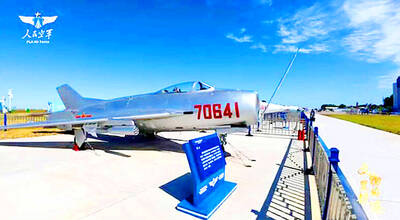
GROUNDED: A KMT lawmaker proposed eliminating drone development programs and freezing funding for counterdrone systems, despite China’s adoption of the technology China has deployed attack drones at air bases near the Taiwan Strait in a strategy aimed at overwhelming Taiwan’s air defense systems through saturation attacks, the Mainland Affairs Council (MAC) said. The council’s latest quarterly report on China said that satellite imagery and open-source intelligence indicate that the Chinese People’s Liberation Army (PLA) had converted retired J-6 fighter jets into J-6W drones, which the PLA has stationed at six air bases near Taiwan, five in China’s Fujian Province and one in Guangdong Province. The report cited J. Michael Dahm, a senior fellow at the US-based Mitchell Institute, as saying that China has


 RSS
RSS