


The National Communications Commission (NCC) yesterday released transparency, and complaint and correction guidelines, saying that it would this year evaluate five big international platforms based on those.
The five large international platforms include YouTube, Facebook, Line, TikTok and Dcard.
The commission published the Guidelines on Complaint and Correction Mechanisms for Internet Service Users (網際網路服務使用者申訴及救濟機制指引) and the Guidelines on Transparency Reporting for Internet Service Users (網際網路服務使用者透明度報告指引) after 51.2 percent of respondents in a survey said they were dissatisfied with digital platforms’ replies to their complaints and correction requests, Office of Internet Communications Director Chen Mei-ching (陳美靜) said.
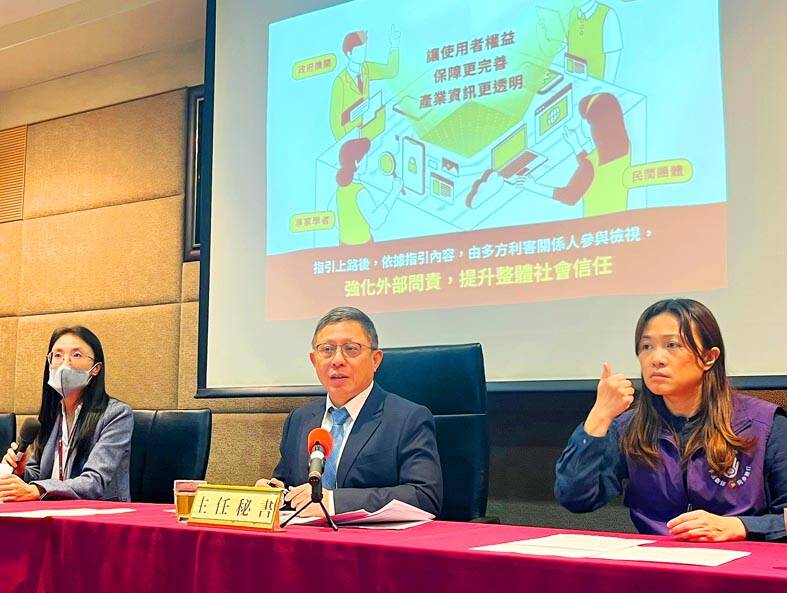
Photo: CNA
About 42 percent said digital platforms do not offer adequate correction mechanisms, while about 66 percent said such platforms are not transparent, Chen said.
The EU, UK, Australia, Singapore and Japan have required Internet service providers to file transparency reports and provide users with complaint and correction mechanisms, she said.
The two guidelines include evaluation criteria for digital platforms, she said.
The commission would evaluate digital platforms’ customer service based on whether they provide a complaint mechanism and clear instructions in traditional Chinese, recruit customer service personnel familiar with Taiwan’s history and culture, and inform users about their policies, Chen said.
They are also required to disclose criteria to review user-generated content, to develop mechanisms to protect users’ rights and prevent abuse, to abide by Taiwan’s laws, and to handle complaints within a reasonable time, she said.
The commission would also consider whether these platforms regularly update their measures to protect the users and their personal information, provide updates on how they handle complaints and whether they promote user literacy, she added.
“The NCC would also review whether they disclose government requests for partnerships and policies on user data and privacy. They should announce any major change in platform policies and mechanisms for multistakeholder collaboration,” she said.
The evaluation would be conducted during the second half of the year based on information disclosed by the five platforms, Chen said.
“After the evaluation, we would convene a meeting involving multiple stakeholders — including platform operators — to jointly comment on the results,” she said, adding that the results are scheduled to be released by the end of this year.
NCC Secretary-General Huang Wen-che (黃文哲) said that the guidelines are not laws and platforms would not be penalized if they do not follow them.
However, the guidelines reflect the public’s expectations for online platforms’ self-regulation.
“We are considering also evaluating Threads and X in the future,” Huang said.
NCC commissioners have not been able to rule in any case for 10 months, as they could not meet the quorum of four commissioners.
It currently has three commissioners.
However, the three commissioners held consultation meetings for 17,787 cases under the NCC’s purview in the past 10 months, 489 of which require final confirmation from the commissioners.

NATIONAL SECURITY: Authorities are working to confirm the identities of the military personnel involved and investigating possible illegal conduct and regulatory violations Authorities are probing possible national security implications after Kinmen police and immigration officers on Sunday found a Chinese woman allegedly posing as a tourist while engaging in prostitution involving more than 10 military personnel. The woman, surnamed Chen (陳), has since been deported, authorities said, adding that investigators are still working to confirm the identities of those implicated, as the records only listed code names and aliases. The case stemmed from a report received by the Kinmen District Prosecutors’ Office on Friday last week from the Jinhu Precinct of the Kinmen County Police Bureau. On Sunday, police, along with the National Immigration

GLOBALGIVING: ‘ Caving to external pressure is not acceptable for an organization that has cultivated justice reform and human rights for 30 years,’ one NGO said A slew of non-government organizations (NGOs) have withdrawn from the GlobalGiving fundraising platform after it announced it would use “Chinese Taipei” instead of “Taiwan” from next month. The Taiwan Good Rice Association wrote on Facebook on Friday that it was informed on April 28 via a teleconference call of the change, which was made because the platform wanted to operate in China. Taiwan Good Rice is to terminate all cooperative relationships with GlobalGiving in response to the platform’s “unilateral and non-negotiable” decision to remove references to Taiwan, the NGO said. “Taiwan is in the official name of Taiwan Good Rice Association and the

HEAVY WEATHER: Typhoon Jangmi is due to crash straight into the Ryukyus as airlines look to shift flights to larger aircraft or cancel flights to Okinawa entirely Taiwan’s international air carriers announced flight adjustments over the weekend as Typhoon Jangmi is forecast to hit the Ryukyu Islands today and tomorrow. The Central Weather Administration (CWA) upgraded Jangmi from a tropical storm to a typhoon at 8am yesterday, with the eye located 580km south of Naha city. It was moving north at 19kph. Today, China Airlines’ CI-120, CI-121, CI-122 and CI-123 flights between Taoyuan and Naha, Okinawa, have been canceled as well as CI-132 and CI-133 between Kaohsiung and Naha. EVA Air’s BR-112, BR-113, BR-186 and BR-185 flights between Taoyuan and Naha are also canceled. Low-cost carrier Tigerair Taiwan canceled IT-230,

REASONS FOR TRAVEL: An assistant professor said that proposed amendments to penalize drivers if they used drugs overseas would not deter people from traveling People who operate a motor vehicle under the influence of marijuana would have their driver’s license revoked, even if they used the substance while overseas, the Ministry of Transportation and Communications said yesterday, citing proposed amendments to the Road Traffic Management and Penalty Act (道路交通管理處罰條例). The amendments would also authorize the government to revoke the licenses of people determined to have used Category 1 or Category 2 narcotics, even if they were not operating a vehicle while under the influence of drugs, as well as ban them from taking the license test for three years, the ministry said. People aged 18 or


 RSS
RSS