


The Legislative Yuan yesterday passed the third reading of proposed amendments to the Labor Insurance Act (勞工保險條例) to institutionalize government funding support.
The amendments stipulate that the central government must provide funding or subsidies if annual premium income falls short of expenditures.
The central government would bear ultimate payment responsibility and would be required to conduct financial reviews at least every three years after the revised law takes effect.
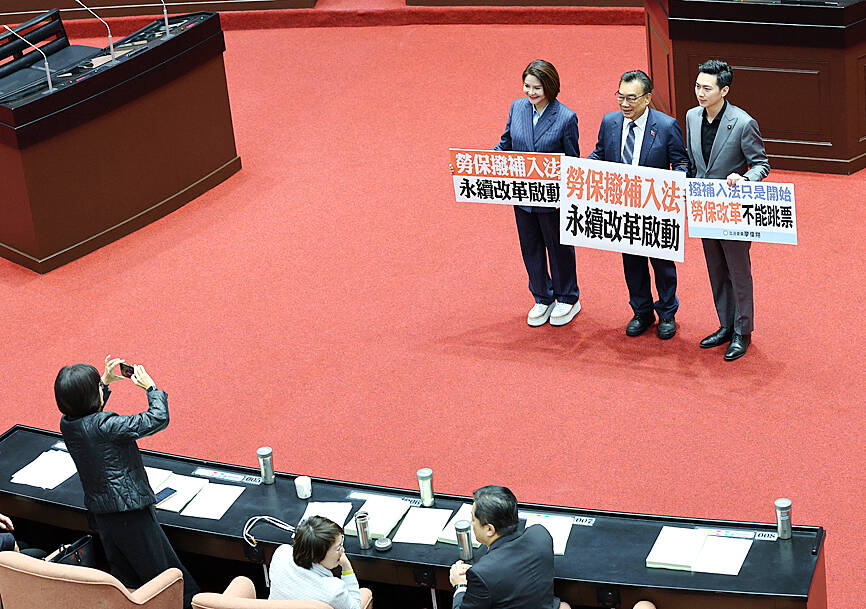
Photo: CNA
While existing provisions do not list government subsidies as a source of funding for the labor insurance fund, the amended articles add government contributions, along with other sources and related revenue, as funding sources.
The central government is required to allocate annual budgetary appropriations based on its fiscal capacity and the financial status of labor insurance, the proposed changes say.
To prevent debt discharge provisions from harming workers’ rights or the fund’s stability, the amendments exclude labor insurance premiums and late fees from debt relief laws.
The exclusion would also apply in cases in which premiums and surcharges remained unpaid prior to the amendments taking effect.
The Bureau of Labor Insurance may temporarily withhold benefits in such cases until all outstanding fees are settled, the proposed amendments say.
In addition, to prevent labor relief loans from being seized through compulsory execution, the amendments allow loan applicants to open a dedicated bank account for the sole purpose of depositing loan principal, provided they present supporting documentation from the insurer.
The revisions stabilize the labor insurance fund from three directions to safeguard insured workers’ rights, Minister of Labor Hung Sun-han (洪申翰) said.
First, they would better implement relief loans for insured workers and ease short-term financial difficulties, the ministry said.
The exemption of insurance premiums and late payment penalties from debt discharge or statutes of limitations under other laws, in line with Article 25 of the Labor Occupational Accident Insurance and Protection Act (勞工職業災害保險及保護法), would secure the fund’s claims and the system’s long-term stability, it said.
Second, listing government subsidies and other related revenues as sources of funding demonstrates the government’s determination and commitment to ensuring the robust operation of the labor insurance system, Hung said.
Third, by stipulating that the central government bears ultimate responsibility for labor insurance finances and requiring a financial review at least once every three years, the revised law would help ensure the system’s stable operations and prevent sudden financial crises, thereby safeguarding workers’ basic economic security in old age, the ministry said.
The labor insurance system has been in place for more than 70 years and plays a vital role in protecting the livelihoods of millions of workers and promoting social security, it said.
The ministry pledged to continue seeking budget appropriations no lower than those of previous years, alongside diversified investment strategies, to boost fund income and ensure the system’s long-term stability.
While enshrining the ultimate payment responsibility in law marks an important milestone for labor rights, it provides workers with only a “bare minimum insurance policy,” Chinese Nationalist Party (KMT) Legislator Liao Wei-hsiang (廖偉翔) said.
If the government limits itself to providing appropriations without launching substantive reforms, the legal provisions could become a “blank check,” Liao said, adding that the Executive Yuan should propose more forward-looking reform plans.
Democratic Progressive Party Legislator Wang Cheng-hsu (王正旭) described passage of the changes as a historic moment.
The core significance of the changes lies in achieving financial stability and fairness, Wang said.
Establishing a review mechanism every three years demonstrates the government’s willingness to confront issues head-on, he added.
Additional reporting by Fang Wei-li

Yangmingshan National Park authorities yesterday urged visitors to respect public spaces and obey the law after a couple was caught on a camera livestream having sex at the park’s Qingtiangang (擎天崗) earlier in the day. The Shilin Police Precinct in Taipei said it has identified a suspect and his vehicle registration number, and would summon him for questioning. The case would be handled in accordance with public indecency charges, it added. The couple entered the park at about 11pm on Thursday and began fooling around by 1am yesterday, the police said, adding that the two were unaware of the park’s all-day live
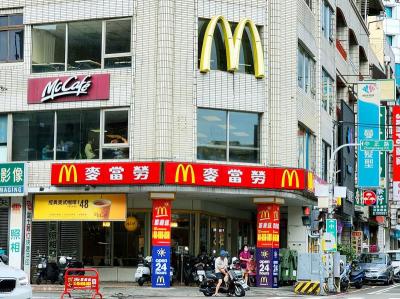
Fast food chain McDonald's is to raise prices by up to NT$5 on some products at its restaurants across Taiwan, starting on Wednesday next week, the company announced today. The prices of all extra value meals and sharing boxes are to increase by NT$5, while breakfast combos and creamy corn soup would go up by NT$3, the company said in a statement. The price of the main items of those meals, if ordered individually, would remain the same. Meanwhile, the price of a medium-sized lemon iced tea and hot cappuccino would rise by NT$3, extra dipping sauces for chicken nuggets would go up

Yangmingshan National Park’s Qingtiangang (擎天崗) nature area has gone viral after a park livestream camera observed a couple in the throes of intimate congress, which was broadcast live on YouTube, drawing large late-night crowds and sparking a backlash over noise, bright lights and disruption to wildlife habitat. The area’s livestream footage appeared to show a couple engaging in sexual activity on a picnic table in the park on Friday last week, with the uncensored footage streamed publicly online. The footage quickly spread across social media, prompting a tide of visitors to travel to the site to “check in” and recreate the

Minister of Digital Affairs Lin Yi-ching (林宜敬) yesterday cited regulatory issues and national security concerns as an expert said that Taiwan is among the few Asian regions without Starlink. Lin made the remarks on Facebook after funP Innovation Group chief executive officer Nathan Chiu (邱繼弘) on Friday said Taiwan and four other countries in Asia — China, North Korea, Afghanistan and Syria — have no access to Starlink. Starlink has become available in 166 countries worldwide, including Ukraine, Malaysia, the Philippines and Vietnam, in the six years since it became commercial, he said. While China and North Korea block Starlink, Syria is not


 RSS
RSS