


Six colleges reported an enrollment rate of less than 60 percent this year, following years of low birthrates, data released yesterday by the Ministry of Education showed.
The release of this year’s freshman enrollment rates at colleges and universities comes as education experts expressed concern over higher education enrollment.
The publicly funded National Taitung Junior College had the lowest enrollment rate at 31.75 percent, followed by five private colleges: Yuh-Ing Junior College of Health Care and Management (50.41 percent), Nanya Institute of Technology (50.51 percent), Min-Hwei College of Health Care Management (53.47 percent), Taiwan Steel University of Science and Technology (58.88 percent) and Aletheia University (59.41 percent), the data showed.
Photo: Rachel Lin, Taipei Times
Most enrollment rates were above 80 percent, while 10 universities or colleges had a 100 percent enrollment rate: National Tsing Hua University (NTHU), National Cheng Kung University (NCKU), National Yang Ming Chiao Tung University (NYCU), National Central University (NCU), National Taiwan University of Science and Technology, CTBC Business School, Ming Chi University of Technology, I-Kuan Tao Chong-De School, Weixin Shengjiao College, and Bliss and Wisdom Buddhist College.
Most publicly funded institutions reported strong enrollment rates, with the rates of leading universities exceeding 96 percent, such as National Taiwan University (NTU, 99.32 percent), National Chengchi University (NCCU, 97.45 percent), National Taiwan Normal University (96.25 percent), National Chung Hsing University (99.01 percent) and National Sun Yat-sen University (96.61 percent).
Low freshman enrollment affects not only schools’ finances and academics, but also the resources the ministry allocates to it, such as grants and subsidies, a source in the education sector said.
Freshman enrollment rates are also an important indicator in determining if the ministry should open discussions on possible school closure, they said.
Colleges with longstanding low enrollment rates might be listed as “schools under project guidance,” meaning they might have to close if not enough improvement has been made by a deadline.
Shrinking enrollments might also affect local industries, they added.
The ministry said it has been helping schools with low enrollment rates adjust their scale and offerings based on the Higher Education Sprout Project, the Act Governing the Closure of Private Educational Institutions at Senior Secondary or Higher Level (私立高級中等以上學校退場條例) and a project guidance mechanism.
The ministry would continue to monitor enrollment rates and education quality to ensure students’ rights and welfare are protected, it said.
Enrollment rates for starting master’s degrees or doctoral programs were also declining, with 54 colleges or universities reporting zero enrollment this year.
NCU reported eight doctoral programs with no new enrollment: the Institute of Industrial Economics, the Graduate Institute of Applied Geology, the Graduate Institute of Astronomy, and doctoral programs in chemical and materials engineering, energy engineering, electrical engineering, communications engineering and mechanical engineering, the data showed.
Other leading universities — NTU, NTHU, NCKU, NYCU and NCCU — had a total of 17 master’s or doctoral programs with zero new enrollment.
The programs included NTU’s physical therapy doctoral program; NCCU’s master’s programs in Slavic languages and literature, and sociology; NTHU’s doctoral program in quantum technology and advanced materials; NCKU’s doctoral programs in international business and statistics; and NYCU’s International Program in Inter-Asia Cultural Studies, Graduate Institute of Clinical Medicine and doctoral program in translational medicine.
Many doctoral programs had an enrollment quota of only one or two students.
The schools might have received no applications or did not receive applications from suitable candidates, the source said.

Chinese spouse and influencer Guan Guan’s (關關) residency permit has been revoked for repeatedly posting pro-China videos that threaten national security, the National Immigration Agency confirmed today. Guan Guan has said many controversial statements in her videos posted to Douyin (抖音), including “the red flag will soon be painted all over Taiwan” and “Taiwan is an inseparable part of China,” and expressing hope for expedited reunification. The agency last year received multiple reports alleging that Guan Guan had advocated for armed reunification. After verifying the reports, the agency last month issued a notice requiring her to appear and explain her actions. Guan

The Kaohsiung Tourism Bureau audited six hotels in an effort to prevent price gouging ahead of Korean band BTS’ concert tour in the city scheduled for Nov. 19, 21 and 22 this year. The bureau on Friday said that the audits — conducted in response to allegations of unfair pricing posted on social media — found no wrongdoing. These establishments included the local branches of Chateau de Chine, Hotel Nikko, My Humble House, and Grand Hai Lai, it said, adding that the Consumer Protection Commission would have penalized price gougers had the accusations been substantiated. The bureau said the Tourism Development Act
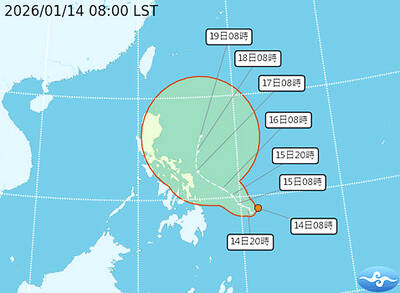
BACK TO WINTER: A strong continental cold air mass would move south on Tuesday next week, bringing colder temperatures to northern and central Taiwan A tropical depression east of the Philippines could soon be upgraded to be the first tropical storm of this year, the Central Weather Administration (CWA) said yesterday, adding that the next cold air mass is forecast to arrive on Monday next week. CWA forecaster Cheng Jie-ren (鄭傑仁) said the first tropical depression of this year is over waters east of the Philippines, about 1,867km southeast of Oluanpi (鵝鑾鼻), and could strengthen into Tropical Storm Nokaen by early today. The system is moving slowly from northwest to north, and is expected to remain east of the Philippines with little chance of affecting Taiwan,

The military yesterday said it has located the flight data recorder, or black box, of an F-16V jet that disappeared off eastern Taiwan earlier this month, and it would soon deploy a salvage team to try to retrieve it. Air Force Command Headquarters said that while it had pinned down the location of the black box, it was still searching for the aircraft’s sole pilot, air force Captain Hsin Po-yi (辛柏毅). Without providing details, the air force said it had located the black box days after detecting some intermittent signals and would now engage a team of professionals to retrieve it. The air


 RSS
RSS