


President William Lai (賴清德) said Taiwan must continue to raise the cost of aggression and strengthen its indigenous defense capabilities to deter China, stressing that peace can only be secured through strength, in an interview with Sanlih E-Television that aired yesterday.
Addressing claims by US defense officials that Chinese President Xi Jinping (習近平) has instructed the People’s Liberation Army to be ready by 2027 for a Taiwan invasion, Lai said what’s important is Taiwan’s response.
“If China sets 2027 as the year to be ready for an invasion of Taiwan, then we have only one choice: to keep raising the difficulty so that China can never meet that standard. Taiwan will naturally remain safe,” Lai said, when asked about the likelihood of a Chinese attack on Taiwan and the urgency of the threat by “History & Herstory” host Cheng Hung-yi (鄭弘儀).
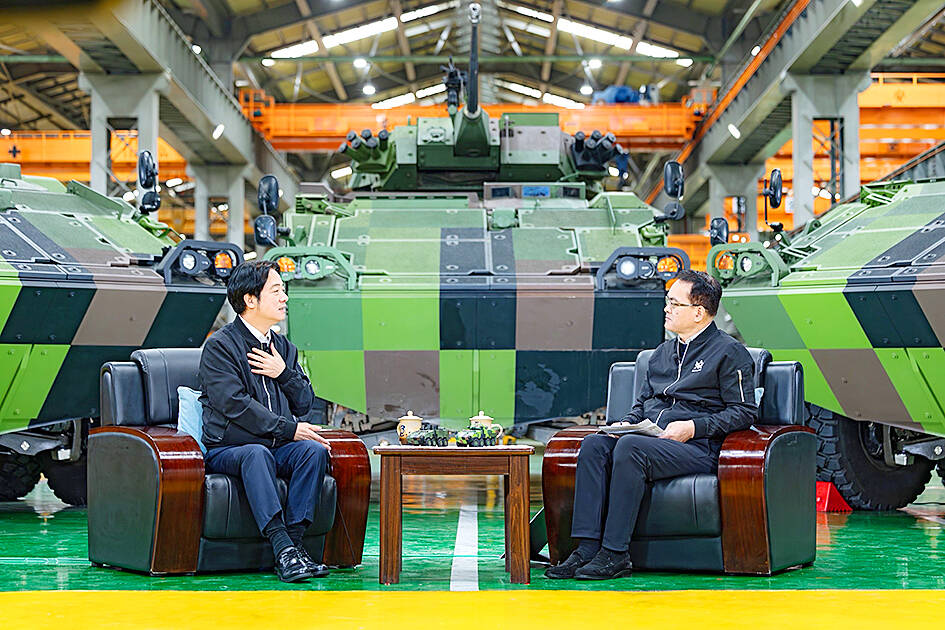
Photo courtesy of the Presidential Office
Lai said China’s ambition to annex Taiwan has been a long-standing national policy, citing past conflicts such as the 1949 Battle of Guningtou and 1958 Taiwan Strait Crisis.
Taiwan has remained secure for decades because China lacked the capability to act, he said during the interview that took place at the defense ministry’s 209th Arsenal, a key facility for producing wheeled armored vehicles such as the CM-32 “Clouded Leopard.”
“Crossing the sea (Taiwan Strait) is itself a difficult challenge. When Russia invaded Ukraine, it simply drove tanks in directly,” Lai said, but he added that Taiwan “cannot be complacent” and should continue to build up its defense capabilities.
Lai reiterated that his administration would not provoke China and remains “firmly committed to maintaining the status quo.”
At the same time, he stressed that peace “must be backed by real strength,” rather than relying on an agreement or the goodwill of an aggressor, noting that history shows negotiations without leverage inevitably lead to surrender.
Lai also pointed to growing international consensus on the importance of Taiwan’s security, saying G7 leaders have repeatedly affirmed that peace and stability in the Taiwan Strait are indispensable to global security and prosperity.
“In other words, China’s threat is not simply Taiwan’s problem, but an international issue, particularly one for countries in the Indo-Pacific region,” he said.
He said that increased defense spending by Japan, South Korea, Australia, the Philippines and European Union members reflects a broader move toward collective defense.
Within this context, Lai said Taiwan must take responsibility for its own security by strengthening defense and investing in indigenous capabilities. He said defense autonomy would enable Taiwan to design, manufacture, maintain and upgrade its own weapons systems.
His administration is advancing a multi-year special defense budget aimed at building a multilayered “T-Dome” air defense network, developing an AI-enabled battlefield intelligence support system, and accelerating the upgrading and transformation of Taiwan’s domestic defense industries, Lai said.
He said developing indigenous defense industries would not only enhance security but also drive long-term economic growth.
Taiwan already has a strong heavy-industry base and plans to expand defense self-reliance across a wide range of areas, from aerospace and satellite communications to ammunition, drones, unmanned surface vessels, unmanned underwater vehicles and robotics, Lai said.
Taiwanese firms have already joined major global supply chains in the United States and Europe, he said.
“Taiwan’s industries are ready,” Lai said, urging opposition parties to support defense spending in the interest of national security.

Chinese spouse and influencer Guan Guan’s (關關) residency permit has been revoked for repeatedly posting pro-China videos that threaten national security, the National Immigration Agency confirmed today. Guan Guan has said many controversial statements in her videos posted to Douyin (抖音), including “the red flag will soon be painted all over Taiwan” and “Taiwan is an inseparable part of China,” and expressing hope for expedited reunification. The agency last year received multiple reports alleging that Guan Guan had advocated for armed reunification. After verifying the reports, the agency last month issued a notice requiring her to appear and explain her actions. Guan

The Kaohsiung Tourism Bureau audited six hotels in an effort to prevent price gouging ahead of Korean band BTS’ concert tour in the city scheduled for Nov. 19, 21 and 22 this year. The bureau on Friday said that the audits — conducted in response to allegations of unfair pricing posted on social media — found no wrongdoing. These establishments included the local branches of Chateau de Chine, Hotel Nikko, My Humble House, and Grand Hai Lai, it said, adding that the Consumer Protection Commission would have penalized price gougers had the accusations been substantiated. The bureau said the Tourism Development Act
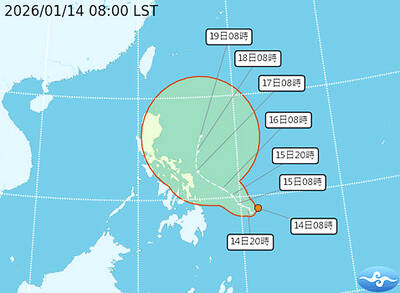
BACK TO WINTER: A strong continental cold air mass would move south on Tuesday next week, bringing colder temperatures to northern and central Taiwan A tropical depression east of the Philippines could soon be upgraded to be the first tropical storm of this year, the Central Weather Administration (CWA) said yesterday, adding that the next cold air mass is forecast to arrive on Monday next week. CWA forecaster Cheng Jie-ren (鄭傑仁) said the first tropical depression of this year is over waters east of the Philippines, about 1,867km southeast of Oluanpi (鵝鑾鼻), and could strengthen into Tropical Storm Nokaen by early today. The system is moving slowly from northwest to north, and is expected to remain east of the Philippines with little chance of affecting Taiwan,

The military yesterday said it has located the flight data recorder, or black box, of an F-16V jet that disappeared off eastern Taiwan earlier this month, and it would soon deploy a salvage team to try to retrieve it. Air Force Command Headquarters said that while it had pinned down the location of the black box, it was still searching for the aircraft’s sole pilot, air force Captain Hsin Po-yi (辛柏毅). Without providing details, the air force said it had located the black box days after detecting some intermittent signals and would now engage a team of professionals to retrieve it. The air


 RSS
RSS