


President William Lai (賴清德) and Premier Cho Jung-tai (卓榮泰) yesterday urged opposition lawmakers to promptly review and pass the general budget for the 2026 fiscal year, warning that delays could disrupt the implementation of key programs and policies.
The remarks came during the Hakka Contribution Awards, where Lai and Cho highlighted concerns that allocations for the Hakka Affairs Council’s NT$3.6 billion (US$114.45 million) annual budget could face significant challenges if the central government budget remains stalled.
The new fiscal year’s budget has been held up by Chinese Nationalist Party (KMT) and Taiwan People’s Party (TPP) legislators, who together hold a legislative majority.
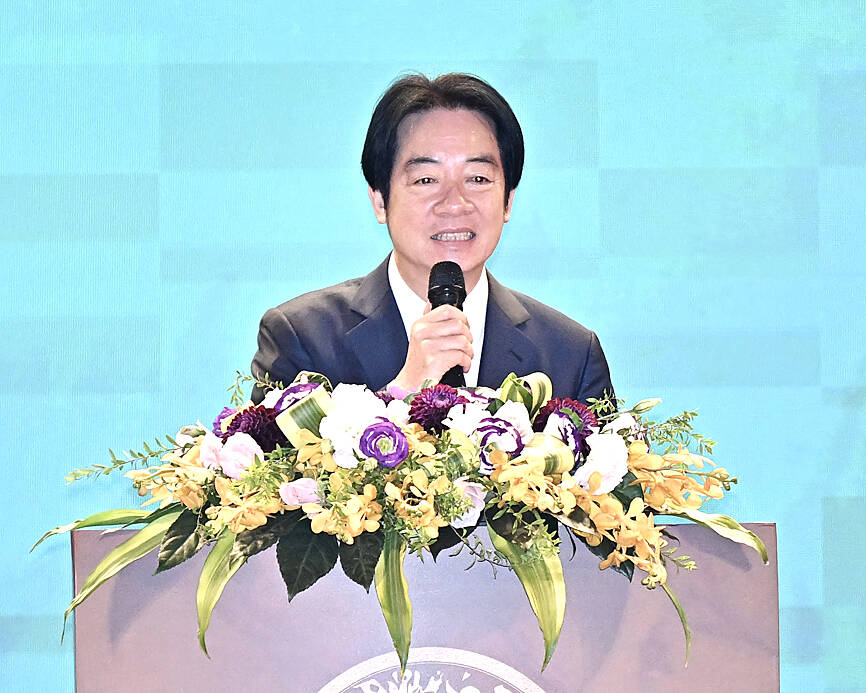
Photo: Tu Chien-jung, Taipei Times
Allocations to the council that could be delayed include about NT$150 million for the Romantic Route 3 arts festival, as well as Hakka film and television productions; about NT$50 million for the digital Hakka token 2.0 program; about NT$40 million for elder care facilities and the Hakka cultural knowledge program; and about NT$55 million for infrastructure upgrades at the Liudui Hakka Cultural Park (六堆客家文化園區), Cho said.
The central government’s NT$3.35 trillion budget for next year includes more than NT$300 billion for local government subsidies, he said.
“Swift legislative review is essential so that ministries can coordinate effectively with local governments,” he said.
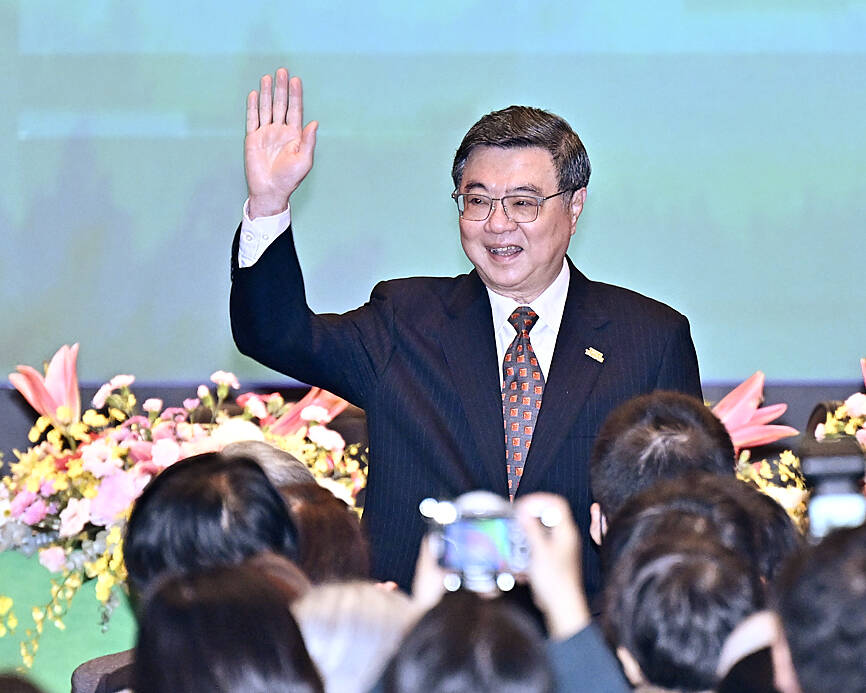
Photo: Tu Chien-jung, Taipei Times
Lai also urged the Legislative Yuan to pass the central government budget quickly to ensure the smooth execution of planned initiatives.
The Directorate-General of Budget, Accounting and Statistics said that NT$299.2 billion of next year’s budget cannot be disbursed until the legislature approves it, including NT$101.7 billion for nascent programs — comprising NT$38 billion for central-government initiatives and NT$63.7 billion for local governments.
Fiscal subsidies, flood-control projects, the monthly TPass initiative, supplementary maternity benefits, and initiatives addressing low birthrate, pandemic monitoring and vaccine development would be affected by a delay, the agency said.
“Without budget approval, local disaster resilience and flood-risk mitigation projects would be severely impacted,” it added, citing a planned NT$9.8 billion initiative to support local river management, drainage improvements and urban flood-control infrastructure.
If the monthly TPass program for next year to 2029 — backed by NT$5.9 billion in central subsidies — is delayed, about 980,000 commuters nationwide would be affected, it said.
Similarly, NT$4.1 billion of supplementary maternity benefits — designed to raise birth-related payments under labor, national, agricultural and civil servant insurance schemes to NT$100,000 — would be unavailable to about 120,000 families with newborns, the agency said.
KMT Legislator Hsieh Lung-chieh (謝龍介) said the Legislative Yuan could start a budget review immediately, provided the Executive Yuan prepares the budget for military and police pay in accordance with the law.
TPP Legislator Chang Chi-kai echoed the statement, saying the Executive Yuan’s budget must account for military pay raises and police and firefighter pensions in line with the law, urging the Cabinet to not “mistreat or neglect public servants, police or military personnel.”
Additional reporting by Hsieh Chun-lin and Lin Che-yuan

Chinese spouse and influencer Guan Guan’s (關關) residency permit has been revoked for repeatedly posting pro-China videos that threaten national security, the National Immigration Agency confirmed today. Guan Guan has said many controversial statements in her videos posted to Douyin (抖音), including “the red flag will soon be painted all over Taiwan” and “Taiwan is an inseparable part of China,” and expressing hope for expedited reunification. The agency last year received multiple reports alleging that Guan Guan had advocated for armed reunification. After verifying the reports, the agency last month issued a notice requiring her to appear and explain her actions. Guan

The Kaohsiung Tourism Bureau audited six hotels in an effort to prevent price gouging ahead of Korean band BTS’ concert tour in the city scheduled for Nov. 19, 21 and 22 this year. The bureau on Friday said that the audits — conducted in response to allegations of unfair pricing posted on social media — found no wrongdoing. These establishments included the local branches of Chateau de Chine, Hotel Nikko, My Humble House, and Grand Hai Lai, it said, adding that the Consumer Protection Commission would have penalized price gougers had the accusations been substantiated. The bureau said the Tourism Development Act
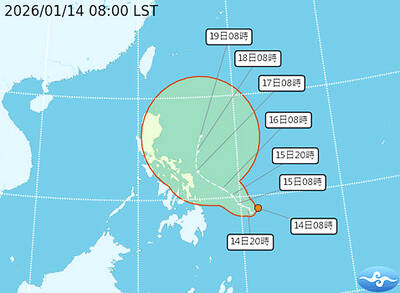
BACK TO WINTER: A strong continental cold air mass would move south on Tuesday next week, bringing colder temperatures to northern and central Taiwan A tropical depression east of the Philippines could soon be upgraded to be the first tropical storm of this year, the Central Weather Administration (CWA) said yesterday, adding that the next cold air mass is forecast to arrive on Monday next week. CWA forecaster Cheng Jie-ren (鄭傑仁) said the first tropical depression of this year is over waters east of the Philippines, about 1,867km southeast of Oluanpi (鵝鑾鼻), and could strengthen into Tropical Storm Nokaen by early today. The system is moving slowly from northwest to north, and is expected to remain east of the Philippines with little chance of affecting Taiwan,

The military yesterday said it has located the flight data recorder, or black box, of an F-16V jet that disappeared off eastern Taiwan earlier this month, and it would soon deploy a salvage team to try to retrieve it. Air Force Command Headquarters said that while it had pinned down the location of the black box, it was still searching for the aircraft’s sole pilot, air force Captain Hsin Po-yi (辛柏毅). Without providing details, the air force said it had located the black box days after detecting some intermittent signals and would now engage a team of professionals to retrieve it. The air


 RSS
RSS