


World War II might have ended 80 years ago, but for businessman Hsu Shun-lung (許順隆), it continues to echo in Taiwan through a tragedy that has yet to be brought to a final resolution.
Hsu, a Taitung County native, remains intent on recovering the remains of men who died on a remote mountain in eastern Taiwan trying to rescue freed prisoners of war (POW) killed in a plane crash there in 1945.
On Sept. 10, 1945, eight days after Japan formally surrendered at the end of World War II, 20 POWs were headed for Manila on a US B-24 bomber that took off from Okinawa.
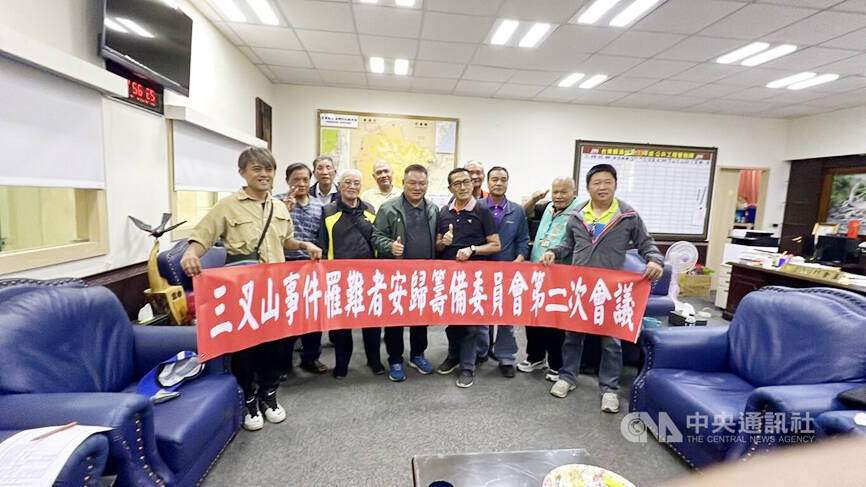
Photo: CNA
The aircraft was caught in Typhoon Ursula and crashed into the 3,496m-high Sancha Mountain (三叉山) in eastern Taiwan, killing the five crew members, and 11 American, five Australian and four Dutch POWs on board.
The tragedy was compounded when the Japanese colonial government in Taiwan, in its final days, sent a 97-man search and rescue team up the remote mountain at the behest of the US government to recover the remains and look for possible survivors.
However, the team was stranded on the mountain on Sept. 30 when another powerful storm, Typhoon Jean, began lashing eastern Taiwan. Twenty-six members perished during the mission, many of whom froze to death.
According to historical accounts, of the 26 rescuers who died, nine were Japanese police and military police officers, 15 were indigenous Taiwanese (12 Amis, one Bunun, one Puyuma and one Pingpu), one was of Hakka origin and one was Hoklo.
The mission eventually succeeded in recovering the remains of 22 of the foreign victims and handing them over to the US in November 1945. The bodies were cremated and buried, but the rescuers who died were left behind, except for some body parts.
After learning of the history, Hsu in November last year began to coordinate efforts to recover the remains of the deceased rescuers.
Part of that involved lobbying the government, which eventually paid dividends.
Among the events it held to mark the 80th anniversary of the end of World War II, the government honored the humanitarian effort by sending a team to the mountain in June to perform a ritual and offer prayers for the deceased team members.
In September, the Ministry of National Defense sent a helicopter to retrieve machine guns dislodged from the B-24 during the crash.
These actions were documented on film and shared by President William Lai (賴清德) on social media.
For Hsu, those actions were a start, but not enough to honor the deceased rescuers, whose remains, Hsu believes, are still in pristine condition on Sancha Mountain.
As he sees it, the rescuers embodied the kind nature of Taiwanese, given that the US bombed Taiwan, then a Japanese colony, during World War II.
“The down-to-earth Taiwanese didn’t distinguish between ‘you’ and ‘me.’ They just had a single-minded focus to save lives,” Hsu said. “I hope it will serve as a reminder of unity, of trying to achieve something together, in this turbulent world.”
To honor that spirit, Hsu wants to hold a ceremony in which all five countries involved in the incident could be represented by relatives of the deceased, but organizing it requires government help.
“Because it involves five countries, it could take civilians three to five years to arrange with limited resources, but if the government steps in to help or take ownership, it would only take a matter of months,” he said.
Hsu said that promoting the obscure humanitarian rescue effort could help raise Taiwan’s international profile, but the government’s interest in the incident seems to have waned, with no actions pursued since September.
A government spokesperson declined to comment about the prospect of an international commemorative ceremony.
That has not discouraged Hsu from pursuing his primary goal — to give the deceased rescuers a proper burial, he said.
Li Kuang-hsiang (黎光祥), a grandson of deceased search team member Li Wei-chin (黎維錦), said the efforts mounted to date have fallen short of bringing peace to the deceased.
According to his relatives, the surviving members of the search and rescue team left the bodies of their dead colleagues behind due to the long journey back, choosing instead to cut their ears, noses and fingers to bring them back to their villages to be cremated, Li Kuang-hsiang said.
Li Kuang-hsiang said his father, who was only two years old at the time of the accident, was brought up by his great-uncle.
“The government should take further action so that bereaved families can have closure,” he said.

Chinese spouse and influencer Guan Guan’s (關關) residency permit has been revoked for repeatedly posting pro-China videos that threaten national security, the National Immigration Agency confirmed today. Guan Guan has said many controversial statements in her videos posted to Douyin (抖音), including “the red flag will soon be painted all over Taiwan” and “Taiwan is an inseparable part of China,” and expressing hope for expedited reunification. The agency last year received multiple reports alleging that Guan Guan had advocated for armed reunification. After verifying the reports, the agency last month issued a notice requiring her to appear and explain her actions. Guan

The Kaohsiung Tourism Bureau audited six hotels in an effort to prevent price gouging ahead of Korean band BTS’ concert tour in the city scheduled for Nov. 19, 21 and 22 this year. The bureau on Friday said that the audits — conducted in response to allegations of unfair pricing posted on social media — found no wrongdoing. These establishments included the local branches of Chateau de Chine, Hotel Nikko, My Humble House, and Grand Hai Lai, it said, adding that the Consumer Protection Commission would have penalized price gougers had the accusations been substantiated. The bureau said the Tourism Development Act
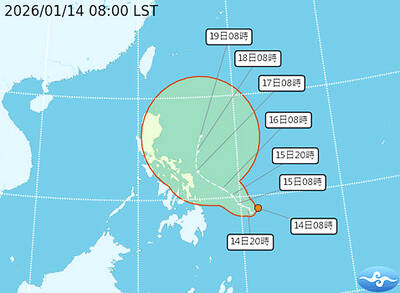
BACK TO WINTER: A strong continental cold air mass would move south on Tuesday next week, bringing colder temperatures to northern and central Taiwan A tropical depression east of the Philippines could soon be upgraded to be the first tropical storm of this year, the Central Weather Administration (CWA) said yesterday, adding that the next cold air mass is forecast to arrive on Monday next week. CWA forecaster Cheng Jie-ren (鄭傑仁) said the first tropical depression of this year is over waters east of the Philippines, about 1,867km southeast of Oluanpi (鵝鑾鼻), and could strengthen into Tropical Storm Nokaen by early today. The system is moving slowly from northwest to north, and is expected to remain east of the Philippines with little chance of affecting Taiwan,

GIVE AND TAKE: Blood demand continues to rise each year, while fewer young donors are available due to the nation’s falling birthrate, a doctor said Blood donors can redeem points earned from donations to obtain limited edition Formosan black bear travel mugs, the Kaohsiung Blood Center said yesterday, as it announced a goal of stocking 20,000 units of blood prior to the Lunar New Year. The last month of the lunar year is National Blood Donation Month, when local centers seek to stockpile blood for use during the Lunar New Year holiday. The blood demand in southern Taiwan — including Tainan and Kaohsiung, as well as Chiayi, Pingtung, Penghu and Taitung counties — is about 2,000 units per day, the center said. The donation campaign aims to boost


 RSS
RSS