


Chinese Nationalist Party (KMT) Chairwoman Cheng Li-wen (鄭麗文) said yesterday that any meeting she might have with Chinese President Xi Jinping (習近平) will come with no preconditions beyond adherence to the so-called "1992 Consensus" and opposition to Taiwan independence.
Cheng made the remarks in response to comments by President William Lai (賴清德) in a pre-recorded interview aired by Sanlih E-Television, in which Lai questioned how the public could believe a potential "Cheng-Xi meeting" would be unconditional when opposition parties have blocked defense budgets and national security bills "with no reason."
Cheng said yesterday that cross-strait dialogue has a clear and long-established political basis in the 1992 Consensus, adding that this is neither secret nor difficult to understand and was demonstrated during former president Ma Ying-jeou’s (馬英九) eight years in office from 2008-2016.
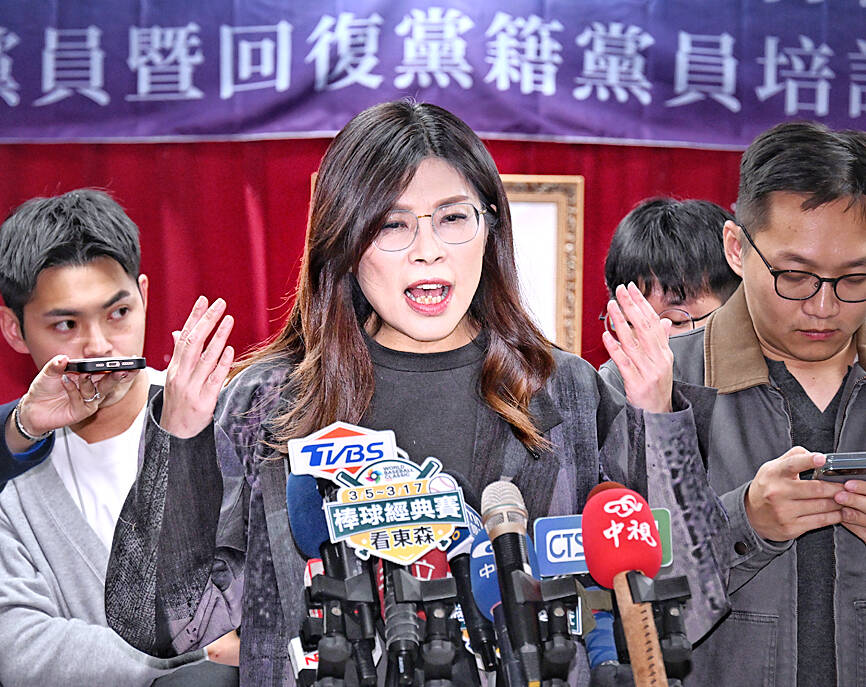
Photo: Fang Pin-chao, Taipei Times
The "1992 consensus" — a term that former Mainland Affairs Council chairman Su Chi (蘇起) in 2006 admitted making up in 2000 — refers to a tacit understanding between the KMT and the Chinese Communist Party that both sides of the Taiwan Strait acknowledge that there is "one China," with each side having its own interpretation of what "China" means.
The Democratic Progressive Party (DPP) has never acknowledged the "1992 consensus," saying that Beijing does not recognize the Republic of China and acceptance of the understanding would imply agreement with China’s claim over Taiwan.
Cheng said on Friday that she hopes to visit China in the first half of next year and meet Xi. If such a meeting is not possible, she said, the trip will not go ahead.
Earlier this month, the Liberty Times (sister paper of the Taipei Times) reported that Beijing laid out "three tickets" for the meeting: blocking the budget for arms purchases; obstructing bills aimed at limiting cross-strait investment and people-to-people exchanges, as well as ending discrimination against Chinese spouses; and having the KMT reaffirm a political path toward unification, while proposing systematic reforms, and taking actions to advance that goal.
Cheng dismissed the report as fabricated, saying she has never accepted any such conditions. "There are no preconditions or side deals," she said, again citing only the 1992 Consensus and opposition to Taiwan independence.
She added that if Lai truly believes there is no need to declare independence, then acknowledging the 1992 Consensus and abandoning the pro-independence DPP platform could also make a Lai-Xi meeting possible.
On cross-strait engagement, Cheng said recent visits by senior KMT figures to China were intended to build goodwill, reduce tensions and restore confidence in peace.
She also said that with major local elections scheduled for late next year, the party hopes to complete key overseas visits, including to Beijing and Washington, in the first half of the year due to its limited resources.
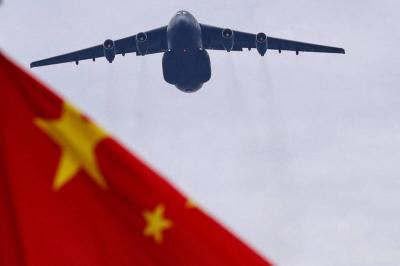
Beijing could eventually see a full amphibious invasion of Taiwan as the only "prudent" way to bring about unification, the US Department of Defense said in a newly released annual report to Congress. The Pentagon's "Annual Report to Congress: Military and Security Developments Involving the People's Republic of China 2025," was in many ways similar to last year’s report but reorganized the analysis of the options China has to take over Taiwan. Generally, according to the report, Chinese leaders view the People's Liberation Army's (PLA) capabilities for a Taiwan campaign as improving, but they remain uncertain about its readiness to successfully seize

Taiwan is getting a day off on Christmas for the first time in 25 years. The change comes after opposition parties passed a law earlier this year to add or restore five public holidays, including Constitution Day, which falls on today, Dec. 25. The day marks the 1947 adoption of the constitution of the Republic of China, as the government in Taipei is formally known. Back then the Chinese Nationalist Party (KMT) governed China from Nanjing. When the KMT, now an opposition party in Taiwan, passed the legislation on holidays, it said that they would help “commemorate the history of national development.” That

Taiwan has overtaken South Korea this year in per capita income for the first time in 23 years, IMF data showed. Per capita income is a nation’s GDP divided by the total population, used to compare average wealth levels across countries. Taiwan also beat Japan this year on per capita income, after surpassing it for the first time last year, US magazine Newsweek reported yesterday. Across Asia, Taiwan ranked fourth for per capita income at US$37,827 this year due to sustained economic growth, the report said. In the top three spots were Singapore, Macau and Hong Kong, it said. South
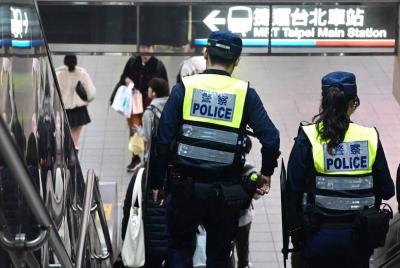
Police today said they are stepping up patrols throughout the Taipei MRT system, after a social media user threatened to detonate a bomb at an unspecified station this afternoon. Although they strongly believe the threat to be unsubstantiated, Taipei Metro police and the Railway Police Bureau still said that security and patrols would be heightened through the system. Many copycat messages have been posted since Friday’s stabbing attacks at Taipei Main Station and near Zhongshan MRT Station that left three dead and 11 injured, police said. Last night, a Threads user in a post said they would detonate a bomb on the Taipei


 RSS
RSS