


President William Lai (賴清德) should show more empathy, as he is the one causing an impasse in the legislative review of next year’s budget, Chinese Nationalist Party (KMT) caucus secretary-general Lo Chih-chiang (羅智強) said yesterday, calling on Lai to have “three soft hearts” to resolve the deadlock.
The Executive Yuan not preparing next year’s budget for military and police pay in accordance with the law has triggered dissatisfaction from the opposition parties, which hold a majority in the legislature, leading to the budget being unable to be assigned to legislative committees for further review, Lo said.
Lai on Thursday said that if the Legislative Yuan cannot review the central government’s budget for the 2026 fiscal year on time, “what qualifications do the opposition parties have to talk about constitutional governance?”

Photo: Taipei Times
“We hope the legislature can support and assist the country’s progress by promptly reviewing the central government’s budget and the special defense budget,” Lai said.
Lo said the difficulty in reviewing the general budget was that the budget the executiv branch submitted to the Legislative Yuan contains illegal omissions.
Items that should have been included by law were not, resulting in the Legislative Yuan being unable to review it, he said.
In particular, the Legislative Yuan passed the third reading of amendments to the Pay Act of the Armed Forces (軍人待遇條例) and the Police Personnel Management Act (警察人員人事條例), but the Executive Yuan refused to allocate the budget for their implementation according to the law, he said.
“After the Legislative Yuan passed the pension cut suspension, the Executive Yuan intends to use the illegally revived Constitutional Court to seize the legislature’s power to amend the law,” he added.
Lo said that to resolve the deadlock, Lai must have “three soft hearts.”
“The first soft heart is to properly care for the military,” he said.
“The Lai administration has allocated the highest-ever defense budget of NT$950 billion [US$30 billion], and plans to spend NT$1.25 trillion on military equipment, but has anyone considered why the current-to-authorized personnel ratio in the military is so low? It is because we cannot provide sufficient dignity and benefits to those in service,” Lo said.
The KMT stands firm in defending national security and the welfare of military personnel, and has proposed a salary increase for soldiers, he said, adding that if the military salary increase budget is allocated, the Legislative Yuan would immediately review the general budget.
“The second soft heart is to properly care for the police and firefighters,” he said.
In the event of major public safety incidents or fires, it is the police and firefighters who are on the front lines, he said, adding that the legislature would have started reviewing the budget if the executive branch had fully allocated the budget for the retirement benefits of police and firefighters.
“The third soft heart is to protect the retirement benefits of public servants,” Lo said.
Civil servants support the nation’s development, and teachers nurture the country’s talents, he said.
“However, due to the pension reforms promoted by the Democratic Progressive Party, the pensions for public servants have been slashed to the bone,” he said. “They are merely humbly requesting a halt to the cuts, but Lai refuses to comply.”

Chinese spouse and influencer Guan Guan’s (關關) residency permit has been revoked for repeatedly posting pro-China videos that threaten national security, the National Immigration Agency confirmed today. Guan Guan has said many controversial statements in her videos posted to Douyin (抖音), including “the red flag will soon be painted all over Taiwan” and “Taiwan is an inseparable part of China,” and expressing hope for expedited reunification. The agency last year received multiple reports alleging that Guan Guan had advocated for armed reunification. After verifying the reports, the agency last month issued a notice requiring her to appear and explain her actions. Guan

The Kaohsiung Tourism Bureau audited six hotels in an effort to prevent price gouging ahead of Korean band BTS’ concert tour in the city scheduled for Nov. 19, 21 and 22 this year. The bureau on Friday said that the audits — conducted in response to allegations of unfair pricing posted on social media — found no wrongdoing. These establishments included the local branches of Chateau de Chine, Hotel Nikko, My Humble House, and Grand Hai Lai, it said, adding that the Consumer Protection Commission would have penalized price gougers had the accusations been substantiated. The bureau said the Tourism Development Act
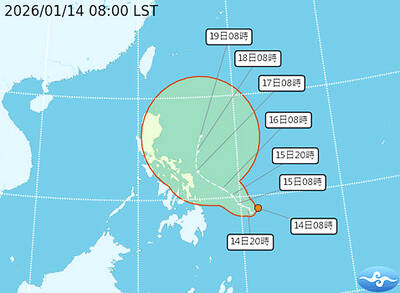
BACK TO WINTER: A strong continental cold air mass would move south on Tuesday next week, bringing colder temperatures to northern and central Taiwan A tropical depression east of the Philippines could soon be upgraded to be the first tropical storm of this year, the Central Weather Administration (CWA) said yesterday, adding that the next cold air mass is forecast to arrive on Monday next week. CWA forecaster Cheng Jie-ren (鄭傑仁) said the first tropical depression of this year is over waters east of the Philippines, about 1,867km southeast of Oluanpi (鵝鑾鼻), and could strengthen into Tropical Storm Nokaen by early today. The system is moving slowly from northwest to north, and is expected to remain east of the Philippines with little chance of affecting Taiwan,

GIVE AND TAKE: Blood demand continues to rise each year, while fewer young donors are available due to the nation’s falling birthrate, a doctor said Blood donors can redeem points earned from donations to obtain limited edition Formosan black bear travel mugs, the Kaohsiung Blood Center said yesterday, as it announced a goal of stocking 20,000 units of blood prior to the Lunar New Year. The last month of the lunar year is National Blood Donation Month, when local centers seek to stockpile blood for use during the Lunar New Year holiday. The blood demand in southern Taiwan — including Tainan and Kaohsiung, as well as Chiayi, Pingtung, Penghu and Taitung counties — is about 2,000 units per day, the center said. The donation campaign aims to boost


 RSS
RSS