

The Executive Yuan yesterday passed an amendment to the Social Order Maintenance Act (社會秩序維護法) that would have offenders face maximum fines of up to NT$30,000 for spreading hate speech in public places such as parks and train stations.
According to the draft amendment, people advocating, promoting, spreading, or broadcasting hate speech, terrorist ideology, or claims from foreign hostile forces that escalate social division or seek to eliminate the country’s sovereignty in public places such as parks or stations with flags, slogans, or related materials, and that are likely to affect public order, would face detention for up to three days or a fine of up to NT$30,000.
The Ministry of the Interior said that hate speech affects the unity of the public.
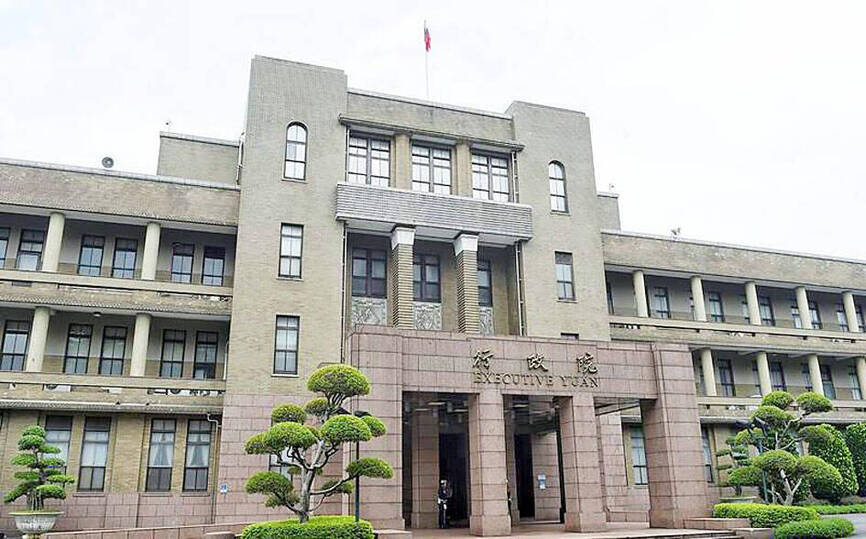
Photo: Chung Li-hua, Taipei Times
When such speech is spread in public places, it is necessary to regulate it to maintain public order, it said, adding that as speech transmitted via the Internet has no boundaries, the widespread dissemination or transmission of such speech online makes it necessary to add regulations and management provisions.
The draft also adds provisions that if hate speech, terrorism, or claims from foreign hostile forces advocating for the escalation of social division or the elimination of the country’s sovereignty are publicly promoted, spread, or broadcast on the Internet, and such actions are likely to affect public order, the ministry may order Internet platform, content or application service providers to restrict access to the content, remove it, or take measures such as restricting or terminating the user’s account or service, the ministry said.
The content on the Internet is diverse, and it has become common for people to use the Internet for private communications, the ministry said.
For private personal messages which might be controversial, the impact on public order is generally minor, and there is no need for intervention or regulation, it said, adding that this is to balance the right to privacy in communications.
Therefore, the scope of the amendment focuses on “public” Internet content, such as setting up Web sites or using social media to post information that is freely accessible to the public, it said.
On how such public speech would be handled, Deputy Interior Minister Ma Shih-yuan (馬士元) said that after the metro attack in Taipei on Friday last week, there has been a lot of imitative speech online.
If there are specific threats made, such as mentioning a particular place to threaten the public, it would be dealt with according to Article 151 of the Criminal Code, which carries a penalty of up to 2 years in prison, he said.
The Social Order Maintenance Act mainly targets more general, widespread speech that is not aimed at a specific individual or group, he said.
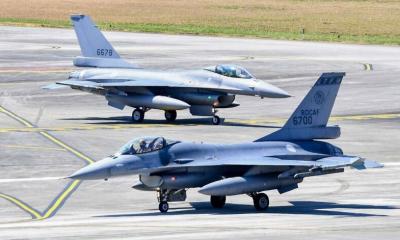
The first two F-16V Block 70 jets Taiwan purchased from the US were spotted unexpectedly turning back after departing from Hawaii yesterday, potentially further delaying delivery of the aircraft. Taiwan has purchased 66 of the F-16 C/D Block 70 jets to be deployed at Chihhang Air Base (志航基地) in Taitung County and operated by the air force's 7th Tactical Fighter Wing to defend Taiwan’s eastern region. Two single-seat jets, bearing serial No. 6727 and 6728, were spotted taking off from Hickam Field in Hawaii yesterday, observers said. Based on the precedent set during the delivery of Taiwan's older F-16 Block 20s, the new

Taiwan’s growing defense preparations might be sending a stronger signal to the US than to Beijing, highlighting the need for Taipei to tailor its deterrence efforts to different audiences, a US security academic said yesterday. Stanford University Freeman Spogli Institute for International Studies fellow Oriana Skylar Mastro made the comment during a Taipei Security Dialogue panel examining lessons Taiwan could draw from the wars in Ukraine and the Middle East. Mastro said she was impressed by Taiwan’s increased defense spending, emphasis on asymmetric capabilities and efforts to prepare society for conflict, but questioned whom those initiatives were influencing. She said when she asked
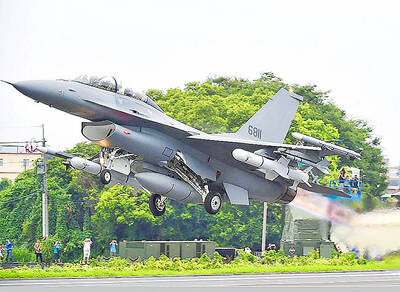
A sharp rise in compensation to be paid by air force officers who leave before completing their required service could indicate an increase in pilots leaving the military early, an analyst said on Friday, warning that the trend could worsen a shortage of experienced personnel. Chieh Chung (揭仲), a researcher at the Association for Strategic Foresight, issued the warning even though the number of volunteer military personnel is expected to increase next year. The planned headcount for volunteer military personnel, covering officers, noncommissioned officers (NCO) and enlisted soldiers, is 158,223 for next year, up 4,258 from 153,965 this year, Chieh said. The increase
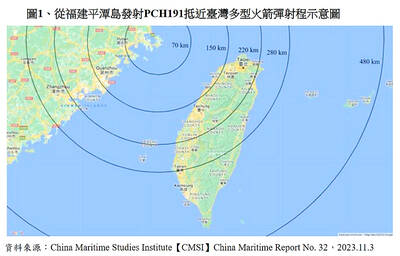
Potential improvements to munitions used by China’s long-range rocket-artillery units could extend their range to cover the entire Miyako Strait, which might give the Chinese People’s Liberation Army (PLA) the ability to secure the strategic waterway, the Mainland Affairs Council (MAC) said in a report. The PLA’s long-range rocket-artillery units deployed along the Taiwan Strait are concentrated along the coast of Fujian Province, including Changle, Pingtan and Shishi, the quarterly report on China said. The artillery brigades of the PLA’s 71st, 72nd and 73rd group armies have been deployed, with preparations for potential battlefield operations under way since August 2022, the report


 RSS
RSS