


Opposition lawmakers today finalized plans for impeachment proceedings against President William Lai (賴清德), including appearances by the president before the legislature next month and in May before a vote on May 19.
The Chinese Nationalist Party (KMT) and Taiwan People’s Party (TPP) lawmakers voted in the majority to pass the two separate motions.
The legislature would hold public hearings on Jan. 14 and 15 to hear the opinions of impartial parties, as well as review sessions on Jan. 21 and 22, and May 13 and 14 during which Lai would be invited to explain his position.
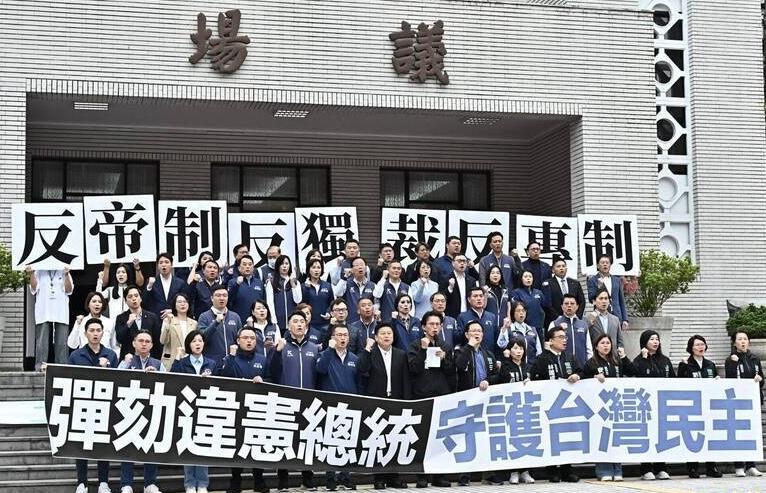
Photo: Tu Chien-jung, Taipei Times
A hearing is also to be held on April 27 for government officials and other relevant parties to present testimony and take questions from lawmakers before the vote on May 19.
The impeachment case arose after Premier Cho Jung-tai (卓榮泰) on Dec. 15 refused to countersign a fiscal planning bill that had already passed its third reading in the Legislative Yuan.
Lai then failed to promulgate the bill before the deadline on Dec. 15.
The KMT caucus said that Lai contravened Article 72 of the Constitution in his refusal to promulgate amendments to the Act Governing the Allocation of Government Revenues and Expenditures (財政收支劃分法).
It was the first time in Taiwan’s history that a president had failed to promulgate a law enacted by lawmakers.
Article 4-7 of the Additional Articles of the Constitution (中華民國憲法增修條文) stipulates that the Legislative Yuan may initiate impeachment against the president if more than one-half of legislators agree, and the motion would be passed only if at least two-thirds of legislators agree.
It would then be referred to the Constitutional Court for adjudication.
At least two-thirds of the sitting grand justices must approve the case for the impeachment to be upheld and the impeached official removed from office.
Since taking office, Lai has “confiscated the nation’s democracy” and “trampled on the Constitution,” KMT caucus whip Fu Kun-chi (傅崐萁) said.
As Lai has violated constitutional order, the legislature must hold him responsible through impeachment procedures, TPP Chairman Huang Kuo-chang (黃國昌) said.
Democratic Progressive Party (DPP) caucus chief executive Chung Chia-pin (鍾佳濱) said that the opposition parties were treating Constitutional Court judgements as if they did not exist and were using impeachment as a game.
DPP Legislator Rosalia Wu (吳思瑤) said that an opposition that “harms the nation and its people” is seeking revenge against a governing party that is working to benefit the country.
The impeachment motion is “purely political infighting,” as the opposition knows it does not control the necessary two-thirds of the legislature needed to pass the impeachment case, she said.
The proposals were submitted to “humiliate” the president, Wu said, adding that the legislature needs to review the fiscal budget for next year instead.
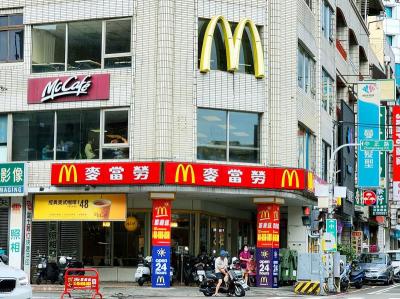
Fast food chain McDonald's is to raise prices by up to NT$5 on some products at its restaurants across Taiwan, starting on Wednesday next week, the company announced today. The prices of all extra value meals and sharing boxes are to increase by NT$5, while breakfast combos and creamy corn soup would go up by NT$3, the company said in a statement. The price of the main items of those meals, if ordered individually, would remain the same. Meanwhile, the price of a medium-sized lemon iced tea and hot cappuccino would rise by NT$3, extra dipping sauces for chicken nuggets would go up

Nvidia Corp CEO Jensen Huang (黃仁勳) arrived in Taiwan yesterday ahead of upcoming AI and technology events, saying he plans to meet with clients and Taiwan Semiconductor Manufacturing Co Chairman C.C. Wei (魏哲家) during his visit. After landing at Taipei Songshan Airport, Huang posed for photos with fans and handed out Yakult drinks to reporters and supporters waiting at the scene, saying he has “a lot to do” during the trip. Asked about reports that Nvidia’s planned headquarters site in Taipei’s Beitou Shilin Technology Park could break ground on May 27, Huang said that if the company holds an event, he would

Carrefour Taiwan is to begin using a new name from the start of July, but it cannot divulge the name until then, the chairman of the supermarket chain's parent company said today. President Chain Store Co chairman Lo Chih-hsien (羅智先) was asked by reporters after a shareholders' meeting to confirm whether the company has settled on a new name for the supermarket brand. In March, the government-registered name of two Carrefour Taiwan branches was quietly changed to "Le Chia Kang" (樂家康) in Chinese, raising speculation that has been selected as the name. Lo said that because of local regulations and contractual obligations, the
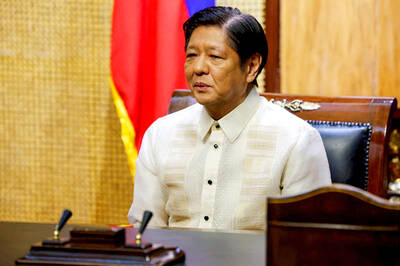
The Philippines would likely be involved in any conflict over Taiwan due to its proximity to the democracy claimed by China, President Ferdinand Marcos Jr said, reiterating a stance that risks angering Beijing. “In the Philippines, we do not have a choice because Taiwan is so close to the Philippines and we have almost 200,000 Filipino nationals living and working in Taiwan,” Marcos said in an interview with Japanese media in Manila on Monday. The Philippine leader’s comments come ahead of a state visit to Japan next week, where he is to meet with Japanese Prime Minister Sanae Takaichi to discuss security


 RSS
RSS