


A verdict in the trial of former Taipei mayor Ko Wen-je (柯文哲) over allegations that he accepted bribes in the Core Pacific City development project and misused political donations would be handed down in late March, a Taipei judge said on Wednesday.
The chief justice of the panel at the Taipei District Court announced that the ruling in the consolidated case involving Ko and 10 other suspects is to be delivered at 2:30pm on March 26 following oral arguments to be completed on Wednesday.
Ko was detained on Sept. 5 last year and indicted two months later on four charges, including accepting NT$17.1 million (US$543,202) in bribes relating to the Core Pacific City development project while serving as Taipei mayor and embezzling political donations during his presidential campaign last year.
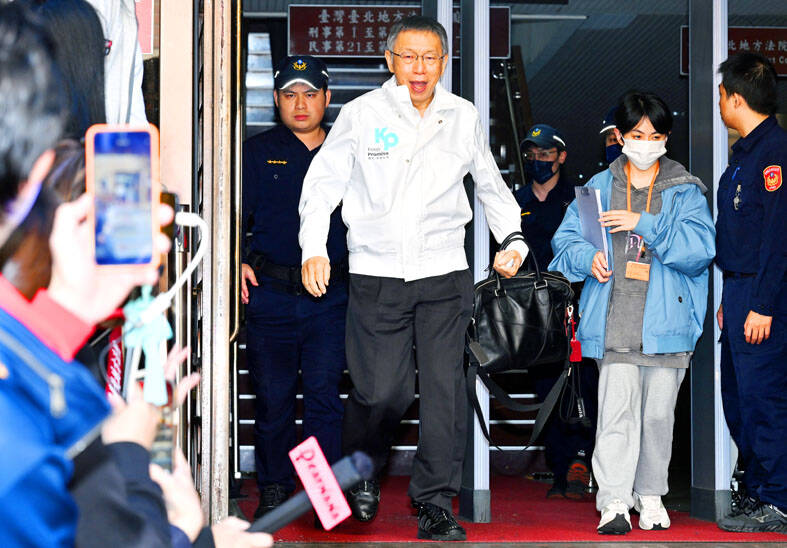
Photo: Liao Chen-huei, Taipei Times
Prosecutors are seeking a 28-and-a-half year sentence for Ko.
In the Core Pacific City development project case, Ko is accused of receiving bribes from Core Pacific Group chairman Sheen Ching-jing (沈慶京) in exchange for granting a massive, illegal increase in the project’s floor-area ratio (FAR).
During the hearing on his suspected involvement in the Core Pacific City project, the former Taiwan People’s Party chairman said that he only knew that the project was submitted for review by city government agencies and took no further part in it.
Ko rejected the prosecutors’ “official-business collusion” allegations, saying their attempts to “slander” and “frame” him have harmed civil servants, leaving them hesitant to act for fear of being accused of favoritism.
After the hearing, Ko told reporters that he has endured huge hardship throughout the case.
He was released in September after posting bail of NT$70 million, bringing an end to his year-long incommunicado detention.
Ko said that the judiciary must never become a tool for political gain, adding that the judicial system is in dire need of reform.
Although there has been no live broadcast of the trial hearings, recordings were made and would be made public, Ko said, adding that they would provide the public with a better opportunity to understand the full context and history of the case.
Prosecutors told the court that Ko had shown a poor attitude following the alleged crimes.
They said he repeatedly cursed at prosecutors during the trial and threw objects at them, while also using social media to distort trial proceedings and witness testimony, and to attack prosecutors, judges and witnesses.
Ko allowed his supporters to pressure the judiciary, including by surrounding the Taipei District Prosecutors’ Office and issuing online threats, they said.
Ko’s conduct demonstrated a lack of respect for the judiciary and placed prosecutors, as well as district and high-court judges, under intense pressure, they said.
Meanwhile, Taipei City Councilor Angela Ying (應曉薇), another suspect, expressed hope that the trial would clear her name.
Ying was indicted for receiving NT$52.5 million in three installments from Sheen to facilitate the FAR change.

Considering that most countries issue more than five denominations of banknotes, the central bank has decided to redesign all five denominations, the bank said as it prepares for the first major overhaul of the banknotes in more than 24 years. Central bank Governor Yang Chin-lung (楊金龍) is expected to report to the Legislative Yuan today on the bank’s operations and the redesign’s progress. The bank in a report sent to the legislature ahead of today’s meeting said it had commissioned a survey on the public’s preferences. Survey results showed that NT$100 and NT$1,000 banknotes are the most commonly used, while NT$200 and NT$2,000

The Centers for Disease Control (CDC) yesterday reported the first case of a new COVID-19 subvariant — BA.3.2 — in a 10-year-old Singaporean girl who had a fever upon arrival in Taiwan and tested positive for the disease. The girl left Taiwan on March 20 and the case did not have a direct impact on the local community, it said. The WHO added the BA.3.2 strain to its list of Variants Under Monitoring in December last year, but this was the first imported case of the COVID-19 variant in Taiwan, CDC Deputy Director-General Lin Ming-cheng (林明誠) said. The girl arrived in Taiwan on

South Korea is planning to revise its controversial electronic arrival card, a step Taiwanese officials said prompted them to hold off on planned retaliatory measures, a South Korean media report said yesterday. A Yonhap News Agency report said that the South Korean Ministry of Foreign Affairs is planning to remove the “previous departure place” and “next destination” fields from its e-arrival card system. The plan, reached after interagency consultations, is under review and aims to simplify entry procedures and align the electronic form with the paper version, a South Korean ministry official said. The fields — which appeared only on the electronic form

The Ministry of Foreign Affairs (MOFA) is suspending retaliation measures against South Korea that were set to take effect tomorrow, after Seoul said it is updating its e-arrival system, MOFA said today. The measures were to be a new round of retaliation after Taiwan on March 1 changed South Korea's designation on government-issued alien resident certificates held by South Korean nationals to "South Korea” from the "Republic of Korea," the country’s official name. The move came after months of protests to Seoul over its listing of Taiwan as "China (Taiwan)" in dropdown menus on its new online immigration entry system. MOFA last week


 RSS
RSS