


The Chinese Nationalist Party (KMT) and the Taiwan People’s Party (TPP) yesterday announced plans for government-funded investment accounts for children that could be claimed upon turning 18.
KMT Chairwoman Cheng Li-wun (鄭麗文) and TPP Chairman Huang Kuo-chang (黃國昌) unveiled the “Taiwan Future Account” initiative at a news conference in Taipei.
The KMT and the TPP decided to propose the “Taiwan future account special act” to address the nation’s declining birthrate, Huang said.

Photo: Liao Chen-huei, Taipei Times
Under the proposal, the government would make an initial NT$50,000 (US$1,588) deposit into an account for each child aged 12 or younger with valid household registration in Taiwan, with an additional NT$10,000 contributed annually for a 13-year pilot period, which would be invested in index funds on Taiwan’s stock market.
Investments would not be restricted to specific industries or themes, nor would leverage be allowed.
Parents would be allowed to make individual investments, with related tax incentives, Cheng said.
Companies could contribute to accounts for employees’ children, with similar tax benefits and policy tools such as additional points under environmental, social and governance indicators, she said.
Ownership of the account would rest with the child, and its operation would be similar to the individual accounts under the new labor pension system.
If parents make no additional contributions, a child would be able to withdraw about NT$339,000 upon reaching the age of 18, Huang said.
If parents contribute NT$10,000 annually, the balance could grow to about NT$561,000, he added.
The estimated budget for the program’s first year would be NT$113 billion, with about NT$26 billion required annually thereafter, assuming 120,000 births per year, Cheng said.
Funding sources would include annual government budgets and accumulated budget surpluses or borrowing, according to the plan.
The fund would be operated under a commissioned management model with a conservative investment strategy, according to information provided by the TPP.
A fund management and supervisory committee would be established for independent oversight, with annual management fees capped at 0.1 percent, Cheng said.
The Ministry of Health and Welfare said such a program would require “more comprehensive and careful” planning, as it lacks differentiated design based on varying family economic conditions, adding that priority should be given to those in need.
Based on an estimated 2.37 million children aged younger than 12 by last year, the initial budget would exceed NT$118.5 billion, the ministry said in a statement.
Spending over a 12-year period would reach about NT$284.4 billion, if the government were required to allocate funds each year for newly eligible children in the same age group, including annual NT$10,000 contributions for each child up to the age of 12, the ministry said.
“Given that the government’s 2026 budget proposal already requires borrowing nearly NT$300 billion, the funding sources and longer-term fiscal impact [of such a proposal] must be carefully considered,” it said.
The funds could be used for higher education, starting a business, skills training or a down payment on a first home once the account holder reaches adulthood, Cheng said.
She described the policy as an investment in children’s futures, saying that the money belongs to Taiwan’s next generation of leaders.
Beside benefiting young adults at an important stage in their lives, the investment could benefit Taiwan’s stock market and economy, Cheng said.
For the past nine years, annual government expenditures have continued to rise, yet the number of newborns has steadily fallen, with births this year likely to drop below 110,000, Huang said.
The Democratic Progressive Party (DPP) has said the low birthrate is a national security crisis and established an office to address the issue, he said.
Despite increased spending and promotional campaigns, the birthrate has continued to decline and the problem has worsened, Huang said.
Asked if proposing the Taiwan Future Account through a special act could raise concerns about the legislature overstepping the authority of the executive branch, he said there is no problem.
A special act is itself a legislative act, he said, asking: “Since when are special acts under our democratic constitutional system drafted by the executive branch?”
If the proposal is introduced as a special act, it would be unconstitutional, DPP caucus chief executive Chung Chia-pin (鍾佳濱) said.
Citing Article 70 of the Constitution, Chung said the Legislative Yuan shall not make proposals for an increase in expenditures in a budgetary bill presented by the Executive Yuan.
The KMT and the TPP appear to believe the Legislative Yuan is all-powerful and above the other branches of government, he said.
DPP Legislator Rosalia Wu (吳思瑤) said under the Constitution and the Budget Act (預算法), legislators can advocate policies and help facilitate them, but cannot directly designate or increase government budget expenditures. The ruling party is open to rational dialogue and cooperation, as long as proposals benefit the country and its people, she said.
Cheng urged the ruling party not to reject the bill simply because it was proposed by opposition parties, adding that the DPP and the Executive Yuan are welcome to join the effort and put forward their own versions.
On Wednesday, DPP Legislator Kuo Kuo-wen (郭國文) proposed that the government and parents jointly invest in exchange-traded funds (ETFs) for children.
Under the plan, the government and parents would both contribute NT$1,200 monthly to a Taiwan ETF investment account until the child is 10.
Assuming an annual return of about 10 percent on local stocks, the child could have NT$1 million by the time they turn 18, Kuo said.
Additional reporting by Lee Wen-hsin

A magnitude 6.1 earthquake struck off the coast of Yilan County at 8:39pm tonight, the Central Weather Administration (CWA) said, with no immediate reports of damage or injuries. The epicenter was 38.7km east-northeast of Yilan County Hall at a focal depth of 98.3km, the CWA’s Seismological Center said. The quake’s maximum intensity, which gauges the actual physical effect of a seismic event, was a level 4 on Taiwan’s 7-tier intensity scale, the center said. That intensity level was recorded in Yilan County’s Nanao Township (南澳), Hsinchu County’s Guansi Township (關西), Nantou County’s Hehuanshan (合歡山) and Hualien County’s Yanliao (鹽寮). An intensity of 3 was

Instead of focusing solely on the threat of a full-scale military invasion, the US and its allies must prepare for a potential Chinese “quarantine” of Taiwan enforced through customs inspections, Stanford University Hoover fellow Eyck Freymann said in a Foreign Affairs article published on Wednesday. China could use various “gray zone” tactics in “reconfiguring the regional and ultimately the global economic order without a war,” said Freymann, who is also a nonresident research fellow at the US Naval War College. China might seize control of Taiwan’s links to the outside world by requiring all flights and ships entering or leaving Taiwan
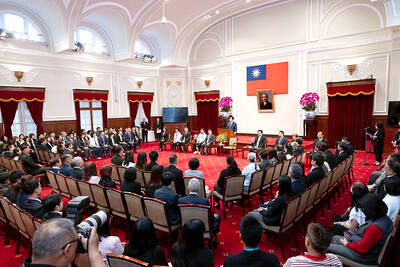
The next minimum wage hike is expected to exceed NT$30,000, President William Lai (賴清德) said yesterday during an award ceremony honoring “model workers,” including migrant workers, at the Presidential Office ahead of Workers’ Day today. Lai said he wished to thank the awardees on behalf of the nation and extend his most sincere respect for their hard work, on which Taiwan’s prosperity has been built. Lai specifically thanked 10 migrant workers selected for the award, saying that although they left their home countries to further their own goals, their efforts have benefited Taiwan as well. The nation’s industrial sector and small businesses lay
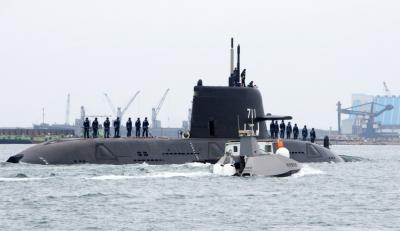
Taiwan's first indigenous defense submarine, the SS-711 Hai Kun (海鯤, or Narwhal), departed for its 13th sea trial at 7am today, marking its seventh submerged test, with delivery to the navy scheduled for July. The outing also marked its first sea deployment since President William Lai (賴清德) boarded the submarine for an inspection on March 19, drawing a crowd of military enthusiasts who gathered to show support. The submarine this morning departed port accompanied by CSBC Corp’s Endeavor Manta (奮進魔鬼魚號) uncrewed surface vessel and a navy M109 assault boat. Amid public interest in key milestones such as torpedo-launching operations and overnight submerged trials,


 RSS
RSS