


Taiwan is to pursue and expand ties with like-minded countries to counter Beijing’s poaching, rather than reactively defending existing relationships with diplomatic allies, Minister of Foreign Affairs Lin Chia-lung (林佳龍) said earlier this month.
He made the remarks in a video interview released earlier this month by the YouTube channel Hsiaochun Taiwan Plus (筱君台灣PLUS), saying that Taipei’s Diplomatic Allies Prosperity Project would showcase the advantages of being Taiwan’s friend to the world.
The Ministry of Foreign Affairs is making a pivot from a “defensive” diplomatic strategy to an “offensive” one, emphasizing developing links with old and new friends, he said.
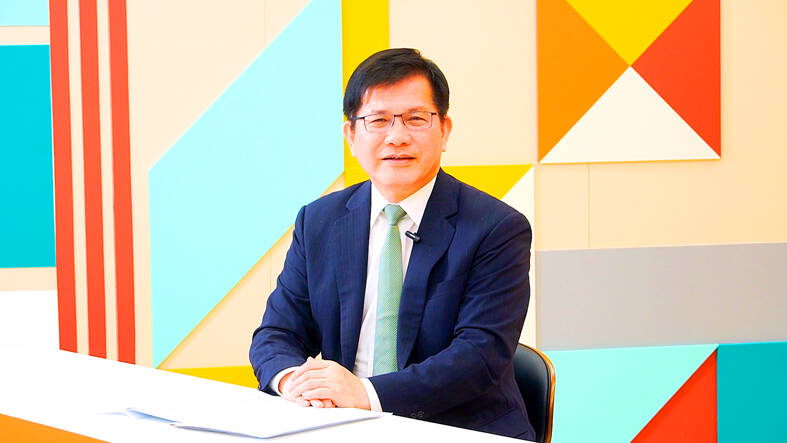
Photo: Huang Yun-hsuan, Taipei Times
That is because the former strategy of passively guarding existing ties against China’s overtures has resulted in a steady loss of diplomatic allies, Lin said.
Taiwan’s rising power and relative importance to the world have enabled the ministry to use the nation’s economic, military and cultural assets in burnishing its international profile, he said.
Foreign governments are coming to the realization that developing relations with Taiwan would provide them with insight on how to handle China and a chance to secure the first island chain, Lin said.
Aggressive diplomacy has already blunted China’s legal warfare against Taiwan, as the European Parliament voted to condemn Beijing’s distortion of UN Resolution 2758, he said.
The EU legislative body’s adaptation of the text denouncing the resolution’s misinterpretation stemmed from the ministry’s years of work with the Inter-Parliamentary Alliance on China, Lin said.
Beijing was forced to reiterate its “one China” principle with the more receptive leaders of the so-called global south, which did little to cover its loss, he said.
The overwhelming consensus among Taiwanese and the international community is that Taiwan does not belong to the People’s Republic of China, and that Taiwan is not the problem of the Taiwan Strait, but the solution to the “China problem,” Lin said.
European officials have acknowledged to their Taiwanese counterparts that they understand that cooperation with Taiwan is a key to contain China’s and Russia’s authoritarian expansionism, he said
The Chinese Communist Party deems Taiwan to be an enemy, as evidenced by Chinese public figures calling for the Chinese military to “seize the island and wipe out the people” should it invade the nation, Lin said.
Taiwanese must face the reality that appeasing China would not save them, and that signing peace treaties with Beijing would leave Taiwan disarmed and at China’s mercy, he said.
Taiwan should seek to help China’s integration into the global community, he said, adding that the world would welcome Beijing with open arms if it demonstrates peaceful intentions and goodwill.
Taipei and Washington achieved consensus on tariffs, as the two sides are working on the exchange and texts connected to trade matters, he said.
Taiwan and the US are in fundamental agreement about bilateral trade due to shared interests, and changes in Washington’s political leadership would not affect it negatively, he said.
Chinese President Xi Jinping’s (習近平) initiation of a telephone call last month with Washington indicated that he was more eager to engage in talks than US President Donald Trump, Lin said.

Chinese spouse and influencer Guan Guan’s (關關) residency permit has been revoked for repeatedly posting pro-China videos that threaten national security, the National Immigration Agency confirmed today. Guan Guan has said many controversial statements in her videos posted to Douyin (抖音), including “the red flag will soon be painted all over Taiwan” and “Taiwan is an inseparable part of China,” and expressing hope for expedited reunification. The agency last year received multiple reports alleging that Guan Guan had advocated for armed reunification. After verifying the reports, the agency last month issued a notice requiring her to appear and explain her actions. Guan

The Kaohsiung Tourism Bureau audited six hotels in an effort to prevent price gouging ahead of Korean band BTS’ concert tour in the city scheduled for Nov. 19, 21 and 22 this year. The bureau on Friday said that the audits — conducted in response to allegations of unfair pricing posted on social media — found no wrongdoing. These establishments included the local branches of Chateau de Chine, Hotel Nikko, My Humble House, and Grand Hai Lai, it said, adding that the Consumer Protection Commission would have penalized price gougers had the accusations been substantiated. The bureau said the Tourism Development Act
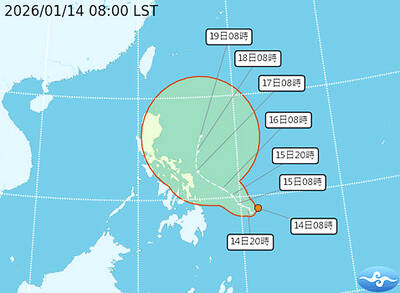
BACK TO WINTER: A strong continental cold air mass would move south on Tuesday next week, bringing colder temperatures to northern and central Taiwan A tropical depression east of the Philippines could soon be upgraded to be the first tropical storm of this year, the Central Weather Administration (CWA) said yesterday, adding that the next cold air mass is forecast to arrive on Monday next week. CWA forecaster Cheng Jie-ren (鄭傑仁) said the first tropical depression of this year is over waters east of the Philippines, about 1,867km southeast of Oluanpi (鵝鑾鼻), and could strengthen into Tropical Storm Nokaen by early today. The system is moving slowly from northwest to north, and is expected to remain east of the Philippines with little chance of affecting Taiwan,

The military yesterday said it has located the flight data recorder, or black box, of an F-16V jet that disappeared off eastern Taiwan earlier this month, and it would soon deploy a salvage team to try to retrieve it. Air Force Command Headquarters said that while it had pinned down the location of the black box, it was still searching for the aircraft’s sole pilot, air force Captain Hsin Po-yi (辛柏毅). Without providing details, the air force said it had located the black box days after detecting some intermittent signals and would now engage a team of professionals to retrieve it. The air


 RSS
RSS