


Taiwan is to add two international and three domestic undersea communications cables as part of its efforts to strengthen communications resilience, Minister of Digital Affairs Lin Yi-jing (林宜敬) said yesterday.
Lin was briefing President William Lai (賴清德) and other participants on the ministry's efforts to bolster the nation's communications and financial security at the sixth meeting of the Presidential Office's Whole-of-Society Defense Resilience Committee.

Photo: Liao Chen-huei, Taipei Times
The new undersea cables would be hardened with an "armor-like" protective layer, so they would not be easily damaged, Lin said.
"We must ensure that our Internet remains connected during typhoons, earthquakes or any other emergencies," he said.
As of press time last night, the ministry had not replied to a query on when the planned communications cables would be completed.
Taiwan has reported several instances of alleged sabotage of underwater communications cables by Chinese civilian vessels in recent years.
In response, the legislature passed a series of legal amendments earlier this month mandating prison terms for saboteurs and the confiscation of vessels and tools used.
The planned undersea cables are part of the ministry's "three-dimensional defensive communications network" initiative, which aims to strengthen Taiwan's communication from land, air and sea, Lin said.
The initiative also includes the addition of an Amazon low-earth-orbit satellite constellation and the inauguration of a high-orbit geosynchronous satellite being built by US manufacturer Astranis, he said.
On land, the ministry is to plan disaster-resilient base stations, expand its existing fleet of vehicles with satcom-on-the-move capability and procure a large number of mobile diesel generators, he said.
Lin said the ministry learned during typhoons over the past year that cellphone connectivity issues are most commonly caused by power outages at cell sites, and that the problem can be effectively solved with mobile generators.
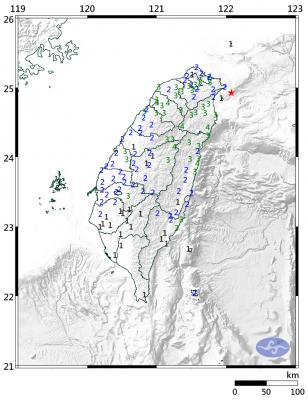
A magnitude 6.1 earthquake struck off the coast of Yilan County at 8:39pm tonight, the Central Weather Administration (CWA) said, with no immediate reports of damage or injuries. The epicenter was 38.7km east-northeast of Yilan County Hall at a focal depth of 98.3km, the CWA’s Seismological Center said. The quake’s maximum intensity, which gauges the actual physical effect of a seismic event, was a level 4 on Taiwan’s 7-tier intensity scale, the center said. That intensity level was recorded in Yilan County’s Nanao Township (南澳), Hsinchu County’s Guansi Township (關西), Nantou County’s Hehuanshan (合歡山) and Hualien County’s Yanliao (鹽寮). An intensity of 3 was
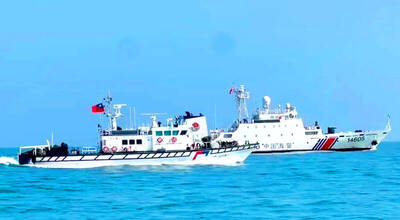
Instead of focusing solely on the threat of a full-scale military invasion, the US and its allies must prepare for a potential Chinese “quarantine” of Taiwan enforced through customs inspections, Stanford University Hoover fellow Eyck Freymann said in a Foreign Affairs article published on Wednesday. China could use various “gray zone” tactics in “reconfiguring the regional and ultimately the global economic order without a war,” said Freymann, who is also a nonresident research fellow at the US Naval War College. China might seize control of Taiwan’s links to the outside world by requiring all flights and ships entering or leaving Taiwan
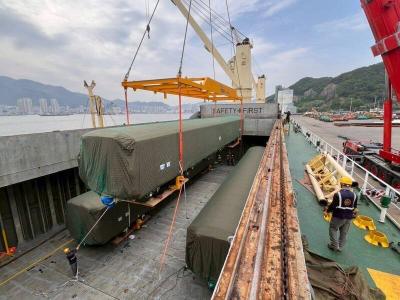
The first of 10 new high-capacity trains purchased from South Korea’s Hyundai Rotem arrived at the Port of Taipei yesterday to meet the demands of an expanding metro network, Taipei Rapid Transit Corp (TRTC) said yesterday. The train completed a three-day, 1,200km voyage from the Port of Masan in South Korea, the company said. Costing NT$590 million (US$18.79 million) each, the new six-carriage trains feature a redesigned interior based on "human-centric" transportation concepts, TRTC said. The design utilizes continuous longitudinal seating to widen the aisles and optimize passenger flow, while also upgrading passenger information displays and driving control systems for a more comfortable
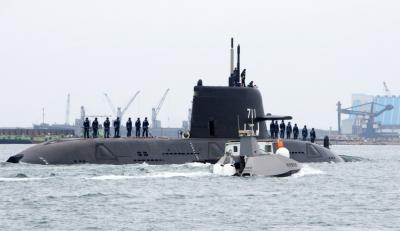
Taiwan's first indigenous defense submarine, the SS-711 Hai Kun (海鯤, or Narwhal), departed for its 13th sea trial at 7am today, marking its seventh submerged test, with delivery to the navy scheduled for July. The outing also marked its first sea deployment since President William Lai (賴清德) boarded the submarine for an inspection on March 19, drawing a crowd of military enthusiasts who gathered to show support. The submarine this morning departed port accompanied by CSBC Corp’s Endeavor Manta (奮進魔鬼魚號) uncrewed surface vessel and a navy M109 assault boat. Amid public interest in key milestones such as torpedo-launching operations and overnight submerged trials,


 RSS
RSS