


A motion to impeach President William Lai (賴清德) yesterday was placed on the agenda for a Legislative Yuan meeting on Friday, while opposition lawmakers formally filed a request with the Control Yuan to initiate an impeachment investigation against Premier Cho Jung-tai (卓榮泰).
The Legislative Yuan’s Procedure Committee met yesterday to set the legislative agenda from Friday to Tuesday next week.
The agenda passed under the opposition’s majority included impeachment proposals from the Chinese Nationalist Party (KMT) and the Taiwan People’s Party (TPP), while discussion of bills on cross-strait relations, national defense and the Executive Yuan’s version of the fiscal planning bill were postponed.
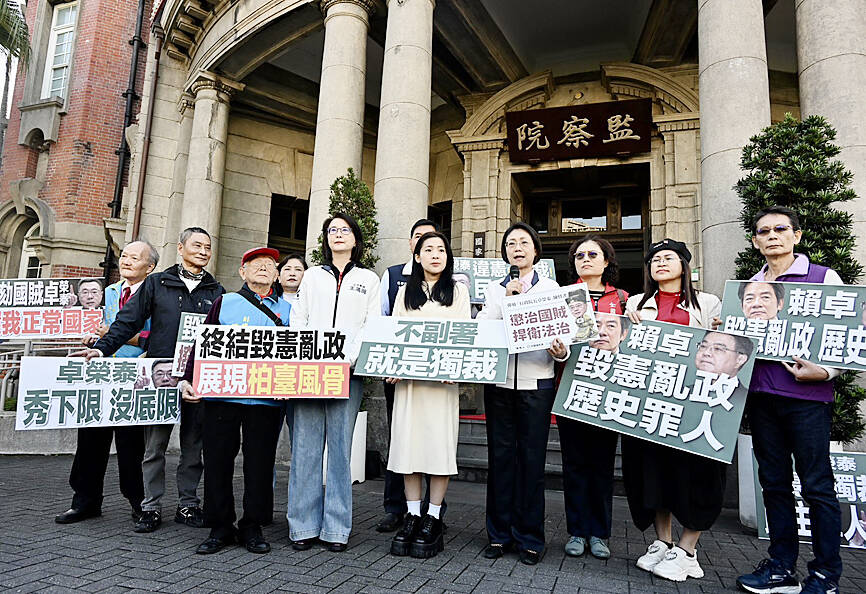
Photo: Lo Pei-de, Taipei Times
The KMT and TPP would continue to discuss the impeachment procedure, which would include asking Lai to address the Legislative Yuan, and holding public hearings at the legislature and other events throughout the nation, KMT caucus secretary-general Lo Chih-chiang (羅智強) said after the meeting.
The impeachment vote would take place on about May 20, as the opposition parties need to reach a consensus first, Lo said.
Article 4-7 of the of the Additional Articles of the Constitution (中華民國憲法增修條文) stipulates that the Legislative Yuan can initiate impeachment against the president if more than one-half of legislators agree, and the motion would be passed only if two-thirds of legislators agree.
If passed, the case would then proceed to the Constitutional Court, where two-thirds of the justices must vote for impeachment.
As the opposition parties do not have a two-thirds majority, the impeachment would not pass, Democratic Progressive Party Legislator Wang Yi-chuan (王義川) said.
The opposition is insisting on going through the impeachment process to force Lai to address the legislature, looking for an excuse to openly criticize him, Wang said.
Wang urged the opposition to safeguard the country, rather than paralyzing parts of the government.
The KMT caucus proposed to impeach Lai for allegedly contravening Article 72 of the Constitution in his refusal to promulgate amendments to the Act Governing the Allocation of Government Revenues and Expenditures (財政收支劃分法) passed by the Legislative Yuan.
Meanwhile, KMT and TPP lawmakers went to the Control Yuan in Taipei to formally request an impeachment investigation into Cho.
While the impeachment process for presidents and vice presidents are initiated by a vote in the legislature and decided by the Constitutional Court, public officials — including the premier — are impeached by the Control Yuan.
The grounds for impeachment include alleged refusal to implement laws already in effect, illegal reduction of local general subsidies and using the countersignature system as a veto tool, they said.
KMT Legislator Weng Hsiao-ling (翁曉玲) accused Cho of contravening the separation of powers by failing to allocate budgets for military and police benefits as required by law, and refusing to countersign the fiscal allocation budget and a bill to halt cuts to public servant pensions passed by the legislature.
Cho dismissed the impeachment push against him, saying that his focus remains on economic governance.
Additional reporting by Lin Hsin-han

FUKUOKA SITUATION: Japanese media reported that the pathogen is expected to be identified by the summer, while the CDC downplayed the idea that it was hMPV A “mysterious cold-like illness” reported in Japan’s Fukuoka Prefecture does not seem to be a new disease, but Japanese authorities have been asked about the situation, the Centers for Disease Control (CDC) said yesterday. The Fukuoka Prefectural Medical Association on Wednesday told a news conference that a “mystery cold” that has become a hot topic on social media is “highly likely to be caused by some kind of viral infection,” Japan’s KBC News reported. “Many people are experiencing symptoms starting with a sore throat, followed by a runny nose, phlegm and a severe cough,” KBC News reported, citing association officials. Health authorities are

Nvidia Corp CEO Jensen Huang (黃仁勳) arrived in Taiwan yesterday ahead of upcoming AI and technology events, saying he plans to meet with clients and Taiwan Semiconductor Manufacturing Co Chairman C.C. Wei (魏哲家) during his visit. After landing at Taipei Songshan Airport, Huang posed for photos with fans and handed out Yakult drinks to reporters and supporters waiting at the scene, saying he has “a lot to do” during the trip. Asked about reports that Nvidia’s planned headquarters site in Taipei’s Beitou Shilin Technology Park could break ground on May 27, Huang said that if the company holds an event, he would

The Ministry of Finance this afternoon announced the winning numbers for the March-April uniform invoice lottery. The winning number for the NT$10 million (US$318,060) special prize is 19531471, and the winning number for the NT$2 million grand prize is 85941329. Three numbers were drawn for the NT$200,000 first prize: 07225810, 20231230 and 83518781. Those with receipts matching the last seven digits of any of the first-prize numbers will win the NT$40,000 second prize, while those matching the last six digits will win the NT$10,000 third prize. Those whose receipts match the last five digits of the first-prize numbers can claim the NT$4,000 fourth prize,
Taiwan Travelogue (臺灣漫遊錄), which earlier this week became the first Taiwanese novel to win the International Booker Prize, is to be adapted into a television series through a Taiwan-Japan coproduction, producer Chang Chen-yu (張辰漁) said yesterday. Chang, a producer at World Softest Production Film Co, wrote on Facebook that the company had been searching for projects with international appeal that retain a strong Taiwanese identity after colleagues and Japanese partners strongly recommended the novel. After reading the book, Chang said he immediately decided to pursue the screen rights. “A great story has the power to transcend time and borders, and connect countless people,”


 RSS
RSS