


Medical experts yesterday called for broader testing for alcohol intolerance in Taiwan given the high prevalence of the disorder and its impact on health.
The Food and Drug Administration has authorized a test kit that detects genetic markers linked to alcohol intolerance, Liver Disease Prevention and Treatment Research Foundation chief executive officer Nien Hsiao-ching (粘曉菁) told a news conference in Taipei.
The technology, which uses a mouth swab, is available as a paid-out-of-pocket procedure, she said.
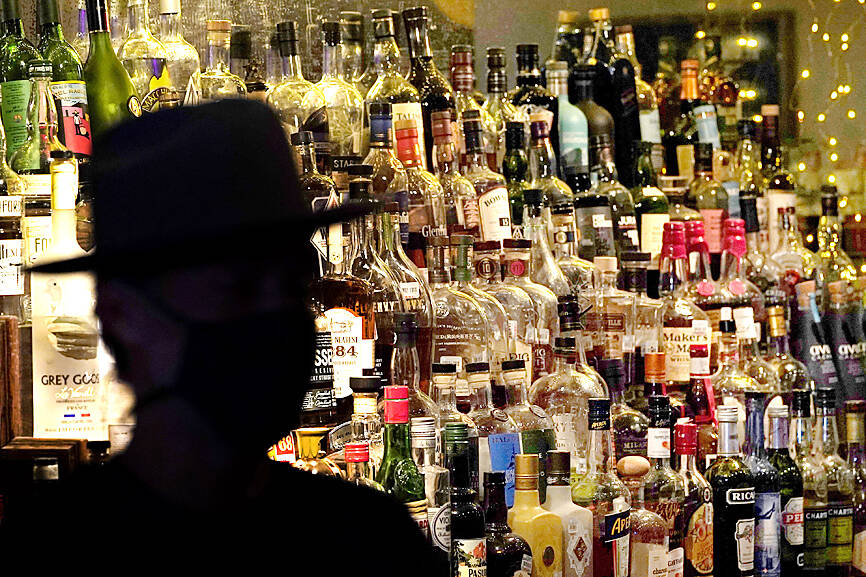
Photo: AP
Alcohol intolerance is caused by mutations of the genes governing the enzymes that break down alcohol, Nien said.
The disorder’s prevalence rate is 8 percent globally, but 30 to 34 percent in East Asia and 47 percent in Taiwan, leading to a significantly worse impact of alcohol on Taiwanese, she said.
Alcohol is metabolized by alcohol dehydrogenase into acetaldehyde before acetaldehyde dehydrogenase (ALDH) breaks down the substance into carbon dioxide and water, which are expelled, she said.
For people with alcohol intolerance, the low-activity ALDH enzymes cause toxic acetaldehyde to build up in the body, resulting in heightened risks of poisoning and cancer, Nien said.
Susceptibility to hangovers, nausea, vertigo and developing a flush after drinking are common symptoms of alcohol intolerance, but genetic testing is required for a diagnosis, she said.
Reliable diagnosis through the test kits would go a long way in reducing the harm posed by alcohol, foundation chairman Sheu Jin-chuan (許金川) said.
Alcohol-related liver diseases, especially cirrhosis, are major causes of death and should be targeted by health authorities, who have made strides in eliminating hepatitis B and C, Sheu said.
Cirrhosis’ greatest danger to health is a lack of obvious symptoms and its late discovery often leaves few treatment options other than organ transplant, he said.
The government spends an estimated NT$53 billion (US$1.7 billion) on healthcare each year to treat alcohol-related conditions, including treatments for hepatitis, liver cancer and alcohol-related accidents, National Health Insurance Administration Director-General Chen Lian-yu (陳亮妤) said.
An estimated 8.5 million Taiwanese consume alcohol, including 1 million who engage in hazardous drinking, in part fueled by an effort to self-medicate, she said.
A drinker is between two and three times more likely to have chronic depression after five years of habitual alcohol consumption, and significantly more likely to develop dementia after 10 years, Chen added.

A magnitude 6.1 earthquake struck off the coast of Yilan County at 8:39pm tonight, the Central Weather Administration (CWA) said, with no immediate reports of damage or injuries. The epicenter was 38.7km east-northeast of Yilan County Hall at a focal depth of 98.3km, the CWA’s Seismological Center said. The quake’s maximum intensity, which gauges the actual physical effect of a seismic event, was a level 4 on Taiwan’s 7-tier intensity scale, the center said. That intensity level was recorded in Yilan County’s Nanao Township (南澳), Hsinchu County’s Guansi Township (關西), Nantou County’s Hehuanshan (合歡山) and Hualien County’s Yanliao (鹽寮). An intensity of 3 was

Instead of focusing solely on the threat of a full-scale military invasion, the US and its allies must prepare for a potential Chinese “quarantine” of Taiwan enforced through customs inspections, Stanford University Hoover fellow Eyck Freymann said in a Foreign Affairs article published on Wednesday. China could use various “gray zone” tactics in “reconfiguring the regional and ultimately the global economic order without a war,” said Freymann, who is also a nonresident research fellow at the US Naval War College. China might seize control of Taiwan’s links to the outside world by requiring all flights and ships entering or leaving Taiwan
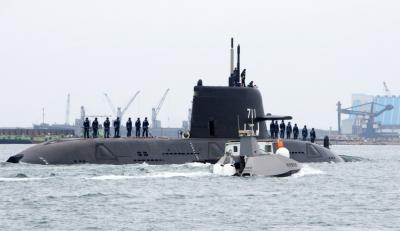
Taiwan's first indigenous defense submarine, the SS-711 Hai Kun (海鯤, or Narwhal), departed for its 13th sea trial at 7am today, marking its seventh submerged test, with delivery to the navy scheduled for July. The outing also marked its first sea deployment since President William Lai (賴清德) boarded the submarine for an inspection on March 19, drawing a crowd of military enthusiasts who gathered to show support. The submarine this morning departed port accompanied by CSBC Corp’s Endeavor Manta (奮進魔鬼魚號) uncrewed surface vessel and a navy M109 assault boat. Amid public interest in key milestones such as torpedo-launching operations and overnight submerged trials,
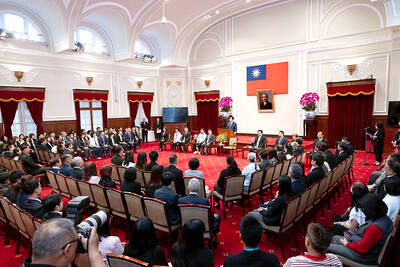
The next minimum wage hike is expected to exceed NT$30,000, President William Lai (賴清德) said yesterday during an award ceremony honoring “model workers,” including migrant workers, at the Presidential Office ahead of Workers’ Day today. Lai said he wished to thank the awardees on behalf of the nation and extend his most sincere respect for their hard work, on which Taiwan’s prosperity has been built. Lai specifically thanked 10 migrant workers selected for the award, saying that although they left their home countries to further their own goals, their efforts have benefited Taiwan as well. The nation’s industrial sector and small businesses lay


 RSS
RSS