


A delegation from Japan’s House of Councillors led by lawmaker Hirofumi Takinami is to meet with President William Lai (賴清德) and Premier Cho Jung-tai (卓榮泰) while visiting Taiwan from today to Wednesday, the Ministry of Foreign Affairs said.
The delegation of five would also meet Minister of Foreign Affairs Lin Chia-lung (林佳龍), Taiwan-Japan Relations Association Chairman Su Jia-chyuan (蘇嘉全) and New Taipei City Mayor Hou You-yi (侯友宜), the ministry said.
The lawmakers are part of the House of Councillors’ “TY Group,” a pro-Taiwan group initiated by Takinami and former house member Yumi Yoshikawa.
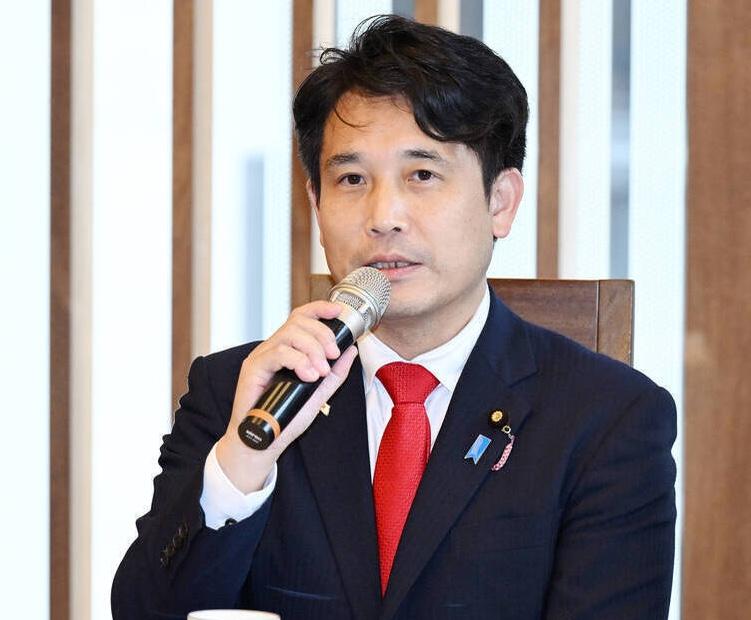
Photo: Liao Chen-huei, Taipei Times
Takinami, who is married to a Taiwanese woman, has often spoken up on Taiwan’s behalf.
The former state minister of agriculture, forestry and fisheries was also instrumental to a change made earlier this year to Japan’s household registration system allowing Taiwanese to list “Taiwan” as their nationality.
In a lecture yesterday organized by the Friends of Lee Teng-hui Association in Japan, Takinami said he realized the importance of the issue in 2002, when he discovered his wife’s nationality was listed as “China” when registering their marriage.
When he raised the problem with the local government, he was told it was a national-level issue.
Takinami is leader of the household registration task force at the Japan-ROC Diet Members' Consultative Council.
After repeated talks with Japan’s Ministry of Justice, the team decided to incorporate the change into an already planned revision of the country’s household registration law to minimize political resistance and foreign pressure, he said.
Takinami said he first sought political support by holding private meetings with officials.
He worked “behind-the-scenes” to avoid any high-profile publicity and prevent any foreign interference before the bill was finalized, he added.
He said that people doubted the plan’s success, but based on his bureaucratic experience, once the government finalized the bill’s direction, it was unlikely to be overturned.
Takinami’s wife, Shiori Takinami, also spoke at the event, saying that it was challenging for the Liberal Democratic Party to campaign for the bill, as people questioned whether the party was overly focused on Taiwan.
However, with quiet and persistent work, understanding eventually comes, she said.
Even though she is now a Japanese citizen, she said her birthplace and hometown are in Taiwan, and vowed to continue fighting for Taiwan and Japan-Taiwan relations with her husband.
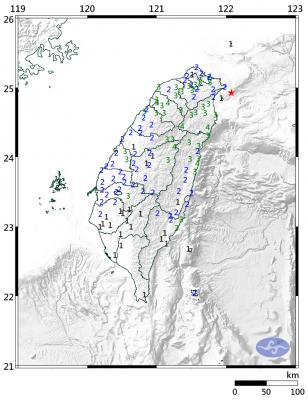
A magnitude 6.1 earthquake struck off the coast of Yilan County at 8:39pm tonight, the Central Weather Administration (CWA) said, with no immediate reports of damage or injuries. The epicenter was 38.7km east-northeast of Yilan County Hall at a focal depth of 98.3km, the CWA’s Seismological Center said. The quake’s maximum intensity, which gauges the actual physical effect of a seismic event, was a level 4 on Taiwan’s 7-tier intensity scale, the center said. That intensity level was recorded in Yilan County’s Nanao Township (南澳), Hsinchu County’s Guansi Township (關西), Nantou County’s Hehuanshan (合歡山) and Hualien County’s Yanliao (鹽寮). An intensity of 3 was

Instead of focusing solely on the threat of a full-scale military invasion, the US and its allies must prepare for a potential Chinese “quarantine” of Taiwan enforced through customs inspections, Stanford University Hoover fellow Eyck Freymann said in a Foreign Affairs article published on Wednesday. China could use various “gray zone” tactics in “reconfiguring the regional and ultimately the global economic order without a war,” said Freymann, who is also a nonresident research fellow at the US Naval War College. China might seize control of Taiwan’s links to the outside world by requiring all flights and ships entering or leaving Taiwan
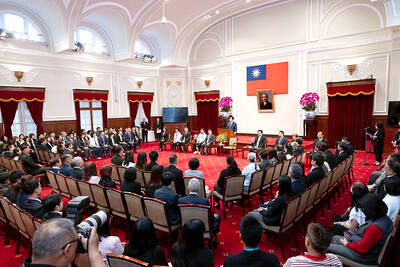
The next minimum wage hike is expected to exceed NT$30,000, President William Lai (賴清德) said yesterday during an award ceremony honoring “model workers,” including migrant workers, at the Presidential Office ahead of Workers’ Day today. Lai said he wished to thank the awardees on behalf of the nation and extend his most sincere respect for their hard work, on which Taiwan’s prosperity has been built. Lai specifically thanked 10 migrant workers selected for the award, saying that although they left their home countries to further their own goals, their efforts have benefited Taiwan as well. The nation’s industrial sector and small businesses lay
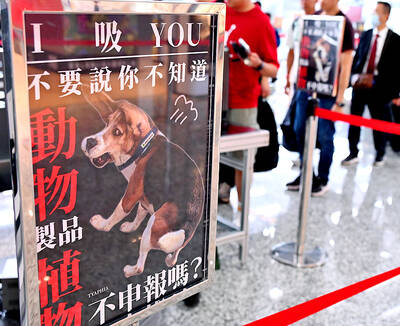
Quarantine awareness posters at Taiwan Taoyuan International Airport have gone viral for their use of wordplay. Issued by the airport branch of the Animal and Plant Health Inspection Agency, the posters feature sniffer dogs making a range of facial expressions, paired with advisory messages built around homophones. “We update the messages for holidays and campaign needs, periodically refreshing materials to attract people’s attention,” quarantine officials said. “The aim is to use the dogs’ appeal to draw focus to quarantine regulations.” A Japanese traveler visiting Taiwan has posted a photo on X of a poster showing a quarantine dog with a


 RSS
RSS