


Civic organizations and bipartisan lawmakers yesterday urged the government to establish a victim support and reporting mechanism, strengthen cross-border threat detection and coordination capabilities, and promote national cybersecurity and protective education to raise public awareness of cross-border suppression.
The call was issued at a news conference hosted by Democratic Progressive Party Legislator Chen Kuan-ting (陳冠廷) and the Anti-Cross-Border Suppression Advocacy Action Team, and attended by Inter-Parliamentary Alliance on China (IPAC) cochair and Taiwan People’s Party (TPP) Legislator Chen Gau-tzu (陳昭姿).
Representatives of the victims, including Kuan Chian-jhong (管建中), a representative from the company responsible for the distribution of State Organs (國有器官) in Taiwan, were also invited to attend the news conference.
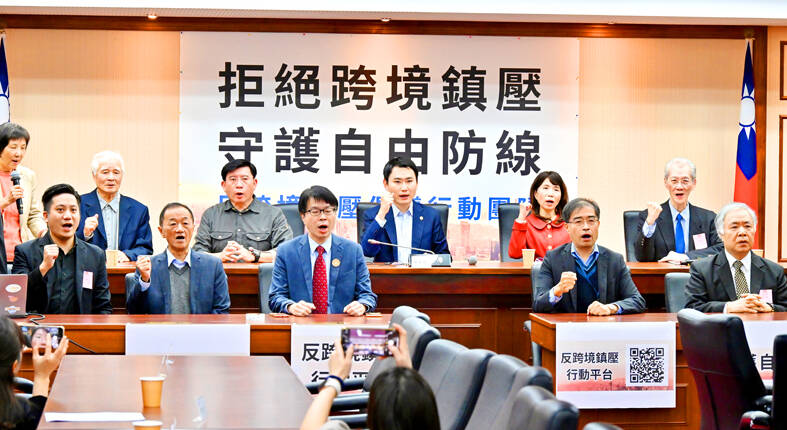
Photo: George Tsorng, Taipei Times
State Organs is a documentary released in October last year that exposes how Chinese government officials engage in organ harvesting and other illegal activities.
Chen Kuan-ting said there have been many cases where individuals who fled China due to persecution continue to be harassed by Chinese national security agencies after seeking refuge overseas.
This year, China has also issued harassment messages targeting Taiwanese officials and legislators, he said, adding that these threats have evolved beyond intimidating messages and bomb threats to include “identity theft,” where low-threshold communications channels are used to impersonate third parties and collect personal information.
This creates confusion for police investigations, effectively using minimal resources to generate maximum fear, forcing citizens into “self-censorship,” he said.
In a joint statement issued at the G7 summit in June, cross-border suppression was recognized as a “global security issue,” he added.
With the international community working to contain and prevent cross-border suppression, he said the purpose of the news conference was to encourage all sectors to address the issue and seek solutions.
He urged administrative agencies to establish clear reporting and assistance mechanisms, so that victims know where to seek help. Additionally, necessary legal tools should be considered to protect Taiwan’s civil society, he said.
Chen Gau-tzu said that domestically, political parties might have differing policies and platforms, but externally everyone shares a unified stance: to safeguard Taiwan’s democracy, freedom and security.
The TPP has a very clear position, which is that the Chinese Communist Party has no right to infringe upon Taiwanese.
Kuan said that on July 15 last year, he officially introduced State Organs to Taiwan.
Over the course of 16 months, more than 840 screenings were held and more than 150 threatening letters were received, he said, adding that the threats included placing bombs in the Presidential Office, the legislature and cinemas, slashing moviegoers and warning movie theaters not to cooperate with Lion Rock Films.
Kuan said that he chose not to remain silent because silence would mean paying a much greater price in the future.

FUKUOKA SITUATION: Japanese media reported that the pathogen is expected to be identified by the summer, while the CDC downplayed the idea that it was hMPV A “mysterious cold-like illness” reported in Japan’s Fukuoka Prefecture does not seem to be a new disease, but Japanese authorities have been asked about the situation, the Centers for Disease Control (CDC) said yesterday. The Fukuoka Prefectural Medical Association on Wednesday told a news conference that a “mystery cold” that has become a hot topic on social media is “highly likely to be caused by some kind of viral infection,” Japan’s KBC News reported. “Many people are experiencing symptoms starting with a sore throat, followed by a runny nose, phlegm and a severe cough,” KBC News reported, citing association officials. Health authorities are

Nvidia Corp CEO Jensen Huang (黃仁勳) arrived in Taiwan yesterday ahead of upcoming AI and technology events, saying he plans to meet with clients and Taiwan Semiconductor Manufacturing Co Chairman C.C. Wei (魏哲家) during his visit. After landing at Taipei Songshan Airport, Huang posed for photos with fans and handed out Yakult drinks to reporters and supporters waiting at the scene, saying he has “a lot to do” during the trip. Asked about reports that Nvidia’s planned headquarters site in Taipei’s Beitou Shilin Technology Park could break ground on May 27, Huang said that if the company holds an event, he would

The Ministry of Finance this afternoon announced the winning numbers for the March-April uniform invoice lottery. The winning number for the NT$10 million (US$318,060) special prize is 19531471, and the winning number for the NT$2 million grand prize is 85941329. Three numbers were drawn for the NT$200,000 first prize: 07225810, 20231230 and 83518781. Those with receipts matching the last seven digits of any of the first-prize numbers will win the NT$40,000 second prize, while those matching the last six digits will win the NT$10,000 third prize. Those whose receipts match the last five digits of the first-prize numbers can claim the NT$4,000 fourth prize,

SIX SUBSIDIES: The monthly allowance for older farmers is to increase to NT$10,000, and NT$5,000 is to be given to homemakers under the national pension system, Lai said The government is to implement major welfare policies for disadvantaged groups, including raising the monthly allowance for older farmers to NT$10,000 and providing homemakers with NT$5,000 per month, President William Lai (賴清德) said yesterday. Lai made the remarks during a visit to Wangling Temple in Chiayi County, saying that the planned increases were being introduced amid economic growth and an increase in tax revenue. Touting a policy, in which the government plans to provide a monthly allowance of NT$5,000 for every child under the age of 18 in a bid to address Taiwan’s low birthrate, Lai said that if received for the


 RSS
RSS