


Taiwan-Japan Relations Association (TJRA) chairman Su Jia-chyuan (蘇嘉全) is to take over as Straits Exchange Foundation (SEF) chairman, while his vacancy is to be filled by former representative to Japan Frank Hsieh (謝長廷), people familiar with the matter said today.
A reshuffle of senior personnel overseeing cross-strait and diplomatic affairs is underway, as incumbent SEF Chairman Frank Wu (吳豊山) yesterday announced that he is to step down at the end of the year.
During a joint board meeting, Wu said he met with President William Lai (賴清德) on Friday last week to discuss personnel matters at the foundation.
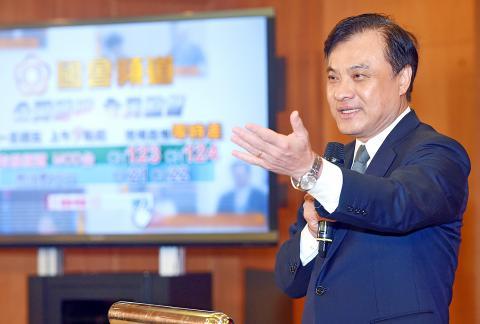
Photo: Liao Chen-huei, Taipei Times
He agreed on the spot to “make way for others,” confirming that his term would run only until Dec. 31, sources said.
His remarks underscored that the Presidential Office and Executive Yuan had already mapped out a new personnel arrangement for the foundation, sources said.
The SEF is a semi-official organization tasked by the government to handle technical matters involving China.
The personnel arrangements for Japan-related and cross-strait affairs are to be filled by Democratic Progressive Party (DPP) figures with “Cabinet-level” political weight, sources said.
Su oversaw the signing of several memorandums of understanding during his tenure as head of the TJRA.
However, his greater asset lies in the trust he built with senior political figures during his time as legislative speaker, sources said.
His anticipated move to the SEF signals that the leadership intends, amid the deliberate deadlock created by Beijing, to hand cross-strait affairs to Su, who has a stronger political profile, sources said.
Meanwhile, Hsieh was appointed a senior adviser to the Presidential Office after stepping down as representative to Japan in August.
Since returning to Taiwan, he has maintained a high public profile, frequently posting on Facebook in support of Premier Cho Jung-tai (卓榮泰).
He reportedly declined an invitation from former president Chen Shui-bian (陳水扁) to appear on a media program, citing “an impending change in position” — a move widely interpreted as a signal that he was preparing to return to public office.
The chair position at the TJRA has traditionally been held by figures close to the highest levels of government, including former DPP secretary-general Chiou I-jen (邱義仁) and Su.
Given Hsieh’s eight years of networking and experience in Japan, his appointment is seen as a logical move aimed at maintaining the level and stability of Taipei’s communication channel with Tokyo.
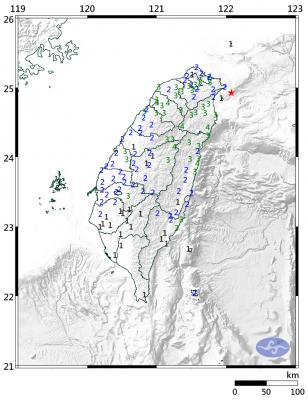
A magnitude 6.1 earthquake struck off the coast of Yilan County at 8:39pm tonight, the Central Weather Administration (CWA) said, with no immediate reports of damage or injuries. The epicenter was 38.7km east-northeast of Yilan County Hall at a focal depth of 98.3km, the CWA’s Seismological Center said. The quake’s maximum intensity, which gauges the actual physical effect of a seismic event, was a level 4 on Taiwan’s 7-tier intensity scale, the center said. That intensity level was recorded in Yilan County’s Nanao Township (南澳), Hsinchu County’s Guansi Township (關西), Nantou County’s Hehuanshan (合歡山) and Hualien County’s Yanliao (鹽寮). An intensity of 3 was

Instead of focusing solely on the threat of a full-scale military invasion, the US and its allies must prepare for a potential Chinese “quarantine” of Taiwan enforced through customs inspections, Stanford University Hoover fellow Eyck Freymann said in a Foreign Affairs article published on Wednesday. China could use various “gray zone” tactics in “reconfiguring the regional and ultimately the global economic order without a war,” said Freymann, who is also a nonresident research fellow at the US Naval War College. China might seize control of Taiwan’s links to the outside world by requiring all flights and ships entering or leaving Taiwan
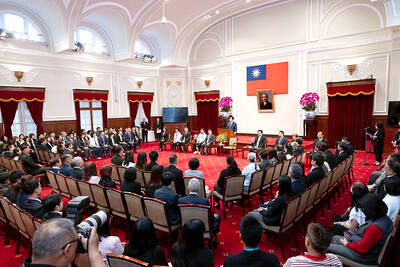
The next minimum wage hike is expected to exceed NT$30,000, President William Lai (賴清德) said yesterday during an award ceremony honoring “model workers,” including migrant workers, at the Presidential Office ahead of Workers’ Day today. Lai said he wished to thank the awardees on behalf of the nation and extend his most sincere respect for their hard work, on which Taiwan’s prosperity has been built. Lai specifically thanked 10 migrant workers selected for the award, saying that although they left their home countries to further their own goals, their efforts have benefited Taiwan as well. The nation’s industrial sector and small businesses lay
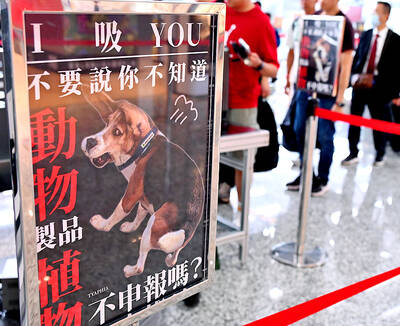
Quarantine awareness posters at Taiwan Taoyuan International Airport have gone viral for their use of wordplay. Issued by the airport branch of the Animal and Plant Health Inspection Agency, the posters feature sniffer dogs making a range of facial expressions, paired with advisory messages built around homophones. “We update the messages for holidays and campaign needs, periodically refreshing materials to attract people’s attention,” quarantine officials said. “The aim is to use the dogs’ appeal to draw focus to quarantine regulations.” A Japanese traveler visiting Taiwan has posted a photo on X of a poster showing a quarantine dog with a


 RSS
RSS