

Taiwanese seafood trader Jay Yen used to import 2,000 tonnes of shrimp from Honduras per year before the Central American country cut diplomatic ties with Taiwan in 2023.
Now, it is just the odd “container or two,” but that could change if Honduras’ next president acts on an election pledge to forge closer ties with Taiwan.
Tegucigalpa’s decision to switch diplomatic recognition from Taipei to Beijing and scrap a free trade agreement with Taiwan was a huge blow for the Honduran shrimp industry.
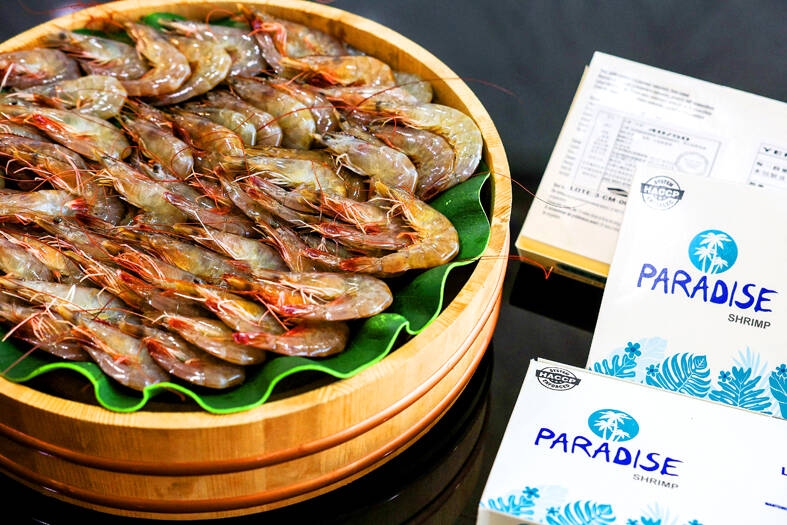
Photo: I-Hwa Cheng, AFP
Imports plunged from about 13,000 tonnes in 2022 to nearly 4,000 tonnes last year, Taiwanese data showed, as a 20 percent tariff made Honduran shrimp more expensive.
A diplomatic reversal would be a “good thing” for business and Taiwanese consumers, Yen said.
“For us, we [would] have more choices to source white shrimp... And the end consumer will have more choices,” he added.
National Party candidate Nasry Asfura and Liberal Party candidate Salvador Nasralla, who are neck and neck in the Honduran presidential race, have signaled support for switching ties from Beijing to Taipei.
A switch back would be a rare diplomatic win for Taiwan, but officials are responding cautiously.
“We are taking a proactive and open attitude,” Minister of Foreign Affairs Lin Chia-lung (林佳龍) said in response to questions from lawmakers.
Taiwan was in contact with Asfura’s and Nasralla’s teams, Lin said, adding that “whatever we do must be beneficial to them and to us.”
Honduras’ move in 2023 to end decades of diplomatic relations with Taipei followed negotiations with Beijing on building a hydroelectric dam.
Taiwan at the time said the switch was part of China’s tactics to coerce and intimidate Taipei’s allies.
Since then, China has expanded its economic influence over Honduras, but has drawn criticism for flooding the country with cheap goods, employing Chinese workers for infrastructure projects and failing to buy enough shrimp.
It has also cost tens of thousands of jobs, as dozens of companies closed, National Association of Aquaculturists of Honduras executive director Javier Amador said.
Shipments to Taiwan were more than six times the volume sent to China, “even with the disadvantage of paying tariffs,” Amador said.
On the campaign trail, Nasralla said: “Taiwan has been our great ally for more than 60 years. What has China given us?”
However, the Honduran presidential candidates’ support for Taiwan could be a “negotiation tactic,” National Chengchi University Department of Diplomacy associate professor Fabricio Fonseca said.
“If China is sensing that they are really serious about this, then, of course, there might be many offers that China can make,” Fonseca said. “If, in the end, they [Asfura or Nasralla] decide not to stick to this campaign promise, they have something to show in return.”
The US could be a deciding factor, if it were to help Taiwan woo back Honduras, he added.
Honduran coffee trader Elias Argueta said he hoped his country renews ties with Taiwan, where he lives with his wife and young daughter.
Argueta, 34, began importing beans from his parents’ farms in Honduras in 2020 and selling them in Taiwan, where coffee beans from Guatemala and Colombia are popular.
Since the diplomatic break-up, it has been harder to secure new customers, because the government stopped promoting Honduran coffee beans.
If relations are restored, “people will be more open to take Honduran coffee, and definitely the official channels will open again here in Taiwan,” Argueta said.
“We do have a very good quality,” he added.
Yen said mending ties between Honduras and Taiwan would not mean an immediate snap back in trade volumes, but it would provide a catalyst.
“Even if Taiwan does rebuild the relationship with Honduras and sign a [free-trade agreement], it might take at least six months to almost a year for the industry to rebuild, for us to restart the business,” Yen said. “But we’re looking forward to it.”

Minister of Sports Lee Yang (李洋) today said the Chinese Taipei Basketball Association (CTBA) has been urged not to undermine Taiwan’s credibility in international competitions, after a Taiwanese team advanced to the semi-finals of the 45th William Jones Cup over the Philippines last week due to a controversial new rule guaranteeing a semi-final place to the host team. The Republic of China Blue team advanced to the semi-finals after winning just one game in the group round due to a “host guarantee” spot, overtaking the Philippines, who held a 5-1 record ahead of the semi-finals. The Blue team finished the tournament
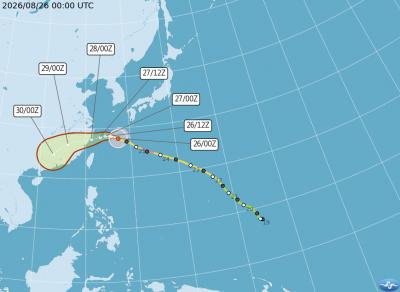
A sea warning for Typhoon Saudel, which has shifted to a more northerly track as it nears Taiwan, is expected early tomorrow, the Central Weather Administration (CWA) said today. As of this morning, Saudel was about 650km east-northeast of Taipei, moving west-northwest at 12kph with maximum sustained winds of 162kph, CWA data showed. Although Saudel remains a moderate typhoon, it has weakened and is expected to weaken further as it nears Taiwan due to unfavorable atmospheric and ocean conditions, CWA forecaster Lin Po-tung (林伯東) said. The storm is forecast to make its closest approach to Taiwan tomorrow and on Friday, Lin added. According to
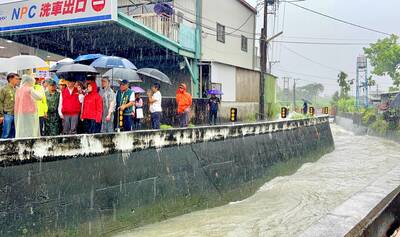
SEA WARNING EXPECTED: As atmospheric conditions are unfavorable for its development, the storm’s intensity is continuing to weaken, a CWA official said Typhoon Saudel is continuing to weaken and shift its path northward, with a sea warning expected to be issued this evening, the Central Weather Administration (CWA) said yesterday. The agency did not rule out issuing a land warning for outlying Lienchiang County (Matsu) tomorrow morning, although all storm warnings could be lifted by Friday night. Saudel is expected to be closest to Taiwan from tomorrow night to Friday, bringing localized heavy rain to northern and southern Taiwan, as well as central mountainous areas, the agency said. As of 2pm yesterday, the center of moderate Typhoon Saudel was about 890km east-northeast
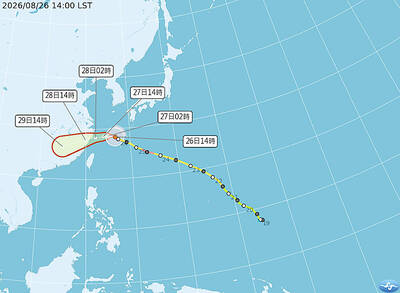
MODERATE TYPHOON: Localized heavy rain is forecast to hit central and southern Taiwan, the CWA said, adding that the storm would likely move away on Saturday A sea warning for Typhoon Saudel, which shifted to a more northerly track as it approached Taiwan, is likely early today, the Central Weather Administration (CWA) said yesterday. As of 2pm yesterday, the center of typhoon was about 630km northeast of Taipei, moving west-northwest at 14kph with maximum wind gusts of up to 162kph, CWA data showed. Saudel is a moderate typhoon and is expected to weaken as it nears Taiwan due to atmospheric and ocean conditions, CWA forecaster Lin Po-tung (林伯東) said. A sea warning indicates hazardous typhoon conditions in waters surrounding Taiwan within 24 hours, Lin said. The storm is forecast to


 RSS
RSS