


The Cabinet yesterday approved the first changes to the People with Disabilities Rights Protection Act (身心障礙者權益保障法) in 18 years, which aims to ensure the participation of people with disabilities in the policymaking process and improve accessibility.
The proposed amendments uphold disabled people’s right of representation in policy consultations, clarify services, build up infrastructure and enforce laws to protect them.
Forty-one articles were amended, nine were added and one was removed to align the law more closely with the Convention on the Rights of Persons with Disabilities.
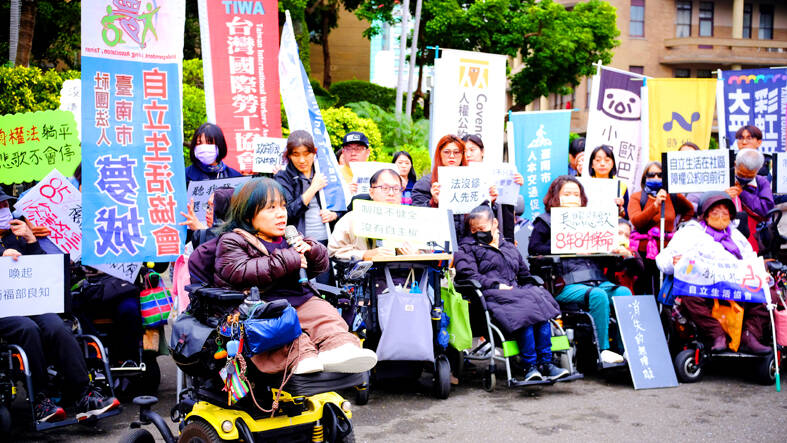
Photo: CNA
Social and Family Affairs Administration Acting Director Chou Tao-chun (周道君) said that under the new Article 50-1, necessary travel arrangements or supplementary personnel needed by those with physical or mental disabilities when participating in events may be provided through a personal assistant.
An ancillary law and other measures would be drafted to oversee the finer details of implementing that amendment, Chou said.
Article 16 of the draft adds the concept of “harassment,” which is more in line with what people with disabilities might say regarding certain acts that, while not obviously discriminatory, still affect the group in general, and for which they might demand compensation or restitution, Chou said.
The draft also states that representatives, and people with physical and mental disabilities should comprise half of the Executive Yuan’s Committee for the Promotion of the Rights of Persons with Disabilities.
People who have contravened laws could be banned from being nominated as a committee member for a period of time or for life, depending on the severity of their actions, the draft says.
If a facility that cares for or serves people with disabilities seriously contravenes the law, it would be fined, and its registered name and the name of its manager would be publicly disclosed, it says.
Should the facility’s infractions result in death, it and the manager would face heavier penalties, it added.
Meanwhile, Web sites and apps developed by the government, state-owned businesses and public bodies subsidized by the government must meet the standard government standards for barrier-free content, the amendment states.
Hospital and financial Web sites should comply with the same requirement, it adds.
Local governments must also implement improvement plans if they are found to lack streets, sidewalks and arcades that meet barrier-free policies, the amendment states.
Additionally, transportation policies and services should be revisited to develop rehabilitation buses and similar services, the amendment says.
Independent Living Association Taipei secretary-general Lin Chun-chieh (林君潔) said that while the details of the amendments warrant further discussion, as the act affects a large group of people across different social strata, the government’s willingness to listen to the public deserves appreciation.
Lin added that she hoped the amendments would be discussed in greater detail in the legislature and that it would be passed during this session.
Additional reporting by CNA
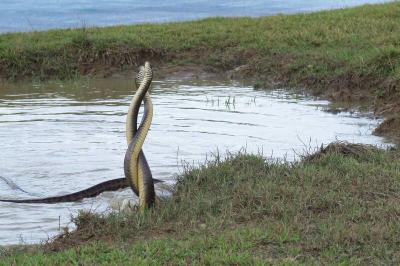
Kenting National Park service technician Yang Jien-fon (楊政峰) won a silver award in World Grand Prix Photography Awards Spring Season for his photograph of two male rat snakes intertwined in combat. Yang’s colleagues at Kenting National Park said he is a master of nature photography who has been held back by his job in civil service. The awards accept entries in all four seasons across six categories: architectural and urban photography, black-and-white and fine art photography, commercial and fashion photography, documentary and people photography, nature and experimental photography, and mobile photography. Awards are ranked according to scores and divided into platinum, gold and

More than half of the bamboo vipers captured in Tainan in the past few years were found in the city’s Sinhua District (新化), while other districts had smaller catches or none at all. Every year, Tainan captures about 6,000 snakes which have made their way into people’s homes. Of the six major venomous snakes in Taiwan, the cobra, the many-banded krait, the brown-spotted pit viper and the bamboo viper are the most frequently captured. The high concentration of bamboo vipers captured in Sinhua District is puzzling. Tainan Agriculture Bureau Forestry and Nature Conservation Division head Chu Chien-ming (朱健明) earlier this week said that the

The Chinese Nationalist Party (KMT) caucus yesterday said it opposes the introduction of migrant workers from India until a mechanism is in place to prevent workers from absconding. Minister of Labor Hung Sun-han (洪申翰) on Thursday told the Legislative Yuan that the first group of migrant workers from India could be introduced as early as this year, as part of a government program. The caucus’ opposition to the policy is based on the assessment that “the risk is too high,” KMT caucus secretary-general Lin Pei-hsiang (林沛祥) said. Taiwan has a serious and long-standing problem of migrant workers absconding from their contracts, indicating that

SPACE VETERAN: Kjell N. Lindgren, who helps lead NASA’s human spaceflight missions, has been on two expeditions on the ISS and has spent 311 days in space Taiwan-born US astronaut Kjell N. Lindgren is to visit Taiwan to promote technological partnerships through one of the programs organized by the US for its 250th national anniversary. Lindgren would be in Taiwan from Tuesday to Saturday next week as part of the US Bureau of Educational and Cultural Affairs’ US Speaker Program, organized to celebrate the 250th anniversary of the signing of the Declaration of Independence, the American Institute in Taiwan (AIT) said in a statement yesterday. Lindgren plans to engage with key leaders across the nation “to advance cutting-edge technological partnerships and inspire the next generation of scientists and engineers,”


 RSS
RSS