


The Executive Yuan today advanced amendments to the National Security Act (國家安全法) that would prohibit anyone from publicly advocating war against Taiwan or using non-peaceful means to eliminate the nation’s sovereignty, with those found guilty facing a maximum fine of NT$1 million (US$31,730).
The draft amendments state that safeguarding national security should extend to physical spaces within the Republic of China’s (ROC) territory, as well as cyberspace.
The amendments added provisions stipulating that no one can publicly advocate, promote or support a foreign country, the People’s Republic of China, Hong Kong, Macau or a foreign hostile force in launching a war against the ROC or using non-peaceful means to eliminate the ROC’s sovereignty through text, images, audio, speech, video, electromagnetic records or other methods.
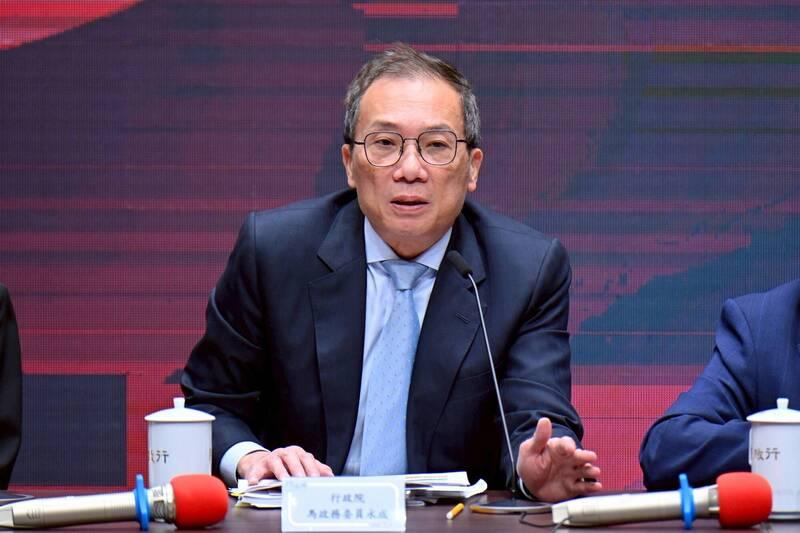
Photo courtesy of the Executive Yuan
Any pro-war speech that is considered in contravention of the act by the Ministry of the Interior after consultation with the Ministry of Justice, the Mainland Affairs Council and relevant agencies would be punishable by a fine of NT$100,000 to NT$1 million.
The amendments would also increase penalties by up to half for active-duty military personnel or civil servants who intentionally contravene the National Security Act.
Regarding online content involving the advocacy of war, the dissemination of false information harmful to national security, society, finance or economic stability, or political propaganda on behalf of the Chinese Communist Party, the draft added obligations for Internet service providers and Internet access providers to take measures as ordered, as well as requirements to preserve and provide relevant data, with contraventions punishable by fines of up to NT$1 million, the amendments state.
Non-compliance could result in orders for correction within a specified period, with repeated fines for continued contraventions, they state.
In cases where online content meets the above criteria and the circumstances are serious or immediate action is necessary to avert imminent danger, the Ministry of the Interior can directly order Internet access providers to halt domain resolution or restrict access, the amendments state.
Asked if the fines for pro-war speech were prompted by recent statements from Chinese spouses supporting unification by force, Minister Without Portfolio Ma Yung-cheng (馬永成) told a news conference after the Cabinet’s meeting today that the issue was partly related.
However, the government is primarily advancing the amendments based on international law, he said.
Citing Article 20-1 of the UN’s International Covenant on Civil and Political Rights, he said that any propaganda for war should be prohibited by law.
Administrative fines differ from criminal penalties, and the proposed amendments avoid the latter to protect freedom of speech, Minister Without Portfolio Lin Min-hsin (林明昕) told the news conference.
Private conversations at home or messages sent to family members would not constitute an offense, but repeatedly making such statements in a public manner accessible to everyone or in large group chats could be problematic, Lin said.
The provisions targeting online speech primarily aim to prevent ongoing dissemination, he added.
The amendments to the National Security Act focus on online content where the Internet Protocol address is overseas or the perpetrator is outside Taiwan, making it difficult to apprehend or punish them, he said.
However, disseminated illegal statements can still be restricted by the Ministry of Digital Affairs, he added.
The Ministry of Digital Affairs would take corresponding measures, such as restricting access or removing content, similar to existing mechanisms under laws covering child and youth protection and tobacco hazard prevention, Lin said.
Cases would be handled after receiving reports from the public or through proactive detection by authorities, he said, adding that the government “would not act as constant online police, patrolling nonstop.”
The Executive Yuan today approved draft amendments to four laws aimed at countering national security threats and "united front" tactics.
The four laws are the National Security Act (國家安全法), the Criminal Code of the Armed Forces (陸海空軍刑法), the Act of Military Service for Officers and Non-commissioned Officers of the Armed Forces (陸海空軍軍官士官服役條例) and the Veterans Assistance Act (國軍退除役官兵輔導條例).
The drafts are to be submitted to the Legislative Yuan for deliberation.
Additional reporting by Chung Li-hua

Yangmingshan National Park authorities yesterday urged visitors to respect public spaces and obey the law after a couple was caught on a camera livestream having sex at the park’s Qingtiangang (擎天崗) earlier in the day. The Shilin Police Precinct in Taipei said it has identified a suspect and his vehicle registration number, and would summon him for questioning. The case would be handled in accordance with public indecency charges, it added. The couple entered the park at about 11pm on Thursday and began fooling around by 1am yesterday, the police said, adding that the two were unaware of the park’s all-day live

Yangmingshan National Park’s Qingtiangang (擎天崗) nature area has gone viral after a park livestream camera observed a couple in the throes of intimate congress, which was broadcast live on YouTube, drawing large late-night crowds and sparking a backlash over noise, bright lights and disruption to wildlife habitat. The area’s livestream footage appeared to show a couple engaging in sexual activity on a picnic table in the park on Friday last week, with the uncensored footage streamed publicly online. The footage quickly spread across social media, prompting a tide of visitors to travel to the site to “check in” and recreate the

Fast food chain McDonald's is to raise prices by up to NT$5 on some products at its restaurants across Taiwan, starting on Wednesday next week, the company announced today. The prices of all extra value meals and sharing boxes are to increase by NT$5, while breakfast combos and creamy corn soup would go up by NT$3, the company said in a statement. The price of the main items of those meals, if ordered individually, would remain the same. Meanwhile, the price of a medium-sized lemon iced tea and hot cappuccino would rise by NT$3, extra dipping sauces for chicken nuggets would go up

Minister of Digital Affairs Lin Yi-ching (林宜敬) yesterday cited regulatory issues and national security concerns as an expert said that Taiwan is among the few Asian regions without Starlink. Lin made the remarks on Facebook after funP Innovation Group chief executive officer Nathan Chiu (邱繼弘) on Friday said Taiwan and four other countries in Asia — China, North Korea, Afghanistan and Syria — have no access to Starlink. Starlink has become available in 166 countries worldwide, including Ukraine, Malaysia, the Philippines and Vietnam, in the six years since it became commercial, he said. While China and North Korea block Starlink, Syria is not


 RSS
RSS