


The US government yesterday announced the potential sale of eight arms packages to Taiwan, including High Mobility Artillery Rocket Systems (HIMARS), anti-tank missiles and drones, at an estimated cost of US$11.1 billion.
It is the second announcement of arms sales to Taiwan by US President Donald Trump’s administration since he returned to the White House earlier this year, and the package is bigger than the first.
The US Department of State late yesterday announced the sales during a nationally televised address by Trump, who made scant mention of foreign policy issues and did not speak about China or Taiwan at all.
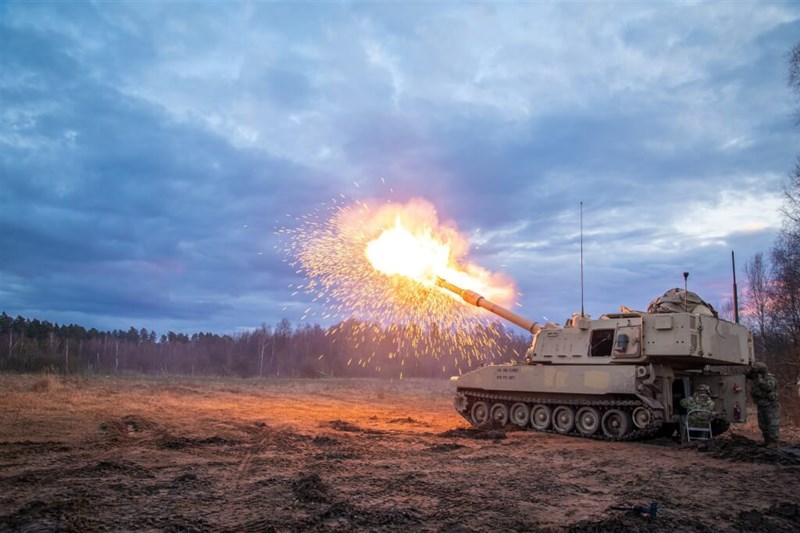
Photo taken from the US Department of War Web site
US-China tensions have ebbed and flowed during Trump’s second term, largely over trade and tariffs, but also over China’s increasing aggressiveness toward Taiwan.
The US Defense Security Cooperation Agency (DSCA) said that it had delivered the required certifications notifying the US Congress of the sales, following approval by the US Department of State.
The sales serve US “national, economic, and security interests by supporting the recipient’s continuing efforts to modernize its armed forces and to maintain a credible defensive capability,” the Department of State said in separate, but nearly identical statements.
“The proposed sale[s] will help improve the security of the recipient and assist in maintaining political stability, military balance, and economic progress in the region,” the statements said.
Under federal law, the US is obligated to assist Taiwan with its self-defense, a point that has become increasingly contentious with China, which has vowed to take Taiwan by force if necessary.
The Ministry of National Defense today said that it appreciated Washington's continued efforts to help Taiwan maintain adequate self-defense capabilities under the Taiwan Relations Act and the “six assurances.”
The packages are at the Congressional notification stage, which is where Congress has a chance to block or alter their sale, although Taiwan has widespread cross-party support, the ministry said in a statement.
Five of the eight arms packages — the M109A7 howitzers, HIMARS rocket systems, TOW 2B anti-tank missiles, anti-armor drones and FGM-148 Javelin anti-tank missiles — are covered by a NT$1.25 trillion (US$39.6 billion) special defense budget last month put forward by the Executive Yuan, which is pending lawmakers' review.
The latest arms package also includes Harpoon missile repair follow-on support; tube-launched, optically tracked, wire-guided missile systems; AH-1W helicopter spare and repair parts; and Tactical Mission Network Software, the DSCA said.
Weapons such as the HIMARS, which have been used extensively by Ukraine against Russian forces, could play an essential role in destroying an invading Chinese force, US-Taiwan Business Council president Rupert Hammond-Chambers said yesterday.
"This bundle of congressional notifications, a record in US security assistance for Taiwan, is a response to the threat from China and the demand from Mr Trump that partners and allies do more to secure their own defense," he said.
The announcement follows an unannounced trip by Minister of Foreign Affairs Lin Chia-lung (林佳龍) to the Washington area last week to meet US officials, said two sources who spoke to Reuters on condition of anonymity.
Reuters was unable to determine the agenda of the meetings and the Ministry of Foreign Affairs declined to comment.
Lin in a statement today thanked Washington for the proposed arms sale, saying that it demonstrates the US’ commitment to enhancing Taiwan's self-defense capabilities, as highlighted in the National Security Strategy Washington released earlier this month.
Presidential Office spokesperson Karen Kuo (郭雅慧) also expressed gratitude to the US, saying the move has again showed that Washington is implementing its security commitments to Taiwan under the Taiwan Relations Act and the “six assurances.”
The arms sale announcement highlights the close partnership between Taiwan and the US, as well as the high importance the US government places on Taiwan's defense needs, Kuo said.
Amid increasingly severe regional security challenges, Taiwan's defense budget for next year is set to exceed 3 percent of GDP in line with NATO standards, with expectations that it would reach 5 percent by 2030, she said, adding that the government has also proposed a special budget to enhance defense resilience and asymmetric warfare capabilities.
Taiwan would continue to advance national defense reforms, improve societal defense resilience, demonstrate its determination for self-defense and safeguard peace through strength, she said.
Peace and stability in the Taiwan Strait and the Indo-Pacific region are indispensable to international security and prosperity, she said, adding that Taiwan would continue to deepen partnerships with the US and other like-minded countries, firmly uphold the universal values of freedom and democracy, and maintain regional peace, stability and prosperous development.
President William Lai (賴清德) last month announced a NT$1.25 trillion special defense budget, with the funds to be allocated from next year to 2033, saying that there was "no room for compromise on national security."
The Democratic Progressive Party (DPP) legislative caucus today reminded lawmakers that part of the procurement list is included in the special defense budget, urging the Legislative Yuan to review it as soon as possible.
National security transcends party lines, DPP caucus chief executive Chung Chia-pin (鍾佳濱) said, adding that he hopes the ruling and opposition parties will in future conduct reviews in unison.
Every item in the arms purchase package, which was not easily approved by the US, is crucial to Taiwan's national defense security, he said.
China's foreign ministry did not immediately respond to a request for comment.
Meanwhile, 48 Chinese incursions into the waters and airspace around Taiwan were detected in the 24 hours before 6am today, with 26 craft crossing the median line of the Taiwan Strait and entering the nation’s northern, central, southwestern and eastern air defense identification zones, the Ministry of National Defense (MND) said.
The armed forces have “monitored the situation and employed [patrol] aircraft, navy ships and coastal missile systems in response to detected activities,” it said.

FUKUOKA SITUATION: Japanese media reported that the pathogen is expected to be identified by the summer, while the CDC downplayed the idea that it was hMPV A “mysterious cold-like illness” reported in Japan’s Fukuoka Prefecture does not seem to be a new disease, but Japanese authorities have been asked about the situation, the Centers for Disease Control (CDC) said yesterday. The Fukuoka Prefectural Medical Association on Wednesday told a news conference that a “mystery cold” that has become a hot topic on social media is “highly likely to be caused by some kind of viral infection,” Japan’s KBC News reported. “Many people are experiencing symptoms starting with a sore throat, followed by a runny nose, phlegm and a severe cough,” KBC News reported, citing association officials. Health authorities are

Nvidia Corp CEO Jensen Huang (黃仁勳) arrived in Taiwan yesterday ahead of upcoming AI and technology events, saying he plans to meet with clients and Taiwan Semiconductor Manufacturing Co Chairman C.C. Wei (魏哲家) during his visit. After landing at Taipei Songshan Airport, Huang posed for photos with fans and handed out Yakult drinks to reporters and supporters waiting at the scene, saying he has “a lot to do” during the trip. Asked about reports that Nvidia’s planned headquarters site in Taipei’s Beitou Shilin Technology Park could break ground on May 27, Huang said that if the company holds an event, he would

The Ministry of Finance this afternoon announced the winning numbers for the March-April uniform invoice lottery. The winning number for the NT$10 million (US$318,060) special prize is 19531471, and the winning number for the NT$2 million grand prize is 85941329. Three numbers were drawn for the NT$200,000 first prize: 07225810, 20231230 and 83518781. Those with receipts matching the last seven digits of any of the first-prize numbers will win the NT$40,000 second prize, while those matching the last six digits will win the NT$10,000 third prize. Those whose receipts match the last five digits of the first-prize numbers can claim the NT$4,000 fourth prize,

SIX SUBSIDIES: The monthly allowance for older farmers is to increase to NT$10,000, and NT$5,000 is to be given to homemakers under the national pension system, Lai said The government is to implement major welfare policies for disadvantaged groups, including raising the monthly allowance for older farmers to NT$10,000 and providing homemakers with NT$5,000 per month, President William Lai (賴清德) said yesterday. Lai made the remarks during a visit to Wangling Temple in Chiayi County, saying that the planned increases were being introduced amid economic growth and an increase in tax revenue. Touting a policy, in which the government plans to provide a monthly allowance of NT$5,000 for every child under the age of 18 in a bid to address Taiwan’s low birthrate, Lai said that if received for the


 RSS
RSS