


Ann Kao (高虹安) said she would return to her office today as Hsinchu mayor after applying to be reinstated in her job after a High Court ruling on Tuesday acquitted her of corruption charges, although she was found guilty of forgery.
Following the ruling, the Hsinchu City Government filed an application for her to be reinstated with the Ministry of the Interior and received the ministry’s approval yesterday.
Kao told reporters she was looking forward to returning to work at the mayoral office to fulfill her promises to city residents and implement the policies in her election platform.
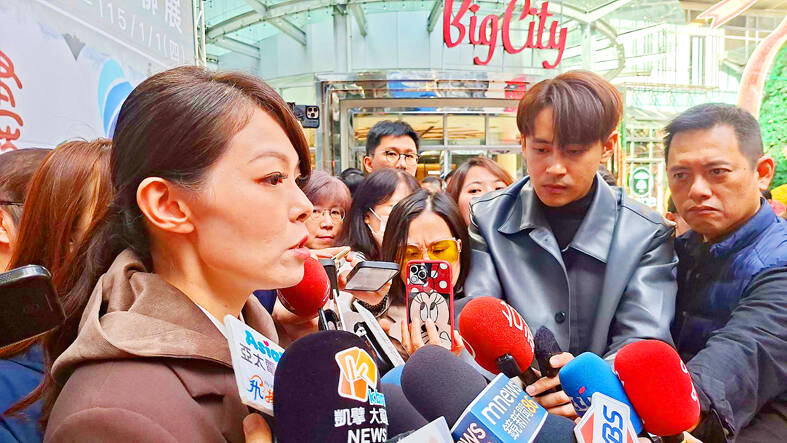
Photo: Hung Mei-hsiu, Taipei Times
Meanwhile, legal experts and politicians urged public prosecutors to appeal the case to the Supreme Court, citing double standards, wrongful application of the law and political consideration by the presiding judge.
“The High Court judge clearly sought to absolve Kao of criminal offenses on corruption and embezzling funds for office staffers. This ruling is contrary to past decisions in similar corruption cases, including at the Supreme Court and in lower-level courts,” Taiwan Forever Association deputy director Huang Di-ying (黃帝穎) said.
He cited the case of former DPP Taipei city councilor Tung Chung-yen (童仲彥), who was convicted of corruption for misappropriating NT$50,000 (US$1,679 at the current exchange rate) of state subsidies to pay for an office assistant. The High Court imposed a jail sentence in a second ruling in 2020. Tung was released on parole in October 2023.
High Court Judge Kuo Yu-chen (郭豫珍) presided over both Kao’s and Tung’s cases, Huang said.
“The ruling on Kao did not cite the same legal violations. It is evidently double standards by Judge Kuo to treat Kao’s case leniently,” Huang said.
The Taipei District Court in July last year convicted Kao of contravening the Anti-Corruption Act (貪污治罪條例) and the Criminal Code, on evidence of forgery, recording inflated assistant salaries and overtime pay claims, and obtaining NT$116,514 in illicit gains.
It handed her a seven-year and four-month prison sentence and resulting in the suspension from her job as mayor.
However, the High Court on Tuesday overturned the corruption conviction and only found her guilty of the charge of causing public officials to make false entries in official records, handing her a six-month jail term which can be commuted to a fine.
Huang said the ruling has stirred public anger, as the presiding judge has legitimized corruption and the illegal pocketing of public funds by elected officials, despite the evidence and testimony of office staffers of Kao misappropriating state funds for assistant wages and producing forged overtime pay claims to claim state subsidies for her personal use.
Pointing to Tung’s case, he asked how the two rulings could be so different.
Tung yesterday also spoke about the similarity of the two cases, accusing the judge of bias and making rulings based on political considerations.
Separately, DPP Legislator Wang Ting-yu (王定宇) yesterday accused Legislative Speaker Han Kuo-yu (韓國瑜) of providing a misleading explanation about state funds being used to pay for expenses and staffers’ wages when the information was requested by the High Court during Kao’s trial.
“The state funds are listed as fiscal budget items for paying the wages of personnel and the various expenses of legislative offices, but Han distorted that by saying that state subsidies are listed as ‘subsidies for legislators themselves,’ whereby each legislator can spend the funds on whatever they decide as appropriate. That led to Kao’s acquittal,” Wang said.

FUKUOKA SITUATION: Japanese media reported that the pathogen is expected to be identified by the summer, while the CDC downplayed the idea that it was hMPV A “mysterious cold-like illness” reported in Japan’s Fukuoka Prefecture does not seem to be a new disease, but Japanese authorities have been asked about the situation, the Centers for Disease Control (CDC) said yesterday. The Fukuoka Prefectural Medical Association on Wednesday told a news conference that a “mystery cold” that has become a hot topic on social media is “highly likely to be caused by some kind of viral infection,” Japan’s KBC News reported. “Many people are experiencing symptoms starting with a sore throat, followed by a runny nose, phlegm and a severe cough,” KBC News reported, citing association officials. Health authorities are

Nvidia Corp CEO Jensen Huang (黃仁勳) arrived in Taiwan yesterday ahead of upcoming AI and technology events, saying he plans to meet with clients and Taiwan Semiconductor Manufacturing Co Chairman C.C. Wei (魏哲家) during his visit. After landing at Taipei Songshan Airport, Huang posed for photos with fans and handed out Yakult drinks to reporters and supporters waiting at the scene, saying he has “a lot to do” during the trip. Asked about reports that Nvidia’s planned headquarters site in Taipei’s Beitou Shilin Technology Park could break ground on May 27, Huang said that if the company holds an event, he would

The Ministry of Finance this afternoon announced the winning numbers for the March-April uniform invoice lottery. The winning number for the NT$10 million (US$318,060) special prize is 19531471, and the winning number for the NT$2 million grand prize is 85941329. Three numbers were drawn for the NT$200,000 first prize: 07225810, 20231230 and 83518781. Those with receipts matching the last seven digits of any of the first-prize numbers will win the NT$40,000 second prize, while those matching the last six digits will win the NT$10,000 third prize. Those whose receipts match the last five digits of the first-prize numbers can claim the NT$4,000 fourth prize,
SIX SUBSIDIES: The monthly allowance for older farmers is to increase to NT$10,000, and NT$5,000 is to be given to homemakers under the national pension system, Lai said The government is to implement major welfare policies for disadvantaged groups, including raising the monthly allowance for older farmers to NT$10,000 and providing homemakers with NT$5,000 per month, President William Lai (賴清德) said yesterday. Lai made the remarks during a visit to Wangling Temple in Chiayi County, saying that the planned increases were being introduced amid economic growth and an increase in tax revenue. Touting a policy, in which the government plans to provide a monthly allowance of NT$5,000 for every child under the age of 18 in a bid to address Taiwan’s low birthrate, Lai said that if received for the


 RSS
RSS