


The Ministry of National Defense (MND) has allegedly awarded a security procurement deal to a tea company that has registered capital of only NT$100,000 (US$3,187), Chinese Nationalist Party (KMT) Legislator Wang Hung-wei (王鴻薇) told a news conference yesterday.
The tender, which was released by the ministry’s Navy Command Headquarters in 2022, and involved sensitive information related to cybersecurity and national security, was awarded to Kaohsiung-based Hong Zhang Tea, Wang said.
The company previously won a bid from the Legislative Yuan, but its request for payment was rejected after Legislative Speaker Han Kuo-yu (韓國瑜) found it had falsified bidding documents, she said.
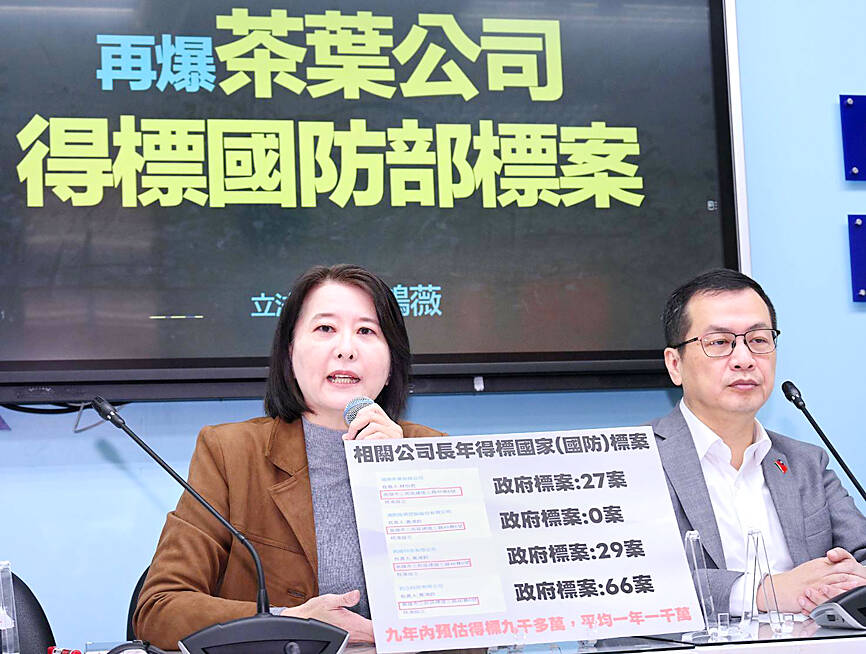
Photo: Fang Pin-chao, Taipei Times
The company sued the legislature in court, but lost, she said.
The company’s former responsible person, Huang Hung-chun (黃鴻鈞), has been involved in at least three cases of forged bidder eligibility and lawsuits against the Tainan National University of the Arts and the Ministry of Justice, in addition to the legislature, Wang said.
Huang was sued by the Ministry of Justice and sentenced, and he also lost the case against the university, she said.
Nevertheless, the vendor was not blacklisted and won a bid from the MND this year, Wang said.
The company has secured government contracts worth an average of NT$10 million per year over the past decade, she said, adding that at least nine of them were tenders from the defense ministry.
Huang also set up three other companies registered with the same address as Hong Zhang, including Jun Wei Technology and Jun Li Technology, she said.
KMT caucus secretary-general Lo Chih-chiang (羅智強) said that the companies continued to obtain defense or security deals from local government in southern or central Taiwan, as well as from central government agencies.
Jun Li Technology in 2018 won a tender released by the navy’s Zuoying Logistics and Support Headquarters for the maintenance of the Joint Conflict and Tactical Simulation war game system, government data showed.
“How could a war game system maintenance tender be awarded to a vendor with so many questionable records?” Wang said.
The ministry’s ability to ensure national security was questionable as it purchased explosives from a furniture company and ammunition from a shoe business, while paying a tea company to maintain a war game system, she said.
Wang was referring to procurement deals that had been awarded to Home-Max Furniture Trading and Big Stone International respectively.
Lo said that Hong Zhang Tea did not update its business information to include computer-related and cybersecurity operations until the end of 2022, the year before it won the security tender.
He called on the MND to investigate this and similar cases.
In other news, KMT Taoyuan City Councilor Ling Tao (凌濤), KMT spokeswoman Yang Chih-yu (楊智?) and KMT Youth League executive director Teng Kai-hsun (鄧凱勛) yesterday filed a complaint with the Taipei District Prosecutors’ Office against MND personnel involved in the procurement deals won by Home-Max and Big Stone, accusing them of corruption and misusing public power for personal profit.
Big Stone in a statement dismissed comments by Ling about its eligibility as a bidder for defense contracts, saying the claims had damaged its reputation.
The company has retained an attorney to file criminal and civil lawsuits against Ling and others involved, it said.
Big Stone’s bid to procure 5.56m cartridges was made in accordance with the Government Procurement Act (政府採購法) and based on its eligibility as an international trading company, it said.
Minister of National Defense Wellington Koo (顧立雄) again defended the tenders, saying that any qualified international trading company can submit a bid.
To ensure the company can fulfill the contract, winners of tenders must present an export permit and documentation identifying the original manufacturer by a set deadline, Koo said.
Additional reporting by Chen Yun and CNA

FUKUOKA SITUATION: Japanese media reported that the pathogen is expected to be identified by the summer, while the CDC downplayed the idea that it was hMPV A “mysterious cold-like illness” reported in Japan’s Fukuoka Prefecture does not seem to be a new disease, but Japanese authorities have been asked about the situation, the Centers for Disease Control (CDC) said yesterday. The Fukuoka Prefectural Medical Association on Wednesday told a news conference that a “mystery cold” that has become a hot topic on social media is “highly likely to be caused by some kind of viral infection,” Japan’s KBC News reported. “Many people are experiencing symptoms starting with a sore throat, followed by a runny nose, phlegm and a severe cough,” KBC News reported, citing association officials. Health authorities are

Nvidia Corp CEO Jensen Huang (黃仁勳) arrived in Taiwan yesterday ahead of upcoming AI and technology events, saying he plans to meet with clients and Taiwan Semiconductor Manufacturing Co Chairman C.C. Wei (魏哲家) during his visit. After landing at Taipei Songshan Airport, Huang posed for photos with fans and handed out Yakult drinks to reporters and supporters waiting at the scene, saying he has “a lot to do” during the trip. Asked about reports that Nvidia’s planned headquarters site in Taipei’s Beitou Shilin Technology Park could break ground on May 27, Huang said that if the company holds an event, he would

The Ministry of Finance this afternoon announced the winning numbers for the March-April uniform invoice lottery. The winning number for the NT$10 million (US$318,060) special prize is 19531471, and the winning number for the NT$2 million grand prize is 85941329. Three numbers were drawn for the NT$200,000 first prize: 07225810, 20231230 and 83518781. Those with receipts matching the last seven digits of any of the first-prize numbers will win the NT$40,000 second prize, while those matching the last six digits will win the NT$10,000 third prize. Those whose receipts match the last five digits of the first-prize numbers can claim the NT$4,000 fourth prize,
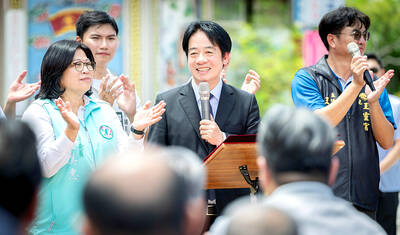
SIX SUBSIDIES: The monthly allowance for older farmers is to increase to NT$10,000, and NT$5,000 is to be given to homemakers under the national pension system, Lai said The government is to implement major welfare policies for disadvantaged groups, including raising the monthly allowance for older farmers to NT$10,000 and providing homemakers with NT$5,000 per month, President William Lai (賴清德) said yesterday. Lai made the remarks during a visit to Wangling Temple in Chiayi County, saying that the planned increases were being introduced amid economic growth and an increase in tax revenue. Touting a policy, in which the government plans to provide a monthly allowance of NT$5,000 for every child under the age of 18 in a bid to address Taiwan’s low birthrate, Lai said that if received for the


 RSS
RSS