


Democratic Progressive Party (DPP) lawmakers yesterday defended the government awarding a contract to import military-grade explosives to a company known for selling furniture.
Chinese Nationalist Party (KMT) legislators last week questioned Minister of National Defense Wellington Koo (顧立雄) after Tainan-based Home-Max Furniture Trading Ltd won a tender to import a batch of RDX, a powerful explosive material.
KMT lawmakers demanded that Koo today report to the legislature’s Foreign Affairs and National Defense Committee on the criteria and approval process for contractors.

Photo: CNA
DPP caucus chief executive Chung Chia-pin (鍾佳濱) said it was unnecessary to bring the minister back, as he already explained the process and the criteria the military follows.
“Businesses in Taiwan that qualify, regardless of their name or location, can participate in tender bids, as long as they can fulfill the terms, receive the export license and permits, can obtain business agreement with manufacturers, and obtain approval from the Ministry of Economic Affairs,” Chung said.
DPP Legislator Rosalia Wu (吳思瑤) said that more Taiwanese companies are needed to join the supply chain to bolster the nation’s domestic defense industry.
It is wrong to question a qualified contract bid based solely on the company’s original field of work, Wu said.
Most countries welcome domestic firms to pursue defense-related business to bolster local weapon production and enhance the nation’s military capabilities, she said.
She pointed to Taiwan’s Hocheng Corp and Swarovski of Austria, the US’ John Deere and South Korea’s Hanwha Group as prominent firms that expanded into supplying military components in their respective countries.
Wu said that opposition parties were maliciously attacking domestic defense contractors.
DPP caucus secretary-general Chen Pei-yu (陳培瑜) called the scrutiny of the Home-Max contract part of a ploy by the KMT and Taiwan People’s Party (TPP) to vilify certain businesses and contractors, under the guise of uncovering fraud or malpractice, hindering the companies from participating in defense procurement programs.
“The opposition parties are seeking to impede companies not affiliated with them, to prevent from joining the government’s efforts to develop a domestic defense industry,” Chen said. “Thereby the KMT and TPP can derail the government’s plan to develop the ‘T-Dome’ defense initiative, to sabotage efforts to upgrade the nation’s weapons system and undermine the military’s capabilities.”
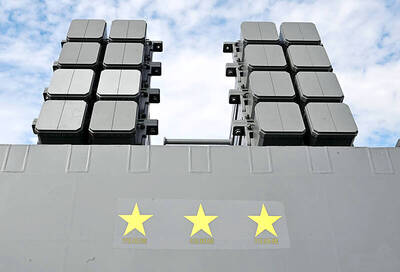
UPGRADE: The Kang Ding-class frigate is replacing its Chaparall missiles with Tien Chien II and Hua Yang VLS, which would provide it with long-range, 360° air defense Taiwan plans to produce 1,200 to 1,376 Hai Chien II missiles (海劍二, Sea Sword II) — also known as TC-2N — to serve as the standard air defense system of the navy’s surface combatant fleet, a source said yesterday. Last week, the Hai Chien II, the naval version of the Tien Kung II missile (天劍二, Sky Sword II), completed a live-fire test in waters off the National Chungshan Institute of Science and Technology’s Jiupeng facility (九鵬) in Pingtung County’s Manjhou Township (滿州). The MIM72 Chaparral and other dated air defense missiles that currently arm Taiwanese ships have inadequate range to combat Chinese

REASONS FOR TRAVEL: An assistant professor said that proposed amendments to penalize drivers if they used drugs overseas would not deter people from traveling People who operate a motor vehicle under the influence of marijuana would have their driver’s license revoked, even if they used the substance while overseas, the Ministry of Transportation and Communications said yesterday, citing proposed amendments to the Road Traffic Management and Penalty Act (道路交通管理處罰條例). The amendments would also authorize the government to revoke the licenses of people determined to have used Category 1 or Category 2 narcotics, even if they were not operating a vehicle while under the influence of drugs, as well as ban them from taking the license test for three years, the ministry said. People aged 18 or
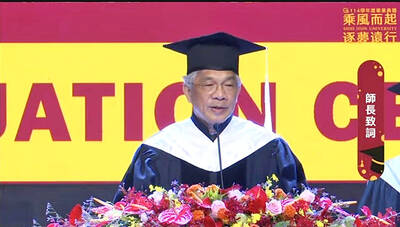
Shih Hsin University President Chen Ching-he (陳清河) yesterday issued a public apology for comments made in his commencement speech last week, stating that he has asked the school to suspend his duties and halt his wages for two months as a show of contrition. At the commencement ceremony on May 30, Chen said, “If you don’t manage your time well, or your own emotions, or your health, then I am telling every one of you — put a quick end to ‘you,’ because the world has no need for ‘you.’” The comments have sparked significant controversy online, and Chen through an open
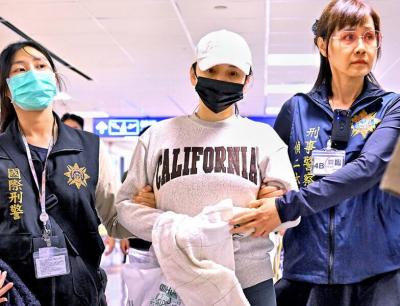
Johanne Liou (劉喬安), a Taiwanese woman who shot to unwanted fame during the Sunflower movement protests in 2014, returned to Taiwan last night after being deported from the US. She is to stand trial in Taiwan for charges involving embezzlement, fraud and drug crimes. The Criminal Investigation Bureau (CIB) said it took her into custody at Taiwan Taoyuan International Airport and would first question her before transferring her to the New Taipei District Prosecutors’ Office. She was arrested upon disembarking a flight from San Francisco that landed shortly before 7pm. Liou absconded to the US in 2019 after jumping bail


 RSS
RSS