


The Food and Drug Administration (FDA) yesterday announced 18 additional cosmetic products containing banned Sudan dyes, raising the number of affected items to 39, including several major international brands.
The FDA identified four new batches of raw materials containing the prohibited dye, linked to a Singapore-based supplier, which affected at least 12 local manufacturers downstream.
The newly listed products include the US-made NARS Light Reflecting Moisturizer and the South Korea-made Atomy Absolute Reset Balm, FDA Deputy Director-General Wang Te-yuan (王德原) told reporters.
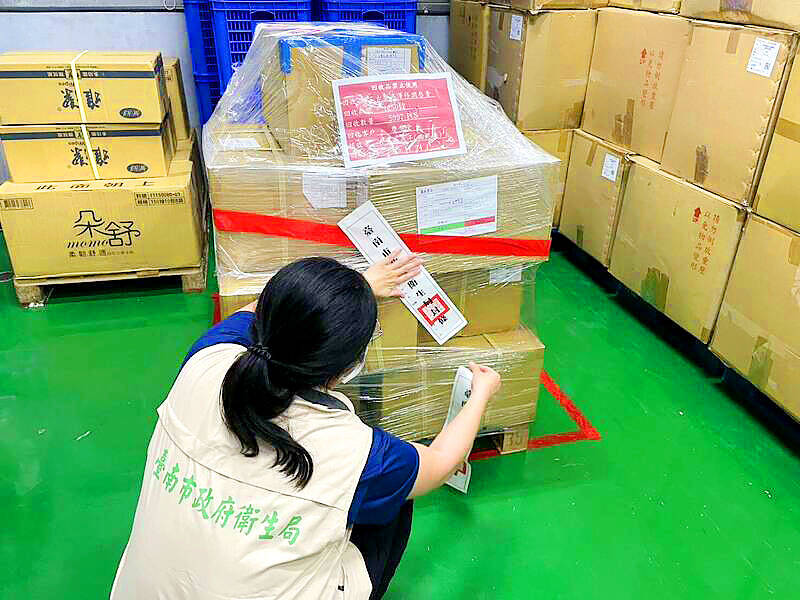
Photo courtesy of the Tainan City Government
The NARS product was voluntarily submitted for testing, and all 310 units have already been recalled, he said.
The Atomy balm was flagged during expanded inspections of imported cosmetics, and authorities have recalled 1,208 units so far.
The four raw material batches came from domestic importer Eho Co — three were found during ongoing inspections of downstream manufacturers, while one was reported by a local supplier, Wang said.
The case began in late October when the FDA intercepted China-made cosmetics suspected of containing Sudan dyes. Investigations traced the materials to the Singapore supplier, prompting notifications to local manufacturers and importers on Nov. 4.
The FDA on Nov. 14 inquired with the Singapore Health Sciences Authority, which said that the city-state prohibits Sudan dyes in cosmetics and would investigate, Wang said.
Under the Cosmetic Hygiene and Safety Act (化粧品衛生安全管理法), using banned dyes can result in fines ranging from NT$20,000 to NT$5 million (US$641 to US$160,246).
Addressing confusion that the products appear white and not red, Wang said that the raw material involved in these cases are a compound ingredient containing three kinds of plant extracts.
Whether it turns red depends on the formula and amount used, he added.

FUKUOKA SITUATION: Japanese media reported that the pathogen is expected to be identified by the summer, while the CDC downplayed the idea that it was hMPV A “mysterious cold-like illness” reported in Japan’s Fukuoka Prefecture does not seem to be a new disease, but Japanese authorities have been asked about the situation, the Centers for Disease Control (CDC) said yesterday. The Fukuoka Prefectural Medical Association on Wednesday told a news conference that a “mystery cold” that has become a hot topic on social media is “highly likely to be caused by some kind of viral infection,” Japan’s KBC News reported. “Many people are experiencing symptoms starting with a sore throat, followed by a runny nose, phlegm and a severe cough,” KBC News reported, citing association officials. Health authorities are

Nvidia Corp CEO Jensen Huang (黃仁勳) arrived in Taiwan yesterday ahead of upcoming AI and technology events, saying he plans to meet with clients and Taiwan Semiconductor Manufacturing Co Chairman C.C. Wei (魏哲家) during his visit. After landing at Taipei Songshan Airport, Huang posed for photos with fans and handed out Yakult drinks to reporters and supporters waiting at the scene, saying he has “a lot to do” during the trip. Asked about reports that Nvidia’s planned headquarters site in Taipei’s Beitou Shilin Technology Park could break ground on May 27, Huang said that if the company holds an event, he would

The Ministry of Finance this afternoon announced the winning numbers for the March-April uniform invoice lottery. The winning number for the NT$10 million (US$318,060) special prize is 19531471, and the winning number for the NT$2 million grand prize is 85941329. Three numbers were drawn for the NT$200,000 first prize: 07225810, 20231230 and 83518781. Those with receipts matching the last seven digits of any of the first-prize numbers will win the NT$40,000 second prize, while those matching the last six digits will win the NT$10,000 third prize. Those whose receipts match the last five digits of the first-prize numbers can claim the NT$4,000 fourth prize,
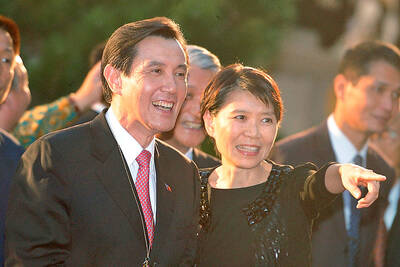
Former president Ma Ying-jeou (馬英九) yesterday expressed “shock and regret” over a statement issued by his wife without his consent, and rejected her assertion that his eldest sister, Ma Yi-nan (馬以南), would manage his medical care or act as his spokesperson amid an ongoing embezzlement probe into his foundation. Ma Ying-jeou in a statement said he was shocked by a statement by his wife, Chou Mei-ching (周美青), regarding his affairs. Ma Yi-nan “must not” be in charge of his healthcare and other personal affairs, nor can she be allowed to represent the Ma family, the former president said. He said he was also


 RSS
RSS