


A Ministry of Education program to develop technologies that can replace animal testing has so far funded 77 courses and trained 2,600 students across six partner universities.
The program subsidizes schools to develop courses on non-animal alternative models, including 3D mapping, digital imaging, virtual and augmented realities and organ-on-a-chip technologies.
Many countries consider finding alternatives to animal testing crucial to meet the challenges of developing new drugs.
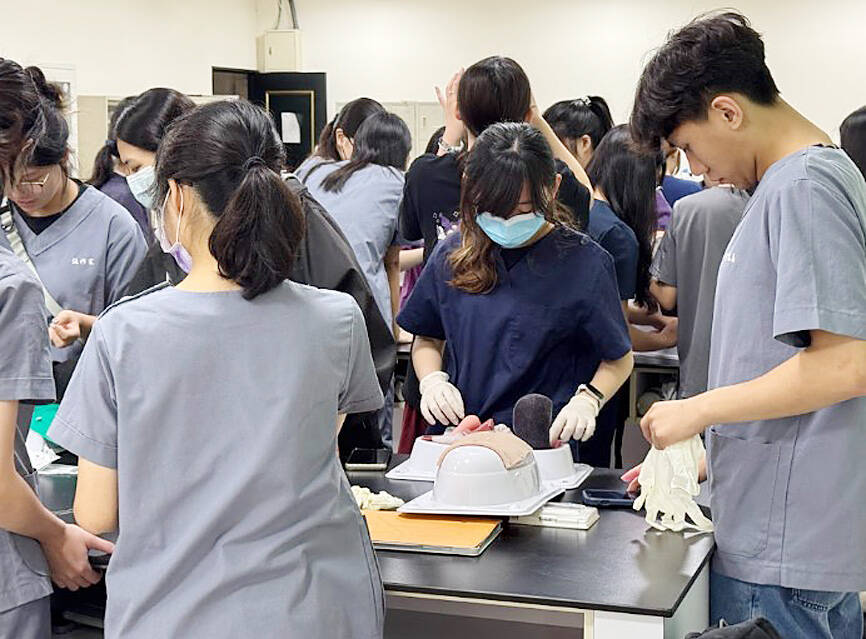
Photo courtesy of National Chung Hsing University
In Taiwan, 17.95 million laboratory animals were used in 2023, according to a Ministry of Agriculture report released in October last year on laboratory animals.
Excluding embryos, that number was more than 1.12 million, a decrease of 3.45 percent from 2022, the report said.
More than 16.46 million chicken embryos were used, the most of any animal, and more than 670,000 rodents were used, with mice being the most common, it said.
The ministry’s program, which runs from last year to 2027, is headquartered at National Chung Hsing University and involves National Taiwan University, National Central University, National Cheng Kung University, National Pingtung University of Science and Technology and National Chiayi University, Department of Information and Technology Education Director Chang Pao-li (張寶儷) said.
The program emphasizes replacement, reduction and refinement, known as the “Three Rs” of animal experimentation.
It funds the six schools to offer courses that teach alternative methods to animal testing and the ethics of animal testing, and even helps students find related internships, Chang said.
There are 77 such courses and about 2,600 students have participated in the program, he said.
One course covers how virtual and augmented reality can replicate surgical procedures without the need for live animals, while another trains students to culture in vitro cell models.
People are increasingly paying attention to animal welfare globally, said Wu Pei-hua (吳佩華), a team leader at the National Center for Biomodels.
Regulations and supporting measures to reduce animal testing are more widespread in Europe and the US than in Taiwan, Wu said.
She said that in 2022, the Executive Yuan set up an inter-agency platform focused on developing technologies that can replace animal testing and implementing the Three Rs.
Many animals die in the process of testing a single new drug, which requires control and test groups, and repeated experiments to determine dosage, each one of which involves about 72 animals, she said.
While safety tests for cosmetics and skin care products used to involve rabbits and live tissue from other animals, today this has progressed to using skin tissue grown through cell cultures, paving the way for organ-on-a-chip technologies, she said.
The center uses liver organ chips from the US instead of lab mice, as the chips use human liver cells, which more closely replicate the human response than mice, Wu said.
However, these chips lack the ability to assess the response of the entire organism, so alternative methods to animal testing often integrate other technologies to increase accuracy, she said.

The Ministry of Finance this afternoon announced the winning numbers for the March-April uniform invoice lottery. The winning number for the NT$10 million (US$318,060) special prize is 19531471, and the winning number for the NT$2 million grand prize is 85941329. Three numbers were drawn for the NT$200,000 first prize: 07225810, 20231230 and 83518781. Those with receipts matching the last seven digits of any of the first-prize numbers will win the NT$40,000 second prize, while those matching the last six digits will win the NT$10,000 third prize. Those whose receipts match the last five digits of the first-prize numbers can claim the NT$4,000 fourth prize,

SIX SUBSIDIES: The monthly allowance for older farmers is to increase to NT$10,000, and NT$5,000 is to be given to homemakers under the national pension system, Lai said The government is to implement major welfare policies for disadvantaged groups, including raising the monthly allowance for older farmers to NT$10,000 and providing homemakers with NT$5,000 per month, President William Lai (賴清德) said yesterday. Lai made the remarks during a visit to Wangling Temple in Chiayi County, saying that the planned increases were being introduced amid economic growth and an increase in tax revenue. Touting a policy, in which the government plans to provide a monthly allowance of NT$5,000 for every child under the age of 18 in a bid to address Taiwan’s low birthrate, Lai said that if received for the
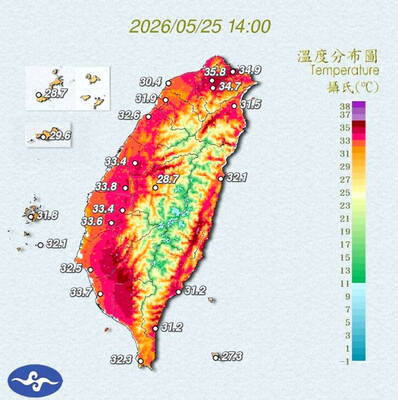
STAY COOL: The HPA recommended that people stay hydrated, use air-conditioning or fans while indoors, wear loose-fitting clothes and walk in the shade while outdoors Employers must implement measures such as installing cooling equipment, and providing drinking water and rest breaks for outdoor workers starting from Monday next week, the Taipei Department of Labor said on Sunday. Employers who fail to comply could face fines of NT$30,000 to NT$300,000 under the Occupational Safety and Health Act (職業安全衛生法), the department said. Businesses in Taipei employing fewer than 100 workers, as well as registered self-employed workers with labor insurance coverage, could receive on-site assessments and guidance from occupational safety consultants to help them apply for central government subsidies to implement or improve heat-protection measures, it said. Under the Ministry of

NATIONAL SECURITY: Authorities are working to confirm the identities of the military personnel involved and investigating possible illegal conduct and regulatory violations Authorities are probing possible national security implications after Kinmen police and immigration officers on Sunday found a Chinese woman allegedly posing as a tourist while engaging in prostitution involving more than 10 military personnel. The woman, surnamed Chen (陳), has since been deported, authorities said, adding that investigators are still working to confirm the identities of those implicated, as the records only listed code names and aliases. The case stemmed from a report received by the Kinmen District Prosecutors’ Office on Friday last week from the Jinhu Precinct of the Kinmen County Police Bureau. On Sunday, police, along with the National Immigration


 RSS
RSS