


Flying over the blue waters off Taiwan’s east coast, a light aircraft equipped with a powerful US-made radar slung under its belly tracks Chinese warships, collecting data that its operator is keen to provide to Taipei’s security forces.
Small Taiwanese operator Apex Aviation, better known for pilot training and charter flights, is pitching the surveillance flights to a government that has started engaging civilian firms in developing new technologies for its “whole of society resilience” initiative.
The government has invited businesses, research groups and other organizations to take on more active roles, including backing up communications and logistics, shoring up cyberdefenses, and potentially contributing to surveillance and intelligence-gathering.
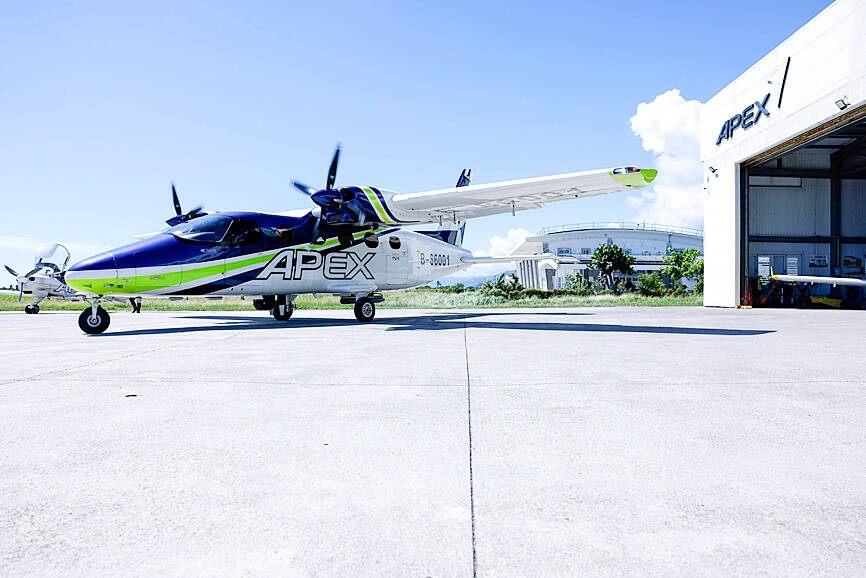
Photo: Ann Wang, Reuters
While common in countries such as the US, this joint military-civilian approach is new for Taiwan, whose armed forces are increasingly hard-pressed responding to daily Chinese activities in the skies and waters near the nation.
Taipei has said it aims to boost defense spending to 5 percent of GDP by 2030 and would introduce a US$40 billion supplementary budget, including “significant” new US arms purchases.
Apex is seeking a role in that build-up, but unlike companies that have received defense contracts so far, the airline wants to run its surveillance operation in-house, while remaining open to transferring equipment to authorities.
“These Chinese drills are happening more and more frequently, getting closer and closer. That’s what creates that sense of urgency. If we don’t jump in now, we might not even get the chance later,” Apex chairman Wilson Kao (高健祐) told reporters.
Apex declined to give estimates on potential revenue from such a deal.
The Ministry of National Defense has so far been cautious about external partners, telling reporters that it is able to effectively monitor Chinese activities and has no plans for cooperation.
However, it said it was open to new ideas.
“The ministry welcomes discussions on public-private collaboration to strengthen national defense build-up,” it said in a statement.
The Coast Guard Administration said that it is working to boost its own reconnaissance capacity and would prioritize drones before gradually expanding the effort to include crewed aircraft.
Apex has spent more than NT$400 million (US$12.8 million) to convert an 11-seater Italian-made Tecnam P2012 Traveller propeller plane into a reconnaissance aircraft equipped with a US-made synthetic aperture radar under its fuselage.
The company wants to feed data from the radar, which can detect objects as small as 30cm by 30cm, to Taiwan’s military and the coast guard as it tracks Chinese ships near the nation.
The business opportunity goes beyond Taiwan.
Apex said it could also market the relatively low-cost patrol service to friendly governments in the region that monitor Chinese activity, adding that it can quickly build a reconnaissance fleet with aircraft and drones.
Experts said authorities must establish a legal basis to allow civilian aircraft to engage in reconnaissance and also raised concerns about whether they would be made vulnerable to Chinese forces.
“Patrol aircraft involves the use of enforcement. Whether enforcement can be handed off to the private sector is a matter of legal debate,” said Su Tzu-yun (蘇紫雲), a research fellow at the Institute for National Defense and Security Research.
The cost of flying a light aircraft on a reconnaissance mission could be as low as one-10th of a military plane.
While Apex only operates in Taiwanese air space, one of its medical charter flights to Kinmen County was repeatedly approached by Chinese military planes for three consecutive days in June.
The incident, condemned by Taipei, raised concerns about the safety of civilian aircraft facing China’s stepped up “gray zone” harassment tactics.
Kao said that Apex’s board had deliberated potential risks before taking on the project.
“I’m just doing the right thing. I’m just steadily moving forward. And I won’t back down just because of any harassment,” he said at Taitung Airport.
Apex has been buoyed by a growing government push for companies with limited or no defense pedigree to develop products for military use. One of the initiative’s biggest highlights is a new generation of sea drones developed by remote control model car, aircraft and boat producer Thunder Tiger.
The company’s SeaShark 800 drone can carry 1.2 tonnes of explosives and travel up to 500km. The craft featured prominently at a summer “beauty show” at which operators offered their wares to Taiwan’s military.
One senior security official said that joint military-civilian initiatives were an idea the government needed to take seriously.
“The operational stress on troops is extremely high. The communist military is creating new forms of pressure, so we must develop new approaches to counter them,” the official said.

NATIONAL SECURITY: Authorities are working to confirm the identities of the military personnel involved and investigating possible illegal conduct and regulatory violations Authorities are probing possible national security implications after Kinmen police and immigration officers on Sunday found a Chinese woman allegedly posing as a tourist while engaging in prostitution involving more than 10 military personnel. The woman, surnamed Chen (陳), has since been deported, authorities said, adding that investigators are still working to confirm the identities of those implicated, as the records only listed code names and aliases. The case stemmed from a report received by the Kinmen District Prosecutors’ Office on Friday last week from the Jinhu Precinct of the Kinmen County Police Bureau. On Sunday, police, along with the National Immigration

GLOBALGIVING: ‘ Caving to external pressure is not acceptable for an organization that has cultivated justice reform and human rights for 30 years,’ one NGO said A slew of non-government organizations (NGOs) have withdrawn from the GlobalGiving fundraising platform after it announced it would use “Chinese Taipei” instead of “Taiwan” from next month. The Taiwan Good Rice Association wrote on Facebook on Friday that it was informed on April 28 via a teleconference call of the change, which was made because the platform wanted to operate in China. Taiwan Good Rice is to terminate all cooperative relationships with GlobalGiving in response to the platform’s “unilateral and non-negotiable” decision to remove references to Taiwan, the NGO said. “Taiwan is in the official name of Taiwan Good Rice Association and the

HEAVY WEATHER: Typhoon Jangmi is due to crash straight into the Ryukyus as airlines look to shift flights to larger aircraft or cancel flights to Okinawa entirely Taiwan’s international air carriers announced flight adjustments over the weekend as Typhoon Jangmi is forecast to hit the Ryukyu Islands today and tomorrow. The Central Weather Administration (CWA) upgraded Jangmi from a tropical storm to a typhoon at 8am yesterday, with the eye located 580km south of Naha city. It was moving north at 19kph. Today, China Airlines’ CI-120, CI-121, CI-122 and CI-123 flights between Taoyuan and Naha, Okinawa, have been canceled as well as CI-132 and CI-133 between Kaohsiung and Naha. EVA Air’s BR-112, BR-113, BR-186 and BR-185 flights between Taoyuan and Naha are also canceled. Low-cost carrier Tigerair Taiwan canceled IT-230,

REASONS FOR TRAVEL: An assistant professor said that proposed amendments to penalize drivers if they used drugs overseas would not deter people from traveling People who operate a motor vehicle under the influence of marijuana would have their driver’s license revoked, even if they used the substance while overseas, the Ministry of Transportation and Communications said yesterday, citing proposed amendments to the Road Traffic Management and Penalty Act (道路交通管理處罰條例). The amendments would also authorize the government to revoke the licenses of people determined to have used Category 1 or Category 2 narcotics, even if they were not operating a vehicle while under the influence of drugs, as well as ban them from taking the license test for three years, the ministry said. People aged 18 or


 RSS
RSS