


Taiwan will work with democratic partners to address challenges to global democracy, and would not allow any person or power, including external autocratic powers, to deprive it of its democracy and its freedom, President William Lai (賴清德) said at the National Human Rights Museum in New Taipei City yesterday.
Taiwan understands the value of freedom and democracy better than anyone, especially as authoritarianism seeks to expand globally and threaten democracies worldwide, Lai told an event to mark World Human Rights Day, which is on Wednesday.
Taiwan is described as the “lighthouse of democracy in Asia,” Lai said.
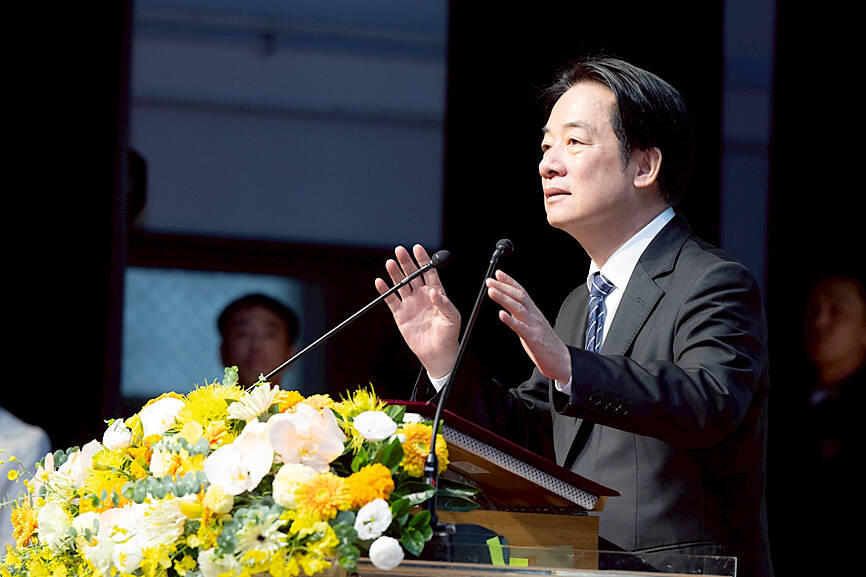
Photo: Screen grab from the Presidential Office’s Flickr page
The nation belongs to Taiwanese, and only by bolstering national security can Taiwan’s human rights and freedom continue to be protected, he said.
Taiwan cannot return to martial law, he said, adding that former presidents Chen Shui-bian (陳水扁) and Tsai Ing-wen (蔡英文) backed human rights in Taiwan in accordance with international standards.
Lai said that his administration would strive to restore the truth about Taiwan’s history, as the truth can help harmonize society and enable future governments to avoid the mistakes of previous administrations.
The government would also preserve sites of injustice and include them in education material so that young people would understand and cherish Taiwan’s hard-won democracy, he said.
Lai said that his administration would continue to seek justice for people who faced hardship or died during the Martial Law period, adding that the government has issued 4,000 restoration of honor certificates to such people or their families.
The certificates would not restore lost lives or time lost in prison, but they show that the government is willing to shoulder responsibility and admit that it was in the wrong, he said.
Transitional justice is not about the past, as it would define what kind of country Taiwan will become, he said, adding that the government would continue to work with civic groups to prompt transitional justice and human rights.
Taiwan is willing to share its experience in resisting authoritarianism with those living under the shadow of oppression and like-minded democratic partners, which would show the world that Taiwan is committed to democracy, and that it stands by peace, human rights and the rule of law, Lai said.
Minister of Culture Li Yuan (李遠) told the event that his ministry would promote Taiwanese films to audiences in Europe to spread the word regarding the nation’s transitional justice efforts and emphasis on human rights issues.
Human rights-related films that won awards at the Taiwan International Human Rights Film Festival would be highlighted, Li said.
The ministry would also continue investigations into sites of injustice and is accepting applications to designate places as areas with transitional justice significance, he said.
The Chiang Kai-shek Memorial Hall in Taipei hosted part of the film festival, playing Hoklo (also known as Taiwanese)-language films to spread awareness of human rights and Taiwan’s embrace of the concept, he said.
For the entire year, the hall has hosted the Flowers of Freedom exhibition, which shows Taiwan’s progress from the Martial Law period to the current day, he added.
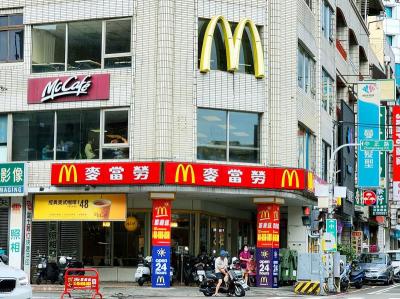
Fast food chain McDonald's is to raise prices by up to NT$5 on some products at its restaurants across Taiwan, starting on Wednesday next week, the company announced today. The prices of all extra value meals and sharing boxes are to increase by NT$5, while breakfast combos and creamy corn soup would go up by NT$3, the company said in a statement. The price of the main items of those meals, if ordered individually, would remain the same. Meanwhile, the price of a medium-sized lemon iced tea and hot cappuccino would rise by NT$3, extra dipping sauces for chicken nuggets would go up
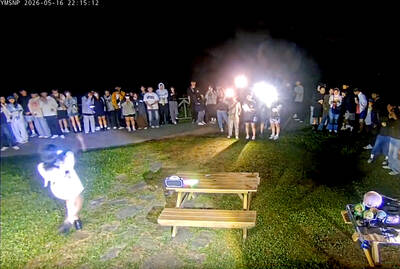
Yangmingshan National Park’s Qingtiangang (擎天崗) nature area has gone viral after a park livestream camera observed a couple in the throes of intimate congress, which was broadcast live on YouTube, drawing large late-night crowds and sparking a backlash over noise, bright lights and disruption to wildlife habitat. The area’s livestream footage appeared to show a couple engaging in sexual activity on a picnic table in the park on Friday last week, with the uncensored footage streamed publicly online. The footage quickly spread across social media, prompting a tide of visitors to travel to the site to “check in” and recreate the

Minister of Digital Affairs Lin Yi-ching (林宜敬) yesterday cited regulatory issues and national security concerns as an expert said that Taiwan is among the few Asian regions without Starlink. Lin made the remarks on Facebook after funP Innovation Group chief executive officer Nathan Chiu (邱繼弘) on Friday said Taiwan and four other countries in Asia — China, North Korea, Afghanistan and Syria — have no access to Starlink. Starlink has become available in 166 countries worldwide, including Ukraine, Malaysia, the Philippines and Vietnam, in the six years since it became commercial, he said. While China and North Korea block Starlink, Syria is not
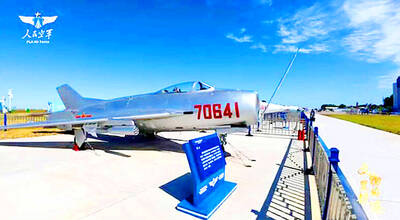
GROUNDED: A KMT lawmaker proposed eliminating drone development programs and freezing funding for counterdrone systems, despite China’s adoption of the technology China has deployed attack drones at air bases near the Taiwan Strait in a strategy aimed at overwhelming Taiwan’s air defense systems through saturation attacks, the Mainland Affairs Council (MAC) said. The council’s latest quarterly report on China said that satellite imagery and open-source intelligence indicate that the Chinese People’s Liberation Army (PLA) had converted retired J-6 fighter jets into J-6W drones, which the PLA has stationed at six air bases near Taiwan, five in China’s Fujian Province and one in Guangdong Province. The report cited J. Michael Dahm, a senior fellow at the US-based Mitchell Institute, as saying that China has


 RSS
RSS