


Taiwanese scientists have hatched the eggs of Penghu Island octopuses under lab conditions, in a potential breakthrough for artificially breeding the endangered species.
The cephalopods, designated octopus sp. TW-10 — which researchers in 2006 identified as a previously undocumented species — is threatened by population decline from overfishing, the National Penghu University of Science and Technology said in a statement last week.
The miniature octopuses are a scientific mystery, famous for being seen almost exclusively during spawning, which takes place between March 29 and April 12, said Lee Meng-fang (李孟芳), an associate professor of aquaculture at the university.
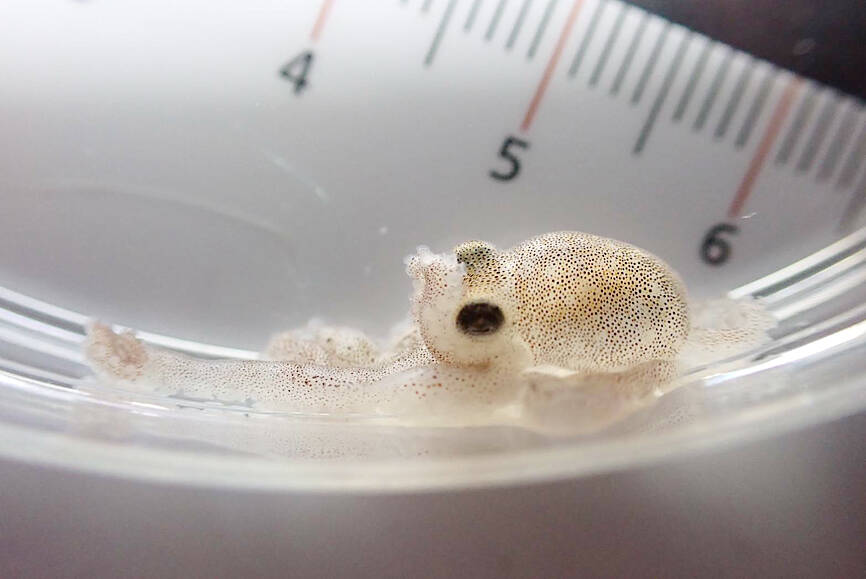
Photo courtesy of Lee Meng-fang
The species’ short lifespan of about a year and its female members’ habit of retreating into the ocean’s depths immediately following mating make the octopuses difficult to observe or study, he said.
The program to breed the octopuses in captivity, which took a decade to achieve results, utilized specimens captured during the spring spawning season, he said.
Female octopuses of the species carry only about 100 of the tiny, 16mm-long eggs, compared with other small cephalopods that lay thousands of eggs at a time, Lee said.
No eggs were documented until the Penghu branch of the Fisheries Research Institute found four caught in the filter of a tank, he added.
Female octopuses of the species carry inseminated eggs internally for between three and four months, then lay clutches of eggs that they protect for three more months, he said, adding that this gestation period takes up almost half of the octopuses’ life cycle.
The research found that female octopuses are highly sensitive to light and other interference when guarding their eggs, often preferring to dispose of the eggs if they are disturbed, he said.
This suggests that light pollution in the seas around Penghu might have contributed to the decline of the octopus population, Lee said.
The study produced 30 octopus larvae, which matured rapidly and attached themselves to the simulated ocean floor as soon as they hatched, bypassing the planktonic phase of normal octopods, he said.
Preliminary success achieved in the captive breeding program could allow the octopuses to be farmed throughout their lifecycle for food, similar to the sea urchins currently being cultivated in Penghu, he said.

FUKUOKA SITUATION: Japanese media reported that the pathogen is expected to be identified by the summer, while the CDC downplayed the idea that it was hMPV A “mysterious cold-like illness” reported in Japan’s Fukuoka Prefecture does not seem to be a new disease, but Japanese authorities have been asked about the situation, the Centers for Disease Control (CDC) said yesterday. The Fukuoka Prefectural Medical Association on Wednesday told a news conference that a “mystery cold” that has become a hot topic on social media is “highly likely to be caused by some kind of viral infection,” Japan’s KBC News reported. “Many people are experiencing symptoms starting with a sore throat, followed by a runny nose, phlegm and a severe cough,” KBC News reported, citing association officials. Health authorities are

Nvidia Corp CEO Jensen Huang (黃仁勳) arrived in Taiwan yesterday ahead of upcoming AI and technology events, saying he plans to meet with clients and Taiwan Semiconductor Manufacturing Co Chairman C.C. Wei (魏哲家) during his visit. After landing at Taipei Songshan Airport, Huang posed for photos with fans and handed out Yakult drinks to reporters and supporters waiting at the scene, saying he has “a lot to do” during the trip. Asked about reports that Nvidia’s planned headquarters site in Taipei’s Beitou Shilin Technology Park could break ground on May 27, Huang said that if the company holds an event, he would

The Ministry of Finance this afternoon announced the winning numbers for the March-April uniform invoice lottery. The winning number for the NT$10 million (US$318,060) special prize is 19531471, and the winning number for the NT$2 million grand prize is 85941329. Three numbers were drawn for the NT$200,000 first prize: 07225810, 20231230 and 83518781. Those with receipts matching the last seven digits of any of the first-prize numbers will win the NT$40,000 second prize, while those matching the last six digits will win the NT$10,000 third prize. Those whose receipts match the last five digits of the first-prize numbers can claim the NT$4,000 fourth prize,

Taiwan Travelogue (臺灣漫遊錄), which earlier this week became the first Taiwanese novel to win the International Booker Prize, is to be adapted into a television series through a Taiwan-Japan coproduction, producer Chang Chen-yu (張辰漁) said yesterday. Chang, a producer at World Softest Production Film Co, wrote on Facebook that the company had been searching for projects with international appeal that retain a strong Taiwanese identity after colleagues and Japanese partners strongly recommended the novel. After reading the book, Chang said he immediately decided to pursue the screen rights. “A great story has the power to transcend time and borders, and connect countless people,”


 RSS
RSS