


Taiwan should reduce its dependence on China for rare earth supplies to safeguard its semiconductor industry, the Australia New Zealand Chamber of Commerce in Taiwan (ANZCham Taiwan) said on Wednesday, suggesting Australia as an alternative.
In its white paper for this year, the chamber said that Taiwan's chip sector is vulnerable because more than 95 percent of its rare earth imports come from China.
Taiwan imports about 3,000 tonnes of rare earth elements annually for manufacturing purposes while producing no rare earth raw materials domestically, and only one or two domestic companies are involved in refining or processing the elements, the report said.
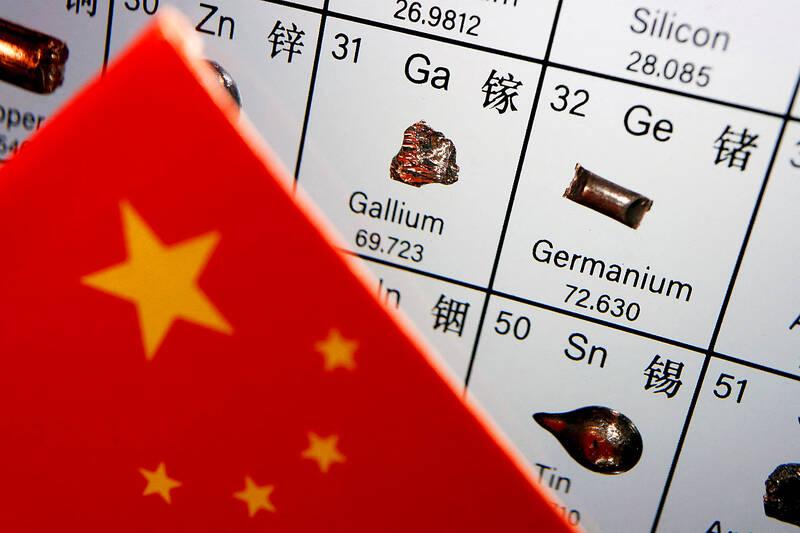
Photo: Reuters
"In short, Taiwan’s critical mineral imports are highly concentrated in one supply source, creating a potential single point of failure," the report said.
Citing China's 2023 export controls on gallium that triggered a 27 percent surge in global prices for the critical material for advanced chips, ANZCham Taiwan said that Taiwan should diversify its supply sources to bolster industrial resilience.
The chamber recommended that Taiwan build a strategic partnership with Australia, which is home to the world's largest lithium mine and the country with the largest share of rare earth mining outside China.
It proposed an alternative trilateral framework that also involved Japan, given its advanced processing capabilities and long-standing status as one of Australia's major minerals investors and customers.
However, it is debatable whether that advice is feasible, as other countries, such as the US, have struggled to stem their reliance on China's rare earths and are aggressively seeking alternatives.
It would take Washington years to really replace China's supplies, in part because of how far behind it and other countries are in building refining capacity, a New York Times report said.
China dominates the sector so thoroughly because of its willingness to tolerate a refining process that consumes energy and is environmentally unfriendly, Chung-hua Institution for Economic Research President Lien Hsien-ming (連賢明) said early last month.
"Many countries with the mines are thus reluctant to build their rare earth industry. Meanwhile, China has managed to destroy its competitors when seeing other countries try to run their own businesses," he said.
Responding to China's stricter rare earth controls imposed on Oct. 9, the Ministry of Economic Affairs said in a statement that the rare earths involved in the controls were different from those used in chip manufacturing, but that it would still keep tabs on the matter.
The issue is critical to Taiwan because of how important electronic components, led by semiconductors, are to the country's economy, accounting for US$177.2 billion in exports last year, or 37.3 percent of the country's total exports, Ministry of Finance data showed.
The issue extends beyond semiconductors, because renewable energy technologies — including solar panels and wind turbines, the two leading contributors to Taiwan's renewable energy mix — also rely on rare earth magnets, the ANZCham paper said.

Actor Darren Wang (王大陸) was sentenced to six months in prison, commutable to a fine, by the New Taipei District Court today for contravening the Personal Data Protection Act (個人資料保護法) in a case linked to an alleged draft-dodging scheme. Wang allegedly paid NT$3.6 million (US$114,380) to an illegal group to help him evade mandatory military service through falsified medical documents, prosecutors said. He transferred the funds to Chen Chih-ming (陳志明), the alleged mastermind of a draft-evasion ring, although he lost contact with him as he was already in detention on fraud charges, they said. Chen is accused of helping a

SECURITY: Starlink owner Elon Musk has taken pro-Beijing positions, and allowing pro-China companies to control Taiwan’s critical infrastructure is risky, a legislator said Starlink was reluctant to offer services in Taiwan because of the nation’s extremely high penetration rates in 4G and 5G services, the Ministry of Digital Affairs said yesterday. The ministry made the comments at a meeting of the legislature’s Transportation Committee, which reviewed amendments to Article 36 of the Telecommunications Management Act (電信管理法). Article 36 bans foreigners from holding more than 49 percent of shares in public telecommunications networks, while shares foreigners directly and indirectly hold are also capped at 60 percent of the total, unless specified otherwise by law. The amendments, sponsored by Chinese Nationalist Party (KMT) Legislator Ko

The eastern extension of the Taipei MRT Red Line could begin operations as early as late June, the Taipei Department of Rapid Transit Systems said yesterday. Taipei Rapid Transit Corp said it is considering offering one month of free rides on the new section to mark its opening. Construction progress on the 1.4km extension, which is to run from the current terminal Xiangshan Station to a new eastern terminal, Guangci/Fengtian Temple Station, was 90.6 percent complete by the end of last month, the department said in a report to the Taipei City Council's Transportation Committee. While construction began in October 2016 with an
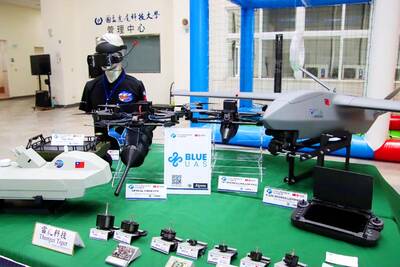
NON-RED SUPPLY: Boosting the nation’s drone industry is becoming increasingly urgent as China’s UAV dominance could become an issue in a crisis, an analyst said Taiwan’s drone exports to Europe grew 41.7-fold from 2024 to last year, with demand from Ukraine’s fight against Russian aggression the most likely driver of growth, a study showed. The Institute for Democracy, Society and Emerging Technology (DSET) in a statement on Wednesday said it found that many of Taiwan’s uncrewed aerial vehicle (UAV) sales were from Poland and the Czech Republic. These countries likely transferred the drones to Ukraine to aid it in its fight against the Russian invasion that started in 2022, it said. Despite the gains, Taiwan is not the dominant drone exporter to these markets, ranking second and fourth


 RSS
RSS