


Chinese Nationalist Party (KMT) Legislator Chen Yu-jen (陳玉珍) yesterday defended her proposal to give legislators full control over their stipends amid criticism that it would open the door to the embezzlement of assistant fees.
Chen proposed draft amendments to the Organic Act of the Legislative Yuan (立法院組織法) to allow legislators to freely use their allowances without providing invoices for reimbursement.
The bill would also make the allowance originally dedicated to covering the wages, health checkup fees and teambuilding expenses for legislators’ assistants applicable to other affairs.

Photo: Taipei Times
It states that how legislators use their allowances and whether it is proper “fall outside the scope of the Anti-Corruption Act (貪污治罪條例) and the Criminal Code,” as legislators only have to bear political responsibility to the public.
Chen also proposed draft amendments to the Regulations on Allowances for Elected Representatives and Subsidies for Chiefs of Village (地方民意代表費用支給及村里長事務補助費補助條例) to give local councilors the same power over allowances for assistant compensation.
Critics said Chen is trying to rescue KMT Legislator Yen Kuan-heng (顏寬恒), who has been found guilty of embezzling assistant fees.
Chen said the laws must be reviewed, as many lawmakers have been prosecuted for embezzling assistant fees, adding that she proposed the amendments in response to requests by the National Local Council Leaders’ Association.
The assistant fee system should not be ossified and such allowances should become available for hiring part-time assistants for various tasks, she said.
The bills are aimed at solving problems that involve all political parties, instead of “saving” lawmakers of a certain party, Chen said, calling on the Democratic Progressive Party (DPP) and its “cyberwarriors” to refrain from discrediting her proposals.
The bills were directly sent to a second reading and are slated to be discussed at today’s legislative meeting.
However, many KMT legislators reportedly signed on the bills thinking they were proposed by the KMT caucus and that they were doing a favor for KMT secretary-general Lee Chien-lung (李乾龍), according to a source who asked to remain anonymous.
Some KMT legislators expressed regret for their endorsement and sought to remove their signatures, they said.
DPP Legislator Chung Chia-pin (鍾佳濱) said the KMT lawmakers knew that the bills would be unacceptable and their signatures would not make them look good in elections.
The opposition parties have sent many bills directly to a second reading without proper cross-caucus discussions, as they try to avoid expressing their individual opinions about contentious bills at committee meetings, he said.
Legislators should be transparent about their attitudes toward different issues, which would be revealed during committee meetings, Chung said, adding that sending bills to a second reading via a quick vote is evading public oversight.
Citizen Congress Watch director Chang Hung-Lin (張宏林) said the bills would also cause national security concerns.
Regulations stipulate that a legislator can hire eight to 14 state-funded assistants, who would have free access to the legislature, he said.
However, temporary or permanent assistants would be allowed if the bill is passed, making it easier for Beijing to conduct infiltration work in the legislature, Chang said.
“Legislators and their assistants have access to classified information, so the assistants must be listed for management and legally held responsible for potential misconduct,” he said.
A report from the Legislative Yuan’s Legislative Research Bureau said that the US and Japan include legislators in the scope of regulations on public servants, despite them being elected officials.
The UK also has the Independent Parliamentary Standards Authority to handle salaries and reimbursements for expenses of UK parliamentary members following an expense scandal in 2009, the report said.
Additional reporting by Lin Che-yuan and Lee Wen-hsin
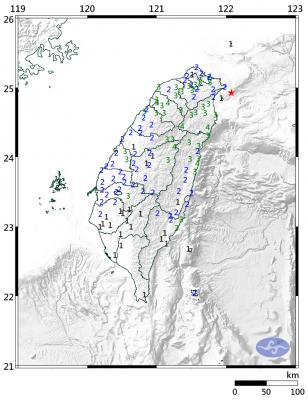
A magnitude 6.1 earthquake struck off the coast of Yilan County at 8:39pm tonight, the Central Weather Administration (CWA) said, with no immediate reports of damage or injuries. The epicenter was 38.7km east-northeast of Yilan County Hall at a focal depth of 98.3km, the CWA’s Seismological Center said. The quake’s maximum intensity, which gauges the actual physical effect of a seismic event, was a level 4 on Taiwan’s 7-tier intensity scale, the center said. That intensity level was recorded in Yilan County’s Nanao Township (南澳), Hsinchu County’s Guansi Township (關西), Nantou County’s Hehuanshan (合歡山) and Hualien County’s Yanliao (鹽寮). An intensity of 3 was

Instead of focusing solely on the threat of a full-scale military invasion, the US and its allies must prepare for a potential Chinese “quarantine” of Taiwan enforced through customs inspections, Stanford University Hoover fellow Eyck Freymann said in a Foreign Affairs article published on Wednesday. China could use various “gray zone” tactics in “reconfiguring the regional and ultimately the global economic order without a war,” said Freymann, who is also a nonresident research fellow at the US Naval War College. China might seize control of Taiwan’s links to the outside world by requiring all flights and ships entering or leaving Taiwan
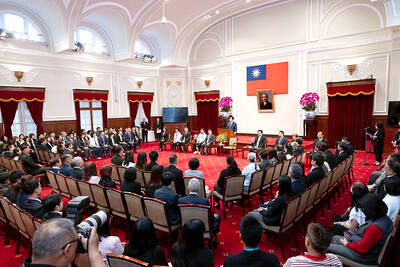
The next minimum wage hike is expected to exceed NT$30,000, President William Lai (賴清德) said yesterday during an award ceremony honoring “model workers,” including migrant workers, at the Presidential Office ahead of Workers’ Day today. Lai said he wished to thank the awardees on behalf of the nation and extend his most sincere respect for their hard work, on which Taiwan’s prosperity has been built. Lai specifically thanked 10 migrant workers selected for the award, saying that although they left their home countries to further their own goals, their efforts have benefited Taiwan as well. The nation’s industrial sector and small businesses lay
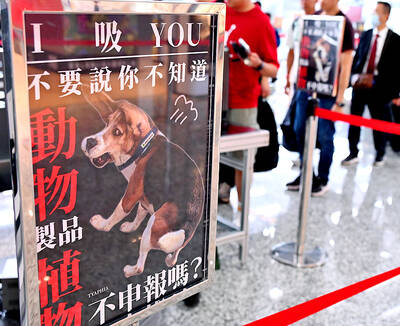
Quarantine awareness posters at Taiwan Taoyuan International Airport have gone viral for their use of wordplay. Issued by the airport branch of the Animal and Plant Health Inspection Agency, the posters feature sniffer dogs making a range of facial expressions, paired with advisory messages built around homophones. “We update the messages for holidays and campaign needs, periodically refreshing materials to attract people’s attention,” quarantine officials said. “The aim is to use the dogs’ appeal to draw focus to quarantine regulations.” A Japanese traveler visiting Taiwan has posted a photo on X of a poster showing a quarantine dog with a


 RSS
RSS