


The legislature yesterday passed a NT$27 billion (US$858.92 million) special budget with no dissenters to rebuild parts of Hualien County battered by flooding in September from a breach of a barrier lake on the Mataian River in Hualien County.
The budget cleared the legislature with the initially proposed NT$27 billion in funding from 2025 to 2030 intact. There is a NT$3 billion reserve on top of that permitted under the NT$30 billion ceiling set by a special reconstruction act approved by the legislature on Oct. 31.
The Sept. 23 flooding, triggered as Typhoon Ragasa’s outer bands passed over the region, inundated parts of Guangfu Township (光復) and nearby areas.
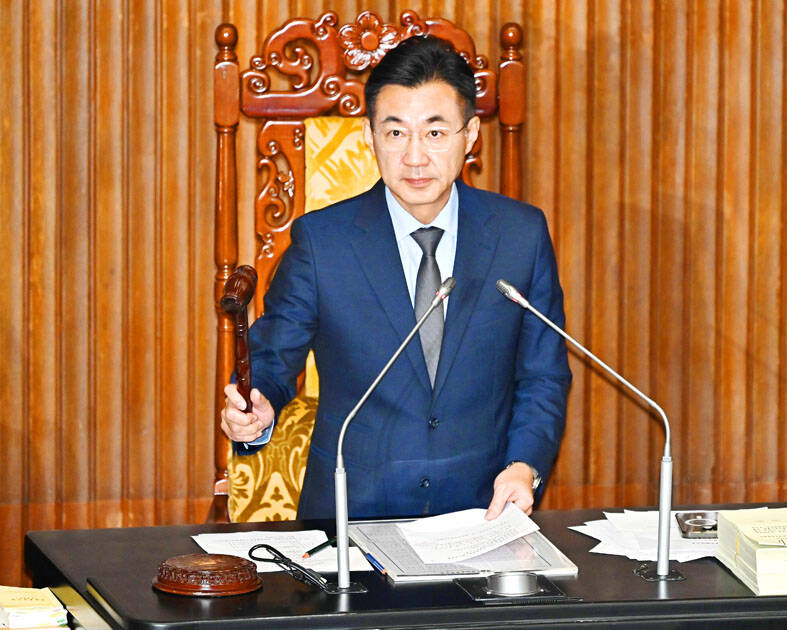
Photo: Tu Chien-jung, Taipei Times
The special act was designed to fast-track long-term recovery, with NT$19.2 billion earmarked for economic development; NT$5.6 billion for community development and environmental protection; NT$1.5 billion for contingency funding; and NT$600 million for general administration.
The Ministry of Economic Affairs said that NT$8.5 billion would go to water resource and river management projects, with a focus on dredging and clearing debris in the short term to improve drainage.
Long-term plans include building fortified levees capable of withstanding debris flows, the ministry said.
Other major projects include repairing damaged bridges; reinforcing slopes; rebuilding agricultural and public infrastructure; supporting temporary housing; and reinforcing the power grid, it said.
Funding for special budgets is to be raised through government borrowing.
Lawmakers also approved supplementary resolutions.
One, proposed by Taiwan People’s Party lawmakers, requires Premier Cho Jung-tai (卓榮泰) to deliver a special report to the legislature within two months on issues such as barrier-dam safety, upstream sediment removal, river-basin treatment plans and funds use.
A joint committee meeting completed a preliminary review of the budget on Nov. 19, while cross-party negotiations chaired by Legislative Speaker Han Kuo-yu (韓國瑜) on Wednesday last week cleared the way for the bill’s final passage yesterday.

Considering that most countries issue more than five denominations of banknotes, the central bank has decided to redesign all five denominations, the bank said as it prepares for the first major overhaul of the banknotes in more than 24 years. Central bank Governor Yang Chin-lung (楊金龍) is expected to report to the Legislative Yuan today on the bank’s operations and the redesign’s progress. The bank in a report sent to the legislature ahead of today’s meeting said it had commissioned a survey on the public’s preferences. Survey results showed that NT$100 and NT$1,000 banknotes are the most commonly used, while NT$200 and NT$2,000

The Centers for Disease Control (CDC) yesterday reported the first case of a new COVID-19 subvariant — BA.3.2 — in a 10-year-old Singaporean girl who had a fever upon arrival in Taiwan and tested positive for the disease. The girl left Taiwan on March 20 and the case did not have a direct impact on the local community, it said. The WHO added the BA.3.2 strain to its list of Variants Under Monitoring in December last year, but this was the first imported case of the COVID-19 variant in Taiwan, CDC Deputy Director-General Lin Ming-cheng (林明誠) said. The girl arrived in Taiwan on

ANNUAL EVENT: Two massive Pokemon balloons are to be set up in Daan Park, with an event zone operating from 10am to 6pm This year’s Taipei Floral Picnic is to be held at Daan Park today and tomorrow, featuring an exclusive Pokemon Go event, a themed food market, a coffee rave picnic area and stage performances, the Taipei Department of Information and Tourism said yesterday. Two massive Pokemon balloons are to be set up in the park as attractions, with an exclusive event zone operating from 10am to 6pm, it said. Participants who complete designated tasks on-site would have a chance to receive limited-edition souvenirs, it added. People could also try the newly launched game Pokemon Pokopia in the trial area, the department said. Three PokeStops are

South Korea is planning to revise its controversial electronic arrival card, a step Taiwanese officials said prompted them to hold off on planned retaliatory measures, a South Korean media report said yesterday. A Yonhap News Agency report said that the South Korean Ministry of Foreign Affairs is planning to remove the “previous departure place” and “next destination” fields from its e-arrival card system. The plan, reached after interagency consultations, is under review and aims to simplify entry procedures and align the electronic form with the paper version, a South Korean ministry official said. The fields — which appeared only on the electronic form


 RSS
RSS