


Taiwan is stepping up efforts to attract Muslim travelers, particularly from Indonesia, with plans to open a tourism office in Jakarta next year as the country seeks to tap into one of the world’s fastest-growing outbound travel markets.
Lin Hsin-jen (林信任), Taiwan’s deputy representative in Indonesia, described Indonesia as a market Taiwan can no longer afford to overlook, noting that the country of 280 million is not only “the world’s largest Muslim tourism market,” but also one of the region’s most reliably growing economies.
“For Taiwan, this is our new blue ocean for tourism,” Lin said in an interview in Jakarta.
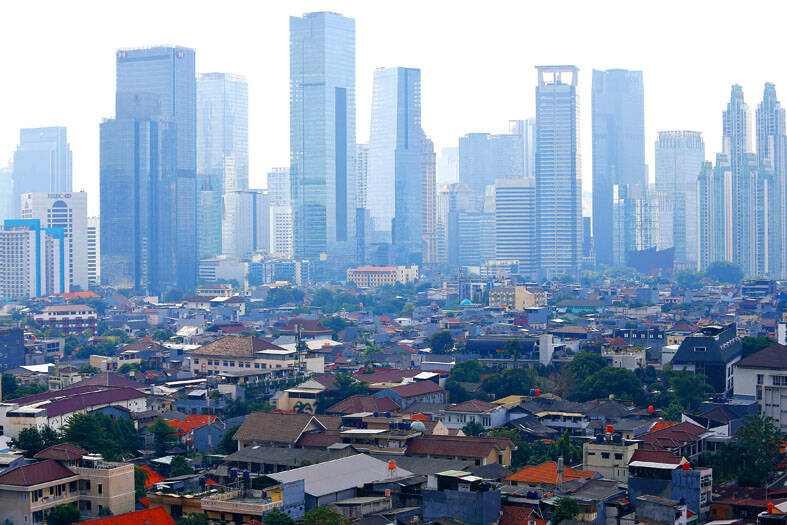
Photo: Reuters
Currently, more than 200,000 Indonesians visit Taiwan each year, a number Lin expects to rise as Taiwan increases its on-the-ground presence and promotional efforts.
Taiwan also consistently ranks second or third worldwide in global surveys evaluating Muslim-friendly tourism destinations, he added.
He said he sees strong growth potential in Indonesia’s family travel, affluent tourists, corporate incentive trips, and overseas Chinese-learning educational tours, and believes Taiwan’s tourism products are well-suited to meet the needs of these travelers.
“Visitors can shop, enjoy mountains and rivers, and experience culture -- all in one place. In this way, Taiwan’s tourism products are a perfect match for the Indonesian market,” Lin said.
According to Indonesian media reports, outbound travel by Indonesian citizens rose 7.63 percent from January to May 2025 compared with the same period in 2024.
“Taiwan is ready. What we need now is the final push in marketing,” Lin said, noting that Taiwan’s Tourism Administration is preparing to launch a dedicated tourism office in Jakarta in 2026 to accelerate outreach.
Besides tapping into Indonesia’s growing tourism market, Taiwan is also strengthening industrial and trade ties with the Southeast Asian nation, said Lu Feng-ching (路豐璟), director of the economic division of the Taipei Economic and Trade Office in Indonesia (TETO).
This year, Taiwan and Indonesia signed a design cooperation agreement aimed at expanding exchanges in exhibitions, professional judging and young designer talent, he said.
The two countries also signed an agreement on Halal promotion, allowing Taiwanese food, beverages, cosmetics and pharmaceuticals certified by the Taiwan Halal Integrity Development Association to enter Indonesia without separate certification, Lu said.
This agreement not only promotes trade with Indonesia, but also opens doors to Middle Eastern markets, he said.
Taiwanese businesses are also expanding their footprint across Indonesia, with roughly 2,000 companies active in manufacturing and services. These range from shoe, textile and electronics manufacturing to financial services, telecommunications and transport, according to Lu.
Taiwan has also been expanding educational exchanges with Indonesia through scholarships and specialized programs, said Grace Ou (歐淑芬), director of the education division at TETO.
TETO Representative Bruce Hung (洪振榮), meanwhile, highlighted the scale of people-to-people exchanges between the two countries, citing roughly 18,000 Indonesian students and more than 300,000 Indonesian workers in Taiwan.
These human connections, he said, form “the foundation of Taiwan-Indonesia relations.”

FUKUOKA SITUATION: Japanese media reported that the pathogen is expected to be identified by the summer, while the CDC downplayed the idea that it was hMPV A “mysterious cold-like illness” reported in Japan’s Fukuoka Prefecture does not seem to be a new disease, but Japanese authorities have been asked about the situation, the Centers for Disease Control (CDC) said yesterday. The Fukuoka Prefectural Medical Association on Wednesday told a news conference that a “mystery cold” that has become a hot topic on social media is “highly likely to be caused by some kind of viral infection,” Japan’s KBC News reported. “Many people are experiencing symptoms starting with a sore throat, followed by a runny nose, phlegm and a severe cough,” KBC News reported, citing association officials. Health authorities are

Nvidia Corp CEO Jensen Huang (黃仁勳) arrived in Taiwan yesterday ahead of upcoming AI and technology events, saying he plans to meet with clients and Taiwan Semiconductor Manufacturing Co Chairman C.C. Wei (魏哲家) during his visit. After landing at Taipei Songshan Airport, Huang posed for photos with fans and handed out Yakult drinks to reporters and supporters waiting at the scene, saying he has “a lot to do” during the trip. Asked about reports that Nvidia’s planned headquarters site in Taipei’s Beitou Shilin Technology Park could break ground on May 27, Huang said that if the company holds an event, he would

The Ministry of Finance this afternoon announced the winning numbers for the March-April uniform invoice lottery. The winning number for the NT$10 million (US$318,060) special prize is 19531471, and the winning number for the NT$2 million grand prize is 85941329. Three numbers were drawn for the NT$200,000 first prize: 07225810, 20231230 and 83518781. Those with receipts matching the last seven digits of any of the first-prize numbers will win the NT$40,000 second prize, while those matching the last six digits will win the NT$10,000 third prize. Those whose receipts match the last five digits of the first-prize numbers can claim the NT$4,000 fourth prize,

SIX SUBSIDIES: The monthly allowance for older farmers is to increase to NT$10,000, and NT$5,000 is to be given to homemakers under the national pension system, Lai said The government is to implement major welfare policies for disadvantaged groups, including raising the monthly allowance for older farmers to NT$10,000 and providing homemakers with NT$5,000 per month, President William Lai (賴清德) said yesterday. Lai made the remarks during a visit to Wangling Temple in Chiayi County, saying that the planned increases were being introduced amid economic growth and an increase in tax revenue. Touting a policy, in which the government plans to provide a monthly allowance of NT$5,000 for every child under the age of 18 in a bid to address Taiwan’s low birthrate, Lai said that if received for the


 RSS
RSS