


Taiwanese shipbuilder CSBC Corp has missed the deadline for completing Taiwan’s first domestic submarine, Minister of National Defense Wellington Koo (顧立雄) said yesterday.
The vessel is the lead boat of a program launched in 2016 that aims to deliver eight vessels, but opposition lawmakers have criticized the repeated delays in the project.
Taiwan is seeking to upgrade its defenses to deter China, which has threatened to use force to annex it.
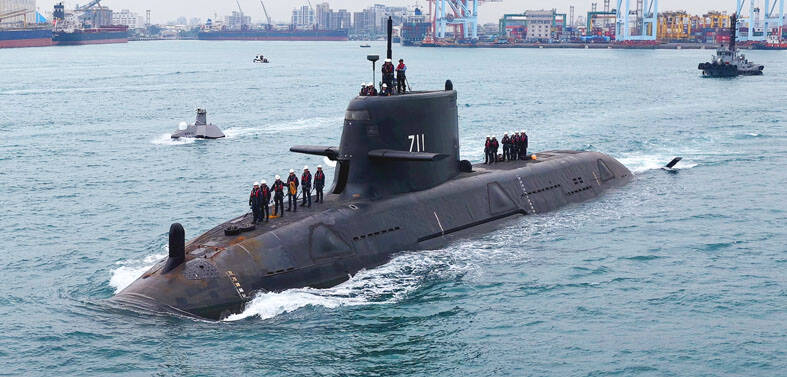
Photo courtesy of CSBC Corp, Taiwan via CNA
Sea trials of the Hai Kun (海鯤), or “Narwhal,” began in June, nearly two years after it was first unveiled.
The original target was to wrap up testing by September 30 and deliver the submarine by the end of last month, the navy said previously. Koo yesterday said that sea trials are ongoing.
“All the sea trials were supposed to be completed by the end of November, but in fact that is no longer achievable,” Koo told lawmakers. “I want to emphasize again that everything we do is based on safety assessments and there’s no rush to meet any specific month.”
A spokesperson for CSBC confirmed the delay.
The submarine program has been plagued by obstacles.
Koo in October said that the original timeline for construction had been unrealistic.
“In practice, we face many difficulties, especially given our own circumstances, including equipment issues and delays in scheduling the manufacturers’ technical personnel,” Koo said.
The submarine measures 80m in length, has a displacement weight of about 2,300 to 2,700 tonnes, and boasts combat systems and torpedoes sourced from the US defense company Lockheed Martin.
The Chinese Nationalist Party (KMT) and the Taiwan People’s Party, which together control the legislature, froze part of the program’s budget earlier this year.
The parties said they wanted to see the results of the submarine’s sea trials before releasing the funds.
Taiwan’s navy has two submarines in active commission, Swordfish-class vessels bought from the Netherlands in the 1980s.
Over the same period, China has built itself one of the world’s largest fleets, with nuclear-powered submarines and aircraft carriers.

Considering that most countries issue more than five denominations of banknotes, the central bank has decided to redesign all five denominations, the bank said as it prepares for the first major overhaul of the banknotes in more than 24 years. Central bank Governor Yang Chin-lung (楊金龍) is expected to report to the Legislative Yuan today on the bank’s operations and the redesign’s progress. The bank in a report sent to the legislature ahead of today’s meeting said it had commissioned a survey on the public’s preferences. Survey results showed that NT$100 and NT$1,000 banknotes are the most commonly used, while NT$200 and NT$2,000

The Centers for Disease Control (CDC) yesterday reported the first case of a new COVID-19 subvariant — BA.3.2 — in a 10-year-old Singaporean girl who had a fever upon arrival in Taiwan and tested positive for the disease. The girl left Taiwan on March 20 and the case did not have a direct impact on the local community, it said. The WHO added the BA.3.2 strain to its list of Variants Under Monitoring in December last year, but this was the first imported case of the COVID-19 variant in Taiwan, CDC Deputy Director-General Lin Ming-cheng (林明誠) said. The girl arrived in Taiwan on

ANNUAL EVENT: Two massive Pokemon balloons are to be set up in Daan Park, with an event zone operating from 10am to 6pm This year’s Taipei Floral Picnic is to be held at Daan Park today and tomorrow, featuring an exclusive Pokemon Go event, a themed food market, a coffee rave picnic area and stage performances, the Taipei Department of Information and Tourism said yesterday. Two massive Pokemon balloons are to be set up in the park as attractions, with an exclusive event zone operating from 10am to 6pm, it said. Participants who complete designated tasks on-site would have a chance to receive limited-edition souvenirs, it added. People could also try the newly launched game Pokemon Pokopia in the trial area, the department said. Three PokeStops are

South Korea is planning to revise its controversial electronic arrival card, a step Taiwanese officials said prompted them to hold off on planned retaliatory measures, a South Korean media report said yesterday. A Yonhap News Agency report said that the South Korean Ministry of Foreign Affairs is planning to remove the “previous departure place” and “next destination” fields from its e-arrival card system. The plan, reached after interagency consultations, is under review and aims to simplify entry procedures and align the electronic form with the paper version, a South Korean ministry official said. The fields — which appeared only on the electronic form


 RSS
RSS