


The possibility of China launching another large-scale military exercise or using Taiwan as an excuse to exert pressure on other countries cannot be ruled out, a Taiwanese security official said yesterday.
The official, speaking on condition of anonymity, made the remarks in the context of the diplomatic spat between Japan and China.
China launched retaliatory measures in response to Japanese Prime Minister Sanae Takaichi’s comments last month relating Japan’s security to a Taiwan contingency.
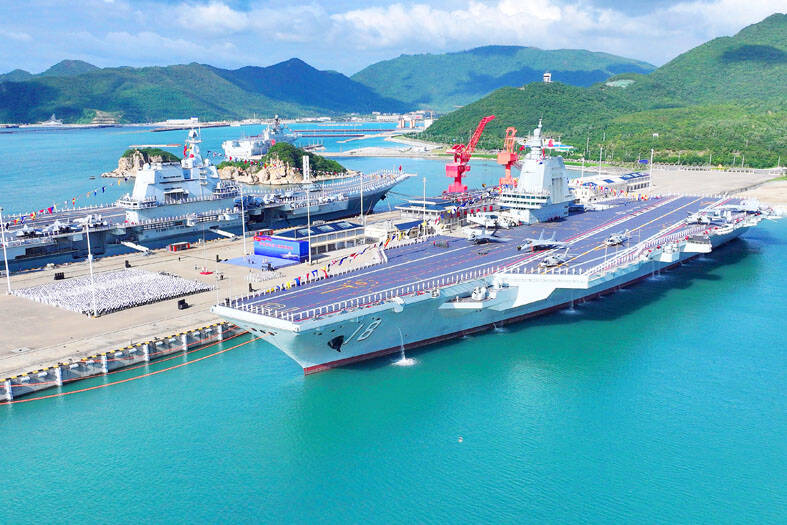
Photo: AP
Although Chinese Minister of Foreign Affairs Wang Yi (王毅) is recognized as an expert with a good understanding of Japan, Beijing’s responses to Takaichi’s remarks departed wildly from diplomatic professionalism and rational decisionmaking, the official said.
The situation has deteriorated since the remarks, they said.
Beijing has accused Takaichi of committing nine offenses, such as provoking the sovereignty of China, interfering with the internal affairs of China, and disrupting the international order, the official said, adding such accusations are simply projections of China’s own misconduct onto Japan.
There is speculation that the uncharacteristically antagonistic response is caused by internal pressures from domestic society due to ineffective governmental leadership or China’s ailing economy, they said.
Beijing might be attempting to divert the Chinese people’s attention over its questionable governance by attempting to stoke nationalism against other countries in the public, the official said.
Taiwan is at risk if China begins basing its decisions on something other than rationality, they said.
The official also pointed to the oddly muted commissioning ceremony of the Fujian, China’s third aircraft carrier and first designed indigenously.
While the other two aircraft carriers’ inaugural ceremonies were grandly held with flag officers lining up to pay tribute, the head of China’s Southern Theater Command General Wu Yanan (吳亞男) and other major generals were absent from the aircraft carrier’s commissioning, they said, while China’s state-run media delayed the live broadcast of the ceremony, and the atmosphere appeared unusually tense and non-celebratory.
While Beijing’s decisionmaking system seemed dysfunctional and its diplomatic signals are mixed, the situation must be closely monitored leading up to Dec. 13, China’s National Memorial Day for the Nanjing Massacre, the official said.
Beijing might use the memorial of the atrocity to stir national sentiment as it finds itself diplomatically feuding with Japan in the present, they said.
If China finds no graceful exit from the dispute, it could turn to military intimidation to attempt to force Japan or other countries in the region into concessions, the official said.
Based on experience, China might launch a large-scale military exercise, using Taiwan as a pretext to exert pressure on other countries, similar to its “Joint Sword” series of exercises last year, they said.
All countries in the region should keep a close eye on the situation, as Beijing’s decisionmaking is neither transparent nor democratic, and has become irrational and confusing, the official said.
Beijing is a hostile nation and considers invading Taiwan one of its major political imperatives, they said.
For Beijing, two main priorities are preventing Taiwan from enhancing its national security laws and regulations, and hindering its defense procurements, they said.
With those two goals achieved, Beijing could take overt action against Taiwan, the official said.
For Taiwan, the goal is clear, which is to use all possible methods to render China unable to effectively invade Taiwan, they said.

FUKUOKA SITUATION: Japanese media reported that the pathogen is expected to be identified by the summer, while the CDC downplayed the idea that it was hMPV A “mysterious cold-like illness” reported in Japan’s Fukuoka Prefecture does not seem to be a new disease, but Japanese authorities have been asked about the situation, the Centers for Disease Control (CDC) said yesterday. The Fukuoka Prefectural Medical Association on Wednesday told a news conference that a “mystery cold” that has become a hot topic on social media is “highly likely to be caused by some kind of viral infection,” Japan’s KBC News reported. “Many people are experiencing symptoms starting with a sore throat, followed by a runny nose, phlegm and a severe cough,” KBC News reported, citing association officials. Health authorities are

Nvidia Corp CEO Jensen Huang (黃仁勳) arrived in Taiwan yesterday ahead of upcoming AI and technology events, saying he plans to meet with clients and Taiwan Semiconductor Manufacturing Co Chairman C.C. Wei (魏哲家) during his visit. After landing at Taipei Songshan Airport, Huang posed for photos with fans and handed out Yakult drinks to reporters and supporters waiting at the scene, saying he has “a lot to do” during the trip. Asked about reports that Nvidia’s planned headquarters site in Taipei’s Beitou Shilin Technology Park could break ground on May 27, Huang said that if the company holds an event, he would

The Ministry of Finance this afternoon announced the winning numbers for the March-April uniform invoice lottery. The winning number for the NT$10 million (US$318,060) special prize is 19531471, and the winning number for the NT$2 million grand prize is 85941329. Three numbers were drawn for the NT$200,000 first prize: 07225810, 20231230 and 83518781. Those with receipts matching the last seven digits of any of the first-prize numbers will win the NT$40,000 second prize, while those matching the last six digits will win the NT$10,000 third prize. Those whose receipts match the last five digits of the first-prize numbers can claim the NT$4,000 fourth prize,
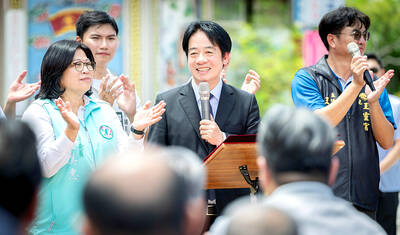
SIX SUBSIDIES: The monthly allowance for older farmers is to increase to NT$10,000, and NT$5,000 is to be given to homemakers under the national pension system, Lai said The government is to implement major welfare policies for disadvantaged groups, including raising the monthly allowance for older farmers to NT$10,000 and providing homemakers with NT$5,000 per month, President William Lai (賴清德) said yesterday. Lai made the remarks during a visit to Wangling Temple in Chiayi County, saying that the planned increases were being introduced amid economic growth and an increase in tax revenue. Touting a policy, in which the government plans to provide a monthly allowance of NT$5,000 for every child under the age of 18 in a bid to address Taiwan’s low birthrate, Lai said that if received for the


 RSS
RSS