


China’s campaign to deprive Taiwan of diplomatic recognition might have a rare reversal this month when voters in Honduras choose their next president.
The two front-runners in tomorrow’s election both pledge to sever ties with Beijing and re-establish them with Taipei.
The candidates, former Honduran vice president Salvador Nasralla and former Tegucigalpa mayor Nasry Asfura, also want to forge a closer relationship with the US, the nation’s top trading partner and main destination for migrants.

Photo: Reuters
Nasralla led a poll last month with Asfura in second ahead of tomorrow’s single-round vote.
US President Donald Trump called on Hondurans to back Asfura, saying in a post on social media that he was the only one of the trio with whom he could work.
Honduran President Xiomara Castro established diplomatic relations with Beijing in 2023, ending ties with Taiwan, saying that the change would bring trade and financing opportunities to the Central American nation of 11 million people.
Castro is not eligible for re-election, but her ally, ruling party candidate Rixi Moncada, would continue to recognize Beijing. She placed third in the poll.
The vote is the latest test of whether the region is aligning itself with Trump as he pressures trade partners to distance themselves from Beijing. On Sunday, Chileans sent conservative Jose Antonio Kast to a presidential runoff while, last month, pro-business senator Rodrigo Paz won Bolivia’s presidential runoff. Both candidates pledged to seek better relations with Washington.
Nasralla and Asfura blamed Castro’s decision for a decline in some exports. Taiwan used to be the biggest market for Honduran shrimp, but imports have slumped since diplomatic ties were cut.
They also say that Castro’s promises of Chinese investment boosting development failed to materialize.
The government in Beijing uses offers of loans, infrastructure investments and aid to induce the few remaining governments that still recognize Taipei to switch, while Taiwan uses similar methods to persuade them to stay. Over the past decade, Panama, the Dominican Republic and El Salvador have all recognized Beijing, but it is unusual for countries to switch allegiance in the opposite direction.
“Economically, the relationship with China has been a bad deal for Honduras despite the expectations, so it’s a pocket-book issue, but it’s also about signaling that we want to align ourselves with the West and the United States,” said Evan Ellis, a professor at the Pennsylvania-based Army War College specializing in Latin America. “If there’s one way to get on President Trump’s radar screen, and [US] Secretary [of State Marco] Rubio’s, in a very positive way, I think it’s that flip.”
The US remains by far the largest buyer of Honduran goods, while exports to China account for less than 1 percent of the total.
After a visit to Beijing in 2023, Castro said that China would finance infrastructure such as a hydroelectric dam and that both nations would sign a free-trade agreement.
However, the deals stalled.
“The decision to cut ties with Taiwan and establish them with China has not resulted in the flows of capital the government may have anticipated,” said Margaret Myers, director of the Asia and Latin America program at the Washington-based Inter-American Dialogue. “Projects have not come to pass.”
Nasralla and Asfura have also promised to cut ties with Venezuela if elected, saying they do not recognize Nicolas Maduro as president. Castro’s government has backed Maduro and criticized the US military buildup in the Caribbean.
The lead-up to tomorrow’s vote has been tense, which both sides accusing the other of planning fraud.
The ruling party accused the opposition of seeking to steal the election and has taken aim at electoral judges. They also installed a temporary congress of loyalists, while opposition lawmakers formed a separate legislative body.
The US and the Organization of American States expressed concern about the electoral process.
US Deputy Secretary of State Christopher Landau said on X that the US would “respond swiftly and decisively to anyone who undermines the integrity of the democratic process in Honduras.”
Voting centers are scheduled to open at 7am and close at 5pm, with initial results expected after 8pm, the Honduran National Board of Elections said.

NATIONAL SECURITY: Authorities are working to confirm the identities of the military personnel involved and investigating possible illegal conduct and regulatory violations Authorities are probing possible national security implications after Kinmen police and immigration officers on Sunday found a Chinese woman allegedly posing as a tourist while engaging in prostitution involving more than 10 military personnel. The woman, surnamed Chen (陳), has since been deported, authorities said, adding that investigators are still working to confirm the identities of those implicated, as the records only listed code names and aliases. The case stemmed from a report received by the Kinmen District Prosecutors’ Office on Friday last week from the Jinhu Precinct of the Kinmen County Police Bureau. On Sunday, police, along with the National Immigration

GLOBALGIVING: ‘ Caving to external pressure is not acceptable for an organization that has cultivated justice reform and human rights for 30 years,’ one NGO said A slew of non-government organizations (NGOs) have withdrawn from the GlobalGiving fundraising platform after it announced it would use “Chinese Taipei” instead of “Taiwan” from next month. The Taiwan Good Rice Association wrote on Facebook on Friday that it was informed on April 28 via a teleconference call of the change, which was made because the platform wanted to operate in China. Taiwan Good Rice is to terminate all cooperative relationships with GlobalGiving in response to the platform’s “unilateral and non-negotiable” decision to remove references to Taiwan, the NGO said. “Taiwan is in the official name of Taiwan Good Rice Association and the

HEAVY WEATHER: Typhoon Jangmi is due to crash straight into the Ryukyus as airlines look to shift flights to larger aircraft or cancel flights to Okinawa entirely Taiwan’s international air carriers announced flight adjustments over the weekend as Typhoon Jangmi is forecast to hit the Ryukyu Islands today and tomorrow. The Central Weather Administration (CWA) upgraded Jangmi from a tropical storm to a typhoon at 8am yesterday, with the eye located 580km south of Naha city. It was moving north at 19kph. Today, China Airlines’ CI-120, CI-121, CI-122 and CI-123 flights between Taoyuan and Naha, Okinawa, have been canceled as well as CI-132 and CI-133 between Kaohsiung and Naha. EVA Air’s BR-112, BR-113, BR-186 and BR-185 flights between Taoyuan and Naha are also canceled. Low-cost carrier Tigerair Taiwan canceled IT-230,
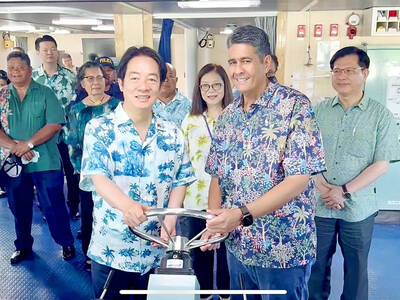
MULTIPRONGED APPROACH: China has sought to pressure Palau across a number of fronts, but the island nation has staunchly resisted overtures to ditch Taiwan Palau has been firm in backing Taiwan despite Chinese pressure that uses tourism economics, cyberattacks and criminal infiltration as tools to threaten the Pacific ally into renouncing its recognition of Taiwan as a sovereign state. The Presidential Office yesterday announced that Vice President Hsiao Bi-khim (蕭美琴) would visit Palau from Saturday to Wednesday next week at the invitation of Palauan President Surangel Whipps Jr. Whipps in April said in an interview that China had outspokenly asked Palau to “denounce Taiwan.” “And we have said: ‘We have no enemies, but nobody tells us who our friends are,’” he said. Whipps has told reporters multiple times


 RSS
RSS