


A cardiology team at National Taiwan University Hospital (NTUH) successfully implanted Taiwan’s first dual-chamber leadless pacemaker, which overcomes limitations of previous single-chamber pacemakers, a new milestone for domestic medical advancements, the hospital said on Tuesday
The NTUH medical team was invited to participate in the global pivotal Aveir Dual-Chamber Leadless i2i IDE Study beginning in 2023, becoming Taiwan’s only collaborating medical center, it said.
During the clinical trial, five patients received implants, with nearly three years of follow-up studies conducted, the hospital said, adding that the results demonstrated that the device operated reliably and maintained excellent synchronization.
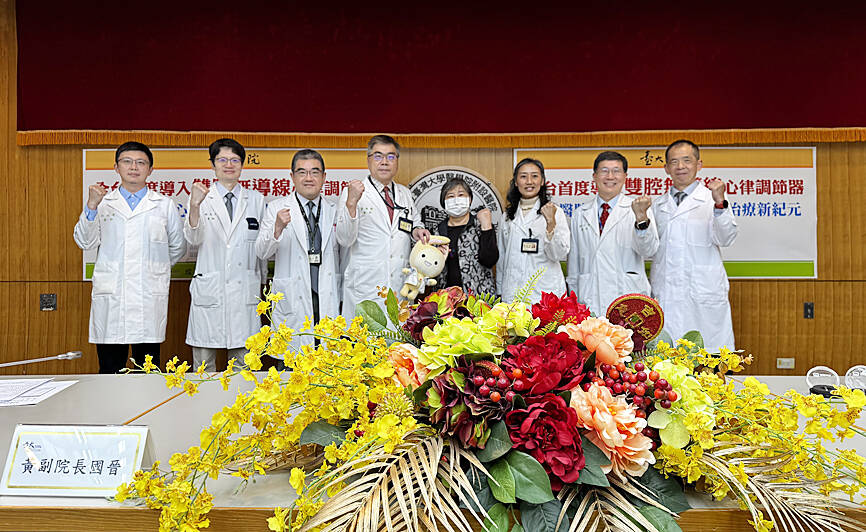
Photo: CNA
The medical team said that a 79-year-old woman, surnamed Cheng (鄭), who had a slower than normal heart rate, began experiencing arrhythmia after she began receiving chemotherapy.
Her arrhythmia worsened to 40 beats per minute, causing her to feel shortness of breath even from walking, which greatly affected her daily life.
NTUH Cardiovascular Center physician Liu Yen-bin (劉言彬) said Cheng’s health condition left her at a high risk of infection, so she became one of the first patients that the medical team implanted with a dual-chamber leadless pacemaker, and the very first in Taiwan.
People with slow heart rates can feel out of breath and fatigue from walking, or sometimes experience dizziness or fainting, which can lead to fall injuries, and in serious cases cause a potentially fatal cardiac arrest, Liu said
More than 7,500 patients with heart rhythm disorders receive a pacemaker implant in Taiwan every year, he said.
About 80 percent of them are implanted with traditional dual-chamber pacemaker with leads, insulated wires threaded through veins to the heart, which leaves a scar in the upper chest, and limits arm and shoulder movement, Liu said.
There is also the risk of lead infection, in which case pacemaker and leads must be removed and could become life-threatening, he added.
Another 2 to 4 percent of patients have conditions needing atrial pacing, but the only leadless pacemakers available in Taiwan until now were single-chamber (ventricular) pacing, he said.
Therefore, although ventricular leadless devices have been available for years, widespread use of atrial pacing systems has only become possible with this innovation, he added.
The hospital said the new dual-chamber leadless pacemaker it introduced has three major innovations, including enhanced safety and comfort, re-engineered battery replacement and extended device longevity, and an atrial pacing and atrioventricular synchronization technology.
The bullet-sized device eliminates the need for transcutaneous leads and subcutaneous batteries, utilizing a minimally invasive femoral vein approach to deliver the pacemaker into the heart, reducing the risk of infections, it said.
When the battery runs out, the old device can be removed through a minimally invasive procedure, reducing the risk of multiple surgeries, the NTUH said, adding that the new system enables direct atrial pacing and uses wireless communication within the body to coordinate with the ventricular pacemaker, achieving dual-chamber synchronization, improving clinical outcomes.
The medical team said the dual-chamber leadless pacemaker is particularly suited for patients with vascular limitations, heightened infection risks or those requiring multiple lead replacements.
The system was approved for market release by the Food and Drug Administration in September, and it is expected to be integrated into clinical care at the hospital later this month or by early next month, it said.
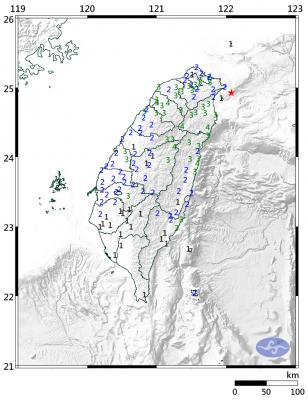
A magnitude 6.1 earthquake struck off the coast of Yilan County at 8:39pm tonight, the Central Weather Administration (CWA) said, with no immediate reports of damage or injuries. The epicenter was 38.7km east-northeast of Yilan County Hall at a focal depth of 98.3km, the CWA’s Seismological Center said. The quake’s maximum intensity, which gauges the actual physical effect of a seismic event, was a level 4 on Taiwan’s 7-tier intensity scale, the center said. That intensity level was recorded in Yilan County’s Nanao Township (南澳), Hsinchu County’s Guansi Township (關西), Nantou County’s Hehuanshan (合歡山) and Hualien County’s Yanliao (鹽寮). An intensity of 3 was
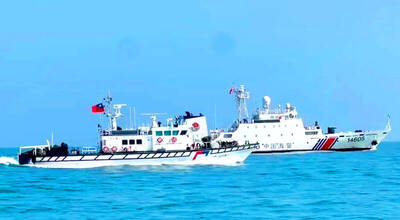
Instead of focusing solely on the threat of a full-scale military invasion, the US and its allies must prepare for a potential Chinese “quarantine” of Taiwan enforced through customs inspections, Stanford University Hoover fellow Eyck Freymann said in a Foreign Affairs article published on Wednesday. China could use various “gray zone” tactics in “reconfiguring the regional and ultimately the global economic order without a war,” said Freymann, who is also a nonresident research fellow at the US Naval War College. China might seize control of Taiwan’s links to the outside world by requiring all flights and ships entering or leaving Taiwan

The next minimum wage hike is expected to exceed NT$30,000, President William Lai (賴清德) said yesterday during an award ceremony honoring “model workers,” including migrant workers, at the Presidential Office ahead of Workers’ Day today. Lai said he wished to thank the awardees on behalf of the nation and extend his most sincere respect for their hard work, on which Taiwan’s prosperity has been built. Lai specifically thanked 10 migrant workers selected for the award, saying that although they left their home countries to further their own goals, their efforts have benefited Taiwan as well. The nation’s industrial sector and small businesses lay
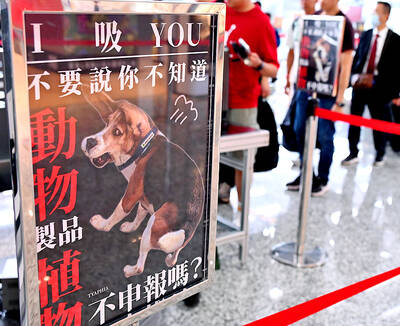
Quarantine awareness posters at Taiwan Taoyuan International Airport have gone viral for their use of wordplay. Issued by the airport branch of the Animal and Plant Health Inspection Agency, the posters feature sniffer dogs making a range of facial expressions, paired with advisory messages built around homophones. “We update the messages for holidays and campaign needs, periodically refreshing materials to attract people’s attention,” quarantine officials said. “The aim is to use the dogs’ appeal to draw focus to quarantine regulations.” A Japanese traveler visiting Taiwan has posted a photo on X of a poster showing a quarantine dog with a


 RSS
RSS