


The Taiwan One Ecology Coalition yesterday urged prompt legislation to ban spring snare traps as it extended an invitation to President William Lai (賴清德) to attend a gathering among people with pets injured by such traps.
The gathering is to be held at the Huajiang Pet Park (華江寵物公園) in New Taipei City’s Banciao District (板橋) on Saturday next week, with people who had their pets injured by spring snare traps joining together to share their stories to advocate for banning the traps.
The coalition yesterday presented an invitation card to a representative from the Presidential Office, inviting Lai to participate in the gathering with his adopted dog, Ban-ban (斑斑), who lost a leg from being caught in a spring snare trap.
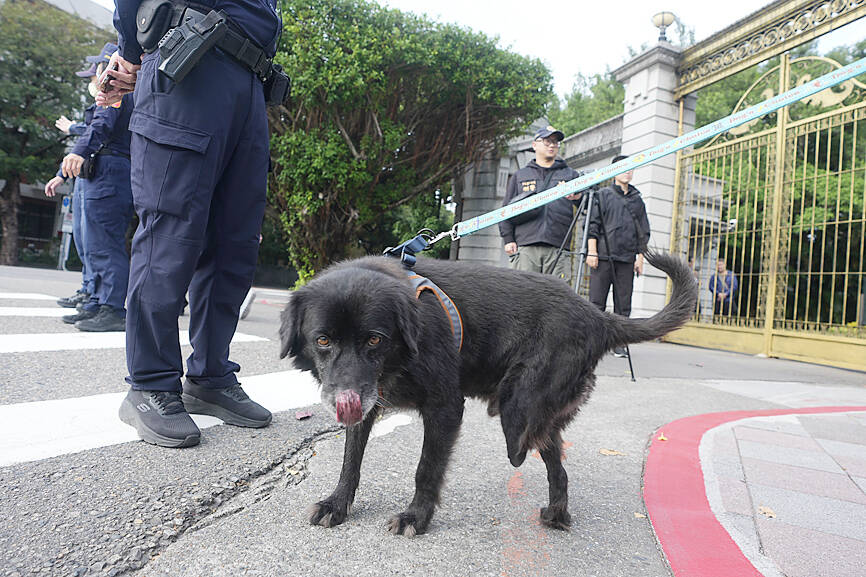
Photo: CNA
The group presented postcards written by more than 200 students of Harvard University and MIT to urge Lai to ban the traps were presented.
Animals caught by spring snare traps have their circulation cut off in the trapped limb, leading to tissue death in the limb, Chinese Animal Welfare International Exchange Association executive supervisor Lee Chih-chiang (李志強) said, citing the example of the dog Hei-hei (黑黑), present at the event, whose leg required amputation due to a spring snare trap.
Animals caught in traps might suffer severe tissue damage, or fractured or broken bones even if they manage to escape, Lee said.
Animals unable to escape generally die after seven to 10 agonizing days, he said.
Although the Forestry and Natural Conservation Agency has developed improved traps, which it said would not cause as much harm to animals, they are not much safer than spring snare traps, Lee said.
Tests conducted by the coalition showed that the improved traps’ 12cm jaws can easily trap the toes of adult Formosan black bears or the paws of bear cubs and cause injuries.
Animal rights advocate Yang Hsiu-ling (楊秀玲) said spring snare traps are not traditional indigenous hunting tools, as they had not been used in Taiwan until about a decade ago.
Coalition representative Huang Tai-shan (黃泰山) said the group hoped Lai could exercise his influence as the head of state in pushing legislation to ban spring snare traps, urging the president to ask the Cabinet to put forward amendments to the Animal Protection Act (動物保護法).
That would benefit many wild animals and dogs similar to Ban-ban, Huang said.
The coalition said the spring snare trap ban campaign has bipartisan support, including Democratic Progressive Party (DPP) Legislator Lin Tai-hua (林岱樺), Chinese Nationalist Party (KMT) Legislator Hsu Chiao-hsin (徐巧芯), DPP Legislator Kuo Yu-ching (郭昱晴) and KMT Legislator Hung Meng-kai (洪孟楷).
However, the draft bill proposed by the ministry has been stalled for about five years in Cabinet meetings and has yet to be sent to the legislature for review, it said.

FUKUOKA SITUATION: Japanese media reported that the pathogen is expected to be identified by the summer, while the CDC downplayed the idea that it was hMPV A “mysterious cold-like illness” reported in Japan’s Fukuoka Prefecture does not seem to be a new disease, but Japanese authorities have been asked about the situation, the Centers for Disease Control (CDC) said yesterday. The Fukuoka Prefectural Medical Association on Wednesday told a news conference that a “mystery cold” that has become a hot topic on social media is “highly likely to be caused by some kind of viral infection,” Japan’s KBC News reported. “Many people are experiencing symptoms starting with a sore throat, followed by a runny nose, phlegm and a severe cough,” KBC News reported, citing association officials. Health authorities are

Nvidia Corp CEO Jensen Huang (黃仁勳) arrived in Taiwan yesterday ahead of upcoming AI and technology events, saying he plans to meet with clients and Taiwan Semiconductor Manufacturing Co Chairman C.C. Wei (魏哲家) during his visit. After landing at Taipei Songshan Airport, Huang posed for photos with fans and handed out Yakult drinks to reporters and supporters waiting at the scene, saying he has “a lot to do” during the trip. Asked about reports that Nvidia’s planned headquarters site in Taipei’s Beitou Shilin Technology Park could break ground on May 27, Huang said that if the company holds an event, he would

The Ministry of Finance this afternoon announced the winning numbers for the March-April uniform invoice lottery. The winning number for the NT$10 million (US$318,060) special prize is 19531471, and the winning number for the NT$2 million grand prize is 85941329. Three numbers were drawn for the NT$200,000 first prize: 07225810, 20231230 and 83518781. Those with receipts matching the last seven digits of any of the first-prize numbers will win the NT$40,000 second prize, while those matching the last six digits will win the NT$10,000 third prize. Those whose receipts match the last five digits of the first-prize numbers can claim the NT$4,000 fourth prize,

Taiwan Travelogue (臺灣漫遊錄), which earlier this week became the first Taiwanese novel to win the International Booker Prize, is to be adapted into a television series through a Taiwan-Japan coproduction, producer Chang Chen-yu (張辰漁) said yesterday. Chang, a producer at World Softest Production Film Co, wrote on Facebook that the company had been searching for projects with international appeal that retain a strong Taiwanese identity after colleagues and Japanese partners strongly recommended the novel. After reading the book, Chang said he immediately decided to pursue the screen rights. “A great story has the power to transcend time and borders, and connect countless people,”


 RSS
RSS