


Singapore, a major hub for Taiwan’s New Southbound Policy, is poised to deepen cooperation with Taiwan in semiconductors, artificial intelligence (AI), green energy and biotechnology, Representative to Singapore Tung Chen-yuan (童振源) said in an exclusive interview with the Liberty Times (sister paper of the Taipei Times) published today.
The New Southbound Policy, introduced in 2016 by then-president Tsai Ing-wen (蔡英文), is designed to enhance trade and exchanges between Taiwan and 18 nations in the Indo-Pacific region and away from China.
Tung, who has served as Taiwan’s top envoy in Singapore for more than two years, highlighted the breadth of bilateral ties between the two countries that extend far beyond military cooperation.
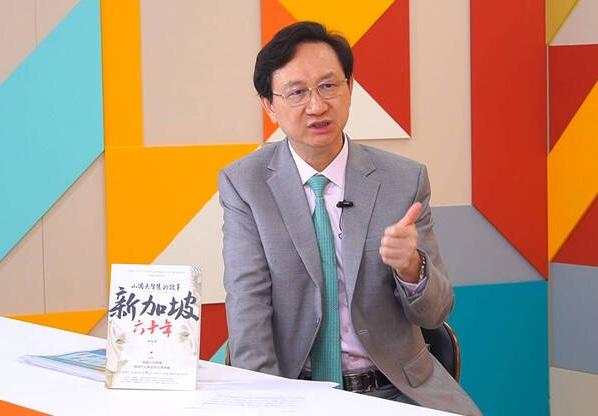
Photo: Chen Yu-jui, Taipei Times
Taiwan provided considerable military assistance in the early years after Singapore declared independence in 1965, Tung said, referring to “Project Starlight” (星光計畫), in which Singapore sent troops to Taiwan to receive military training.
Military ties have since evolved into extensive exchanges in trade, investment, talent and culture, he added.
Singapore is currently Taiwan’s sixth-largest trading partner, while Taiwan ranks as Singapore’s fourth-largest, he said.
Last year, Taiwan invested US$5.81 billion in Singapore, accounting for 68.3 percent of Taiwan’s total investment in ASEAN nations and 12 percent of its entire foreign investment worldwide, even surpassing investment in China, he said.
He outlined four complementary fields where deeper cooperation is expected to be mutually beneficial.
First, Taiwan and Singapore share close ties in the semiconductor industry, he said.
Although Taiwan is the world’s most important semiconductor producer and irreplaceable in the global supply chain, Singapore also plays an important role, he said, adding that Singapore produces about 10 percent of the world’s semiconductors and 20 percent of its semiconductor equipment.
Major Taiwanese foundries have poured billions into the city-state over the decades, including Taiwan Semiconductor Manufacturing Co’s US$1.2 billion investment in 1998, United Microelectronics Corp’s (UMC) US$3.6 billion in 2001 and another US$5 billion from UMC in 2022, he said.
Cooperation in this sector would only grow, he added.
Second, Singapore is advancing rapidly in AI and has shown strong willingness to collaborate with Taiwan, he said.
Third, the alternative energy sector is ripe for collaboration, Tung said.
Singapore, which relies on natural gas for 95 percent of its electricity, is not only developing green hydrogen, deploying solar power and importing electricity from abroad, but also exploring new energy sources, such as geothermal energy and small-scale nuclear energy, he said.
These are fields in whcih Taiwan could engage in further exchanges, he added.
Fourth, reproductive biotechnology and medicine would be a promising sector, he said.
Nine of the world’s top 10 pharmaceutical companies, which produce 80 percent of global DNA chips, have their Asian headquarters in Singapore, Tung said.
Singapore’s heavy investment in the sector opens significant opportunities for bilateral collaboration, he added.

FUKUOKA SITUATION: Japanese media reported that the pathogen is expected to be identified by the summer, while the CDC downplayed the idea that it was hMPV A “mysterious cold-like illness” reported in Japan’s Fukuoka Prefecture does not seem to be a new disease, but Japanese authorities have been asked about the situation, the Centers for Disease Control (CDC) said yesterday. The Fukuoka Prefectural Medical Association on Wednesday told a news conference that a “mystery cold” that has become a hot topic on social media is “highly likely to be caused by some kind of viral infection,” Japan’s KBC News reported. “Many people are experiencing symptoms starting with a sore throat, followed by a runny nose, phlegm and a severe cough,” KBC News reported, citing association officials. Health authorities are

Nvidia Corp CEO Jensen Huang (黃仁勳) arrived in Taiwan yesterday ahead of upcoming AI and technology events, saying he plans to meet with clients and Taiwan Semiconductor Manufacturing Co Chairman C.C. Wei (魏哲家) during his visit. After landing at Taipei Songshan Airport, Huang posed for photos with fans and handed out Yakult drinks to reporters and supporters waiting at the scene, saying he has “a lot to do” during the trip. Asked about reports that Nvidia’s planned headquarters site in Taipei’s Beitou Shilin Technology Park could break ground on May 27, Huang said that if the company holds an event, he would

The Ministry of Finance this afternoon announced the winning numbers for the March-April uniform invoice lottery. The winning number for the NT$10 million (US$318,060) special prize is 19531471, and the winning number for the NT$2 million grand prize is 85941329. Three numbers were drawn for the NT$200,000 first prize: 07225810, 20231230 and 83518781. Those with receipts matching the last seven digits of any of the first-prize numbers will win the NT$40,000 second prize, while those matching the last six digits will win the NT$10,000 third prize. Those whose receipts match the last five digits of the first-prize numbers can claim the NT$4,000 fourth prize,
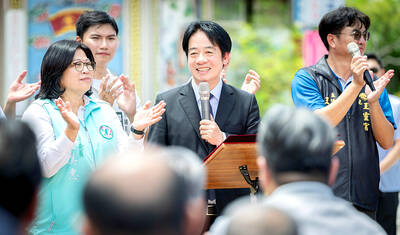
SIX SUBSIDIES: The monthly allowance for older farmers is to increase to NT$10,000, and NT$5,000 is to be given to homemakers under the national pension system, Lai said The government is to implement major welfare policies for disadvantaged groups, including raising the monthly allowance for older farmers to NT$10,000 and providing homemakers with NT$5,000 per month, President William Lai (賴清德) said yesterday. Lai made the remarks during a visit to Wangling Temple in Chiayi County, saying that the planned increases were being introduced amid economic growth and an increase in tax revenue. Touting a policy, in which the government plans to provide a monthly allowance of NT$5,000 for every child under the age of 18 in a bid to address Taiwan’s low birthrate, Lai said that if received for the


 RSS
RSS