


A report saying that US President Donald Trump advised Japanese Prime Minister Sanae Takaichi to avoid provoking China over Taiwan is not based on fact, a Japanese government official said yesterday.
The official, who asked not to be identified, did not offer details on what was actually said during the call.
The Wall Street Journal reported that Trump advised Takaichi during their call this week not to provoke Beijing over the question of Taiwan’s sovereignty, citing unnamed Japanese officials and an American briefed on the call.
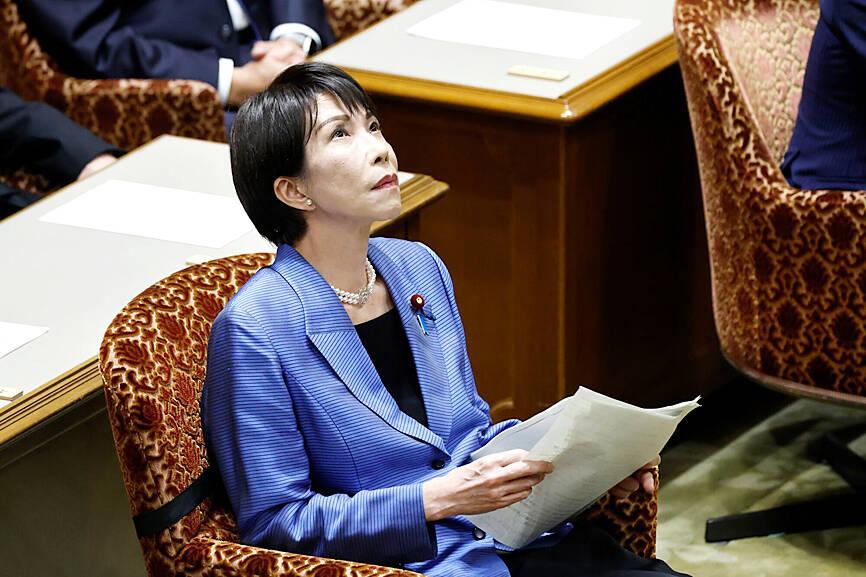
Photo: Bloomberg
The advice was subtle and the president did not pressure Takaichi to retract her comments, the report said.
The US embassy in Japan did not immediately respond to a request for comment.
“I can’t comment further on foreign policy related exchanges,” Japanese Chief Cabinet Secretary Minoru Kihara said yesterday, when asked whether the report was true.
In Tuesday’s call between Trump and Takaichi, “the two leaders confirmed close cooperation between the US and Japan,” he said.
Kihara reiterated that during the call, Trump said Takaichi is his close friend and she can call him anytime.
Takaichi had said Trump discussed his call with Chinese President Xi Jinping (習近平), which preceded his call with her, without elaborating on the content.
Takaichi has not retracted remarks she made on Nov. 7 that linked Japan’s security to a Taiwan contingency, the first such instance for a sitting prime minister.
At the time, she said an attack on Taiwan could be considered a “survival-threatening situation” for Japan.
Takaichi reiterated Japan’s position on responding to regional contingencies — namely, that for any specific incident, Japan would make a judgement taking into account all relevant information.
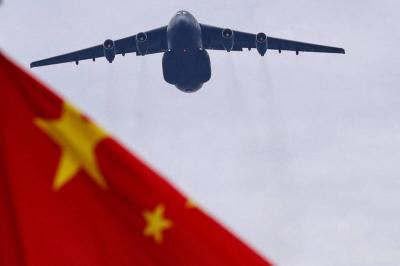
Beijing could eventually see a full amphibious invasion of Taiwan as the only "prudent" way to bring about unification, the US Department of Defense said in a newly released annual report to Congress. The Pentagon's "Annual Report to Congress: Military and Security Developments Involving the People's Republic of China 2025," was in many ways similar to last year’s report but reorganized the analysis of the options China has to take over Taiwan. Generally, according to the report, Chinese leaders view the People's Liberation Army's (PLA) capabilities for a Taiwan campaign as improving, but they remain uncertain about its readiness to successfully seize

Taiwan is getting a day off on Christmas for the first time in 25 years. The change comes after opposition parties passed a law earlier this year to add or restore five public holidays, including Constitution Day, which falls on today, Dec. 25. The day marks the 1947 adoption of the constitution of the Republic of China, as the government in Taipei is formally known. Back then the Chinese Nationalist Party (KMT) governed China from Nanjing. When the KMT, now an opposition party in Taiwan, passed the legislation on holidays, it said that they would help “commemorate the history of national development.” That

HORROR STORIES: One victim recounted not realizing they had been stabbed and seeing people bleeding, while another recalled breaking down in tears after fleeing A man on Friday died after he tried to fight the knife-wielding suspect who went on a stabbing spree near two of Taipei’s busiest metro stations, Taipei Mayor Chiang Wan-an (蔣萬安) said. The 57-year-old man, identified by his family name, Yu (余), encountered the suspect at Exit M7 of Taipei Main Station and immediately tried to stop him, but was fatally wounded and later died, Chiang said, calling the incident “heartbreaking.” Yu’s family would receive at least NT$5 million (US$158,584) in compensation through the Taipei Rapid Transit Corp’s (TRTC) insurance coverage, he said after convening an emergency security response meeting yesterday morning. National

Taiwan has overtaken South Korea this year in per capita income for the first time in 23 years, IMF data showed. Per capita income is a nation’s GDP divided by the total population, used to compare average wealth levels across countries. Taiwan also beat Japan this year on per capita income, after surpassing it for the first time last year, US magazine Newsweek reported yesterday. Across Asia, Taiwan ranked fourth for per capita income at US$37,827 this year due to sustained economic growth, the report said. In the top three spots were Singapore, Macau and Hong Kong, it said. South


 RSS
RSS