


The first satellite of the Formosat-8 system was to be launched into space at 2:18am (Taiwan time) today from the Vanderbilt Space Force Base in California, the Taiwan Space Agency (TASA) said yesterday, adding that people could watch simulcasts of the satellite launch via the Facebook pages of TASA, and the National Science and Technology Council, as well as TASA’s YouTube channel.
Formosat-8 is the nation’s first self-made optical remote sensing satellite constellation, consisting of six satellites with a native resolution of 1m and two with native resolution of less than 1m.
The first satellite of the constellation, named Chi Po-lin (齊柏林衛星) by President William Lai (賴清德), has 84 percent of its components made domestically.
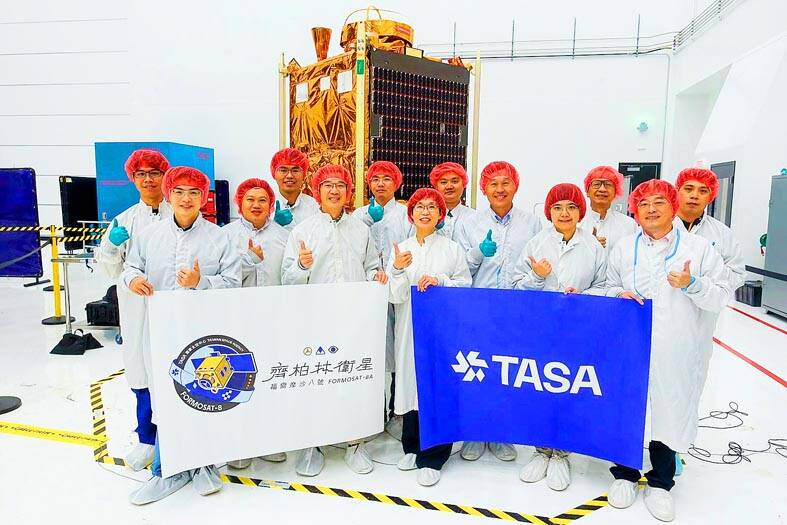
Photo courtesy of the National Science and Technology Council.
Prior to yesterday, the launch of the first satellite had been delayed four times, the agency said.
The National Science and Technology Council said the satellite was to be carried into space via SpaceX’s Falcon 9 Transporter-15 rocket.
In addition to the satellite, the rocket’s payload includes five CubeSats made by Taiwanese start-up companies and university researchers, the council said.
The rocket was scheduled to jettison its payload fairing about three minutes after launch, the council said.
The rocket would deploy five CubeSats into a 510km orbit 54 minutes after launch, it added.
The satellite is expected to separate from the rocket 140 minutes after launch, entering a 561km sun-synchronous orbit to carry out an Earth-observation optical remote sensing mission, the council said.
The Chi Po-lin satellite also carries a dual-band ionospheric transient imager and an electron temperature and density probe — developed by a research team led by National Cheng Kung University physics professor Chen Bing-chih (陳炳志) — to conduct ionospheric observations, as well as research on the origins and triggering mechanisms of ground-based gamma-ray flashes, the council said.
“We hope that this mission would demonstrate multiple technologies independently developed by Taiwan, including satellite high-frequency communication, inter-satellite communication, smart remote sensing, electric propulsion, deployment mechanisms, and deorbit control functions,” the council said.
Full deployment of the constellation is expected by 2031.
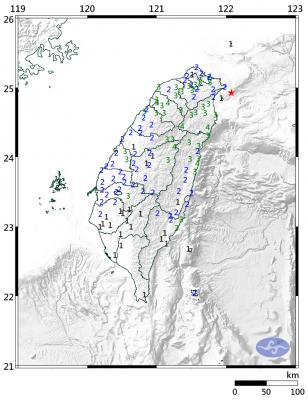
A magnitude 6.1 earthquake struck off the coast of Yilan County at 8:39pm tonight, the Central Weather Administration (CWA) said, with no immediate reports of damage or injuries. The epicenter was 38.7km east-northeast of Yilan County Hall at a focal depth of 98.3km, the CWA’s Seismological Center said. The quake’s maximum intensity, which gauges the actual physical effect of a seismic event, was a level 4 on Taiwan’s 7-tier intensity scale, the center said. That intensity level was recorded in Yilan County’s Nanao Township (南澳), Hsinchu County’s Guansi Township (關西), Nantou County’s Hehuanshan (合歡山) and Hualien County’s Yanliao (鹽寮). An intensity of 3 was
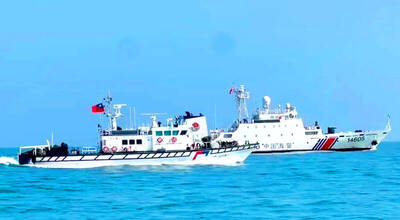
Instead of focusing solely on the threat of a full-scale military invasion, the US and its allies must prepare for a potential Chinese “quarantine” of Taiwan enforced through customs inspections, Stanford University Hoover fellow Eyck Freymann said in a Foreign Affairs article published on Wednesday. China could use various “gray zone” tactics in “reconfiguring the regional and ultimately the global economic order without a war,” said Freymann, who is also a nonresident research fellow at the US Naval War College. China might seize control of Taiwan’s links to the outside world by requiring all flights and ships entering or leaving Taiwan
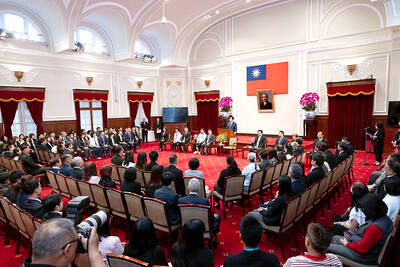
The next minimum wage hike is expected to exceed NT$30,000, President William Lai (賴清德) said yesterday during an award ceremony honoring “model workers,” including migrant workers, at the Presidential Office ahead of Workers’ Day today. Lai said he wished to thank the awardees on behalf of the nation and extend his most sincere respect for their hard work, on which Taiwan’s prosperity has been built. Lai specifically thanked 10 migrant workers selected for the award, saying that although they left their home countries to further their own goals, their efforts have benefited Taiwan as well. The nation’s industrial sector and small businesses lay
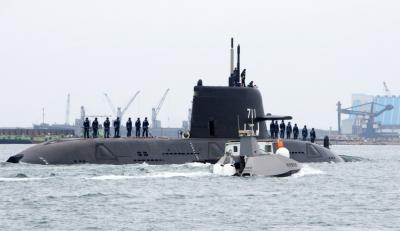
Taiwan's first indigenous defense submarine, the SS-711 Hai Kun (海鯤, or Narwhal), departed for its 13th sea trial at 7am today, marking its seventh submerged test, with delivery to the navy scheduled for July. The outing also marked its first sea deployment since President William Lai (賴清德) boarded the submarine for an inspection on March 19, drawing a crowd of military enthusiasts who gathered to show support. The submarine this morning departed port accompanied by CSBC Corp’s Endeavor Manta (奮進魔鬼魚號) uncrewed surface vessel and a navy M109 assault boat. Amid public interest in key milestones such as torpedo-launching operations and overnight submerged trials,


 RSS
RSS