


Democratic Progressive Party (DPP) Legislator Puma Shen (沈伯洋) yesterday departed for the Netherlands despite threats against him by Beijing.
China’s Chongqing Municipal Public Security Bureau late last month listed Shen as “wanted” and launched an investigation into his alleged “secession-related” criminal activities in Taiwan, including his founding of Kuma Academy, a civil defense organization that tries to prepare Taiwanese on what to do in the event of an invasion by China.
The probe is being carried out under China’s Criminal Law and the judicial guidelines introduced last year on penalizing “Taiwan independence separatists.”
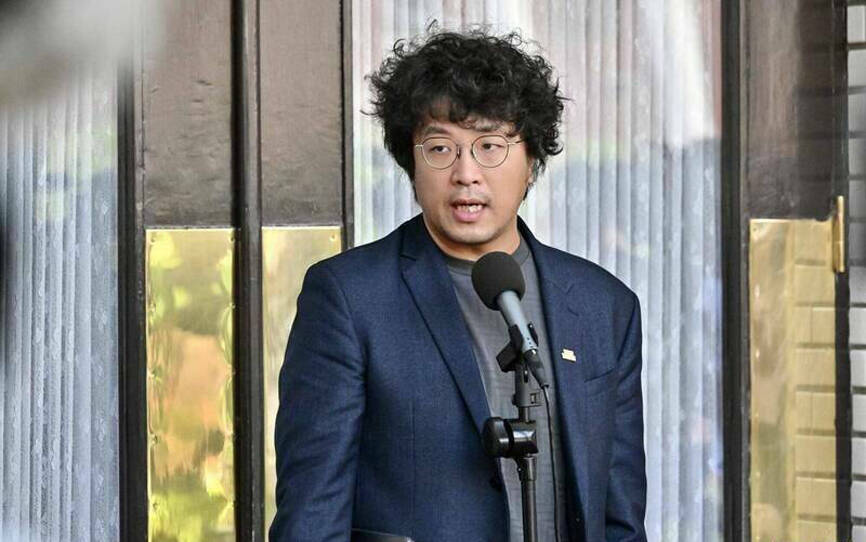
Photo: Taipei Times
A Chinese legal expert said on the state-run China Central Television that Shen should be pursued through Interpol and other mutual judicial assistance agreements with foreign countries.
The legislative Foreign Affairs and National Defense Committee on Wednesday passed a DPP motion condemning the probe into Shen, saying that the Chinese Communist Party “has no jurisdiction” over the people of Taiwan.
The 209th Executive Committee Meeting of Liberal International (LI) started yesterday and ends tomorrow in The Hague, Netherlands.
According to the official agenda, Shen is scheduled today to attend a panel discussion titled “Defending Democracy in an Era of Political Manipulation,” organized by LI’s Human Rights Committee.
The session is scheduled to be chaired by Canadian political operative and LI Human Rights Committee vice chair Claudia McCoy.
Shen is to appear alongside Pavle Grbovic, leader of Serbia’s Movement of Free Citizens, and Bart Groothuis, a European Parliament member from the Netherlands, to jointly explore how to respond to information warfare and infiltration by authoritarian forces.
Shen and DPP Legislator Fan Yun (范雲) are also scheduled to attend a joint conference titled “Indo-Pacific and European Security: Developments, Issues, and Challenges,” co-organized by the Alliance of Liberals and Democrats for Europe, and the Council of Asian Liberals and Democrats tomorrow afternoon.
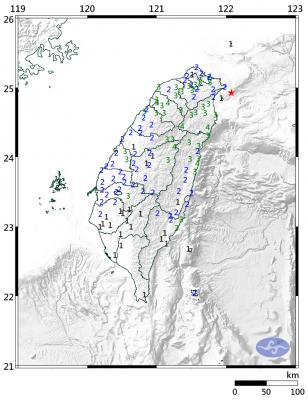
A magnitude 6.1 earthquake struck off the coast of Yilan County at 8:39pm tonight, the Central Weather Administration (CWA) said, with no immediate reports of damage or injuries. The epicenter was 38.7km east-northeast of Yilan County Hall at a focal depth of 98.3km, the CWA’s Seismological Center said. The quake’s maximum intensity, which gauges the actual physical effect of a seismic event, was a level 4 on Taiwan’s 7-tier intensity scale, the center said. That intensity level was recorded in Yilan County’s Nanao Township (南澳), Hsinchu County’s Guansi Township (關西), Nantou County’s Hehuanshan (合歡山) and Hualien County’s Yanliao (鹽寮). An intensity of 3 was

Instead of focusing solely on the threat of a full-scale military invasion, the US and its allies must prepare for a potential Chinese “quarantine” of Taiwan enforced through customs inspections, Stanford University Hoover fellow Eyck Freymann said in a Foreign Affairs article published on Wednesday. China could use various “gray zone” tactics in “reconfiguring the regional and ultimately the global economic order without a war,” said Freymann, who is also a nonresident research fellow at the US Naval War College. China might seize control of Taiwan’s links to the outside world by requiring all flights and ships entering or leaving Taiwan
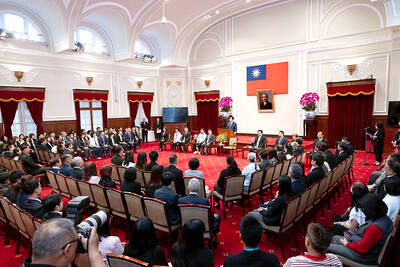
The next minimum wage hike is expected to exceed NT$30,000, President William Lai (賴清德) said yesterday during an award ceremony honoring “model workers,” including migrant workers, at the Presidential Office ahead of Workers’ Day today. Lai said he wished to thank the awardees on behalf of the nation and extend his most sincere respect for their hard work, on which Taiwan’s prosperity has been built. Lai specifically thanked 10 migrant workers selected for the award, saying that although they left their home countries to further their own goals, their efforts have benefited Taiwan as well. The nation’s industrial sector and small businesses lay
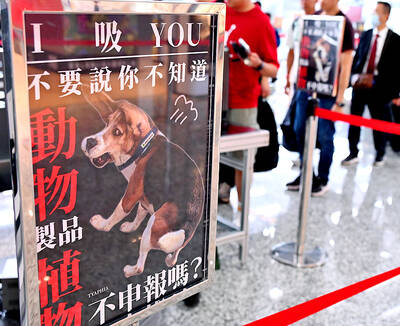
Quarantine awareness posters at Taiwan Taoyuan International Airport have gone viral for their use of wordplay. Issued by the airport branch of the Animal and Plant Health Inspection Agency, the posters feature sniffer dogs making a range of facial expressions, paired with advisory messages built around homophones. “We update the messages for holidays and campaign needs, periodically refreshing materials to attract people’s attention,” quarantine officials said. “The aim is to use the dogs’ appeal to draw focus to quarantine regulations.” A Japanese traveler visiting Taiwan has posted a photo on X of a poster showing a quarantine dog with a


 RSS
RSS