


China is mobilizing a fleet of civilian ships that could aid in an invasion of Taiwan, a mission that “could surpass the Second World War’s Normandy landings in scale and complexity,” Reuters yesterday reported.
The report tracked drills of civilian ships using transponder signals and satellite imagery to conclude that China is developing concrete invasion plans to rehearse new techniques and speed up beach landings, it said.
It said it identified twelve ships that can offload and unload cargo and vehicles without port facilities, traveling from the northern Chinese coast and arriving on Aug. 23 at a landing beach in Guangdong Province near a suspected military base.
The report said this was the first time satellite imagery has shown civilian cargo ships making beach landings during a People’s Liberation Army (PLA) amphibious landing exercise, citing naval warfare experts.
The fleet included six roll-on, roll-off ferries and six deck cargo ships that could be used to carry vehicles, it said.
The roll-on, roll-off ferries have been used in military exercises since at least 2019, it said, citing a US military report.
Some of them can drop off or pick up amphibious assault vehicles directly from the water using retrofitted ramps, it added, citing images from Chinese state media.
The testing of this system suggests the PLA fears it might be unable to seize or prevent the demolition of Taiwan’s existing ports and cargo-handling facilities in the early phases of an invasion, it said, citing military experts.
“Cargo ships could land after the first amphibious assault vehicles swim to shore, and play a crucial role in resupplying them before China gains control of Taiwanese infrastructure,” a former US naval intelligence officer J. Michael Dahm said.
“It is a huge increase in their first wave capacity, in their ability to take heavy vehicles straight to the beach in a first wave,” former US submarine officer Thomas Shugart said.
Taiwan is monitoring the use of civilian vessels in military exercises and has “developed relevant contingency plans,” Minister of National Defense Wellington Koo (顧立雄) said in September.
The PLA has the authority to take control of civilian shipping vessels for military purposes, to join the world’s largest navy, the report said.
Experts estimate that the PLA has enough ships and landing craft to carry about 20,000 troops and their equipment in the first wave of a landing, falling far short of the estimated 300,000 to one million required to launch a successful invasion, the report said.
It is not known how many civilian ships are used in these exercises, as their shipping registration does not differ from other cargo vessels, it said.
However, the simple design and relative ease of construction of deck cargo ships means they can quickly be built in large numbers, it said, citing a report authored by researcher Cono Kennedy that was published by the US Naval War College last year.
China’s shipyards account for 53 percent of global shipbuilding, while the US accounts for just 0.1 percent, it said.
Moreover, one of China's latest roll-on, roll-off ferries can be bought for US$60 million, while the US Navy’s latest amphibious assault ship is estimated to cost more than US$3.8 billion, it said.
Earlier this month, China also commissioned a third, more advanced aircraft carrier, the 80,000-tonne Fujian, in a show of growing naval prowess, it said.
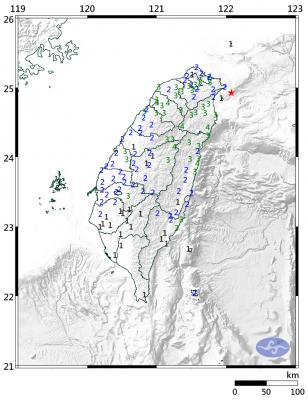
A magnitude 6.1 earthquake struck off the coast of Yilan County at 8:39pm tonight, the Central Weather Administration (CWA) said, with no immediate reports of damage or injuries. The epicenter was 38.7km east-northeast of Yilan County Hall at a focal depth of 98.3km, the CWA’s Seismological Center said. The quake’s maximum intensity, which gauges the actual physical effect of a seismic event, was a level 4 on Taiwan’s 7-tier intensity scale, the center said. That intensity level was recorded in Yilan County’s Nanao Township (南澳), Hsinchu County’s Guansi Township (關西), Nantou County’s Hehuanshan (合歡山) and Hualien County’s Yanliao (鹽寮). An intensity of 3 was
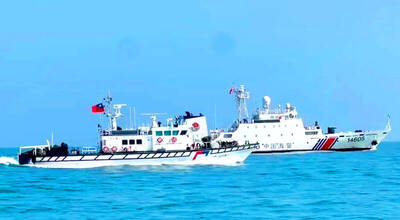
Instead of focusing solely on the threat of a full-scale military invasion, the US and its allies must prepare for a potential Chinese “quarantine” of Taiwan enforced through customs inspections, Stanford University Hoover fellow Eyck Freymann said in a Foreign Affairs article published on Wednesday. China could use various “gray zone” tactics in “reconfiguring the regional and ultimately the global economic order without a war,” said Freymann, who is also a nonresident research fellow at the US Naval War College. China might seize control of Taiwan’s links to the outside world by requiring all flights and ships entering or leaving Taiwan
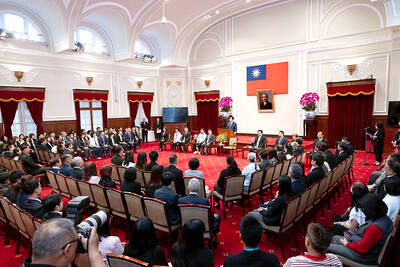
The next minimum wage hike is expected to exceed NT$30,000, President William Lai (賴清德) said yesterday during an award ceremony honoring “model workers,” including migrant workers, at the Presidential Office ahead of Workers’ Day today. Lai said he wished to thank the awardees on behalf of the nation and extend his most sincere respect for their hard work, on which Taiwan’s prosperity has been built. Lai specifically thanked 10 migrant workers selected for the award, saying that although they left their home countries to further their own goals, their efforts have benefited Taiwan as well. The nation’s industrial sector and small businesses lay
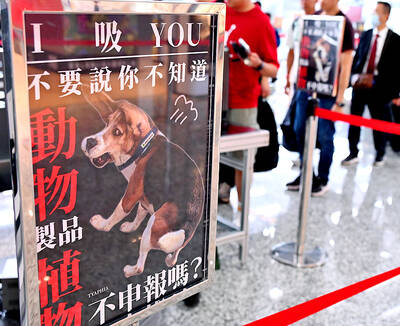
Quarantine awareness posters at Taiwan Taoyuan International Airport have gone viral for their use of wordplay. Issued by the airport branch of the Animal and Plant Health Inspection Agency, the posters feature sniffer dogs making a range of facial expressions, paired with advisory messages built around homophones. “We update the messages for holidays and campaign needs, periodically refreshing materials to attract people’s attention,” quarantine officials said. “The aim is to use the dogs’ appeal to draw focus to quarantine regulations.” A Japanese traveler visiting Taiwan has posted a photo on X of a poster showing a quarantine dog with a


 RSS
RSS