


Japanese Prime Minister Sanae Takaichi’s comments regarding Taiwan were “reckless” and cross-strait issues should not be subject to outside intervention, former president Ma Ying-jeou (馬英九) said yesterday.
Takaichi last week said that if China used force against Taiwan, it might constitute a “survival-threatening situation” for Japan, allowing it to mobilize its armed forces.
Ma wrote on Facebook yesterday that he was greatly concerned about the comment and that it might lead to a revival of right-wing militarism in Japan.
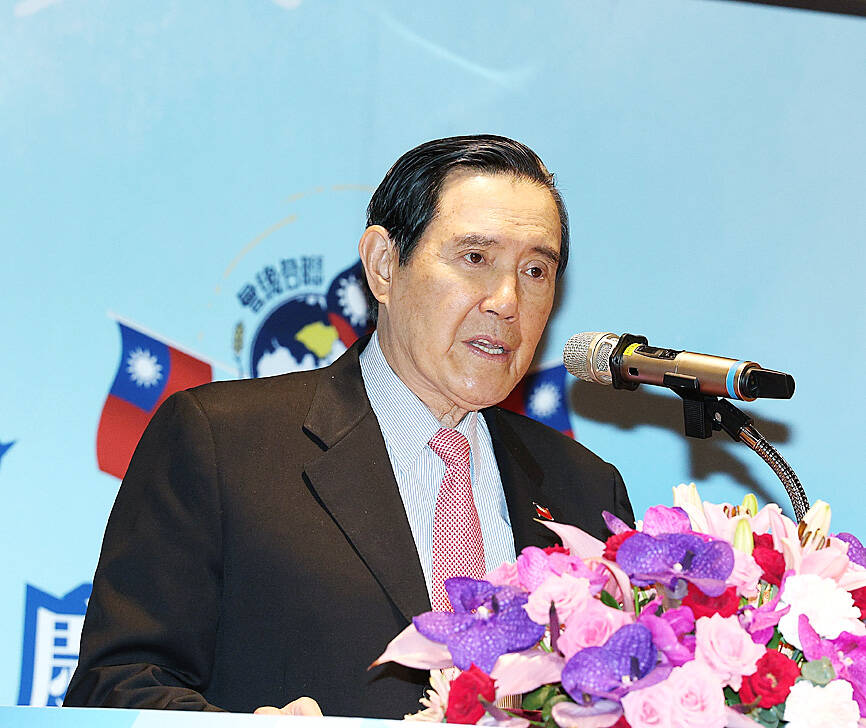
Photo: CNA
Ma urged Japanese leaders to be cautious regarding their words and actions about the situation in the Taiwan Strait.
Ma said while he supports friendly Taiwan-Japan ties, outsiders should not intervene in cross-strait affairs, which should be left to the two sides of the Strait.
Takaichi’s comments were a departure from the caution past Japanese prime ministers showed on the Taiwan issue, Ma said.
Even the hint that Japan might consider armed intervention is drawing criticism, even at home, he added.
Takaichi might not be aware that Tokyo must seek Washington’s approval in a situation justifying military action by Japan, Ma said, adding that the US was evidently not informed ahead of her remarks.
He said he was confident that wisdom would prevail on both sides of the Taiwan Strait and that a peaceful solution would be reached.
Regardless of the circumstances, the Taiwan Strait must remain stable so that a “survival-threatening situation” does not arise, he said.
Separately, former KMT chairwoman Hung Hsiu-chu (洪秀柱) said that Takaichi was “overreaching” with her comment.
She put Taiwan in a dangerous position, and it must be made clear that “Taiwan is no longer a Japanese colony,” Hung said.
The Taiwan issue is an “internal matter stemming from the Chinese Civil War” and foreign politicians are not in a position to comment on cross-strait affairs, she said.
Democratic Progressive Party Legislator Chen Kuan-ting (陳冠廷) said that Ma’s comments were from Beijing’s perspective and ignored that China has not renounced the use of force as a means to resolve the Taiwan issue.
Ma aligns with the Chinese narrative in many instances, even using “strong reactions from the Chinese side” as a standard for judgement, Chen said.
Taiwan’s security and interests cannot be centered around China’s emotional reactions, and Beijing should not be allowed to determine how Taiwan interacts with the international community, he said.
“The reason the situation in the Taiwan Strait has become tense in the past few years has always been very clear: Chinese military aircraft and warships continue to harass Taiwan, and crossing the median line [of the Taiwan Strait] has become the new normal,” Chen said, adding that China’s “gray zone” actions and escalating threats are real and present security challenges.
“However, Ma focuses on Japan and avoids discussing the increasing military pressure from China,” he said. “This not only misses the point, but also could lead to international misunderstandings.”
Japan’s concerns about regional security are based on its own national security realities and assessments of the situation in the Indo-Pacific region, not on what Ma claims is “stirring up the Taiwan Strait,” Chen said.
Taiwan and Japan in the past few years have formed solid connections in areas such as democracy, humanitarian efforts, economics and security, he said.
This normal cooperation is not a “return to militarism,” but a necessary collaboration between democratic nations in the face of authoritarian expansion, he said.
While Taiwan seeks peace, it does not want peace at the price of bending the knee, he said, adding that the nation’s future should not and cannot be dictated by China.

FUKUOKA SITUATION: Japanese media reported that the pathogen is expected to be identified by the summer, while the CDC downplayed the idea that it was hMPV A “mysterious cold-like illness” reported in Japan’s Fukuoka Prefecture does not seem to be a new disease, but Japanese authorities have been asked about the situation, the Centers for Disease Control (CDC) said yesterday. The Fukuoka Prefectural Medical Association on Wednesday told a news conference that a “mystery cold” that has become a hot topic on social media is “highly likely to be caused by some kind of viral infection,” Japan’s KBC News reported. “Many people are experiencing symptoms starting with a sore throat, followed by a runny nose, phlegm and a severe cough,” KBC News reported, citing association officials. Health authorities are

Nvidia Corp CEO Jensen Huang (黃仁勳) arrived in Taiwan yesterday ahead of upcoming AI and technology events, saying he plans to meet with clients and Taiwan Semiconductor Manufacturing Co Chairman C.C. Wei (魏哲家) during his visit. After landing at Taipei Songshan Airport, Huang posed for photos with fans and handed out Yakult drinks to reporters and supporters waiting at the scene, saying he has “a lot to do” during the trip. Asked about reports that Nvidia’s planned headquarters site in Taipei’s Beitou Shilin Technology Park could break ground on May 27, Huang said that if the company holds an event, he would

The Ministry of Finance this afternoon announced the winning numbers for the March-April uniform invoice lottery. The winning number for the NT$10 million (US$318,060) special prize is 19531471, and the winning number for the NT$2 million grand prize is 85941329. Three numbers were drawn for the NT$200,000 first prize: 07225810, 20231230 and 83518781. Those with receipts matching the last seven digits of any of the first-prize numbers will win the NT$40,000 second prize, while those matching the last six digits will win the NT$10,000 third prize. Those whose receipts match the last five digits of the first-prize numbers can claim the NT$4,000 fourth prize,
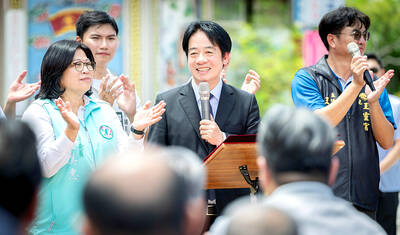
SIX SUBSIDIES: The monthly allowance for older farmers is to increase to NT$10,000, and NT$5,000 is to be given to homemakers under the national pension system, Lai said The government is to implement major welfare policies for disadvantaged groups, including raising the monthly allowance for older farmers to NT$10,000 and providing homemakers with NT$5,000 per month, President William Lai (賴清德) said yesterday. Lai made the remarks during a visit to Wangling Temple in Chiayi County, saying that the planned increases were being introduced amid economic growth and an increase in tax revenue. Touting a policy, in which the government plans to provide a monthly allowance of NT$5,000 for every child under the age of 18 in a bid to address Taiwan’s low birthrate, Lai said that if received for the


 RSS
RSS