


China yesterday began sea trials of its most advanced amphibious assault ship, a type of vessel that a Taiwanese military official said might pose a greater threat than traditional aircraft carriers.
The Sichuan Type 076 vessel, which set sail from Shanghai’s Hudong-Zhonghua Shipyard, combines some of the attributes of an aircraft carrier and earlier amphibious assault ships, with the ability to launch aircraft and landing craft loaded with troops.
It is about half the size of the Fujian, the latest aircraft carrier commissioned by China on Friday last week, with a displacement of about 50,000 tonnes.
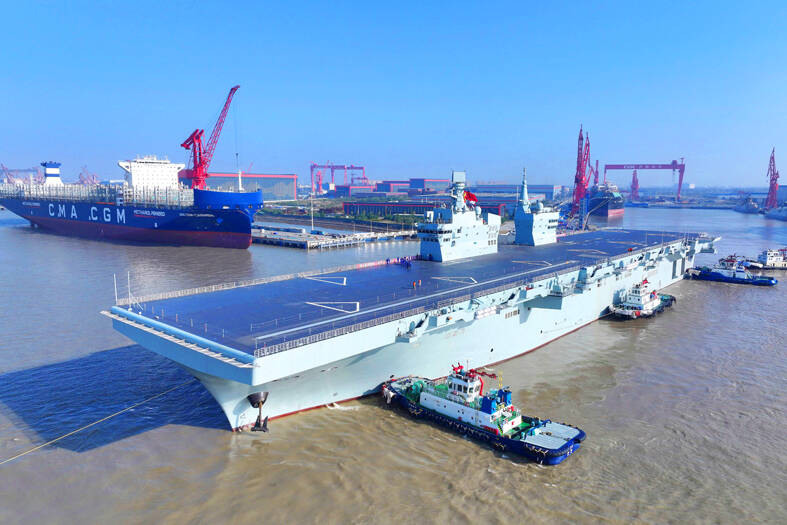
Photo: Xinhua via AP
Both ships were indigenously designed and built.
Exact technical specifications have not been released, but amphibious assault ships could be faster than carriers, which gives them more operational flexibility, but they are more lightly protected against attack and cannot carry as many or as broad a range of aircraft.
Amphibious assault ships would be critical for an invasion of Taiwan, although Taiwan is also bristling with missile defense systems that could make any attempt costly.
The Sichuan is roughly similar to the US Navy’s America-class and Wasp-class amphibious assault ships.
However, it is equipped with the same modern electromagnetic catapult system that has been successfully tested on the Fujian carrier, while the US ships lack such launch systems and instead can only operate helicopters, and short or vertical take-off and landing planes.
Official Chinese media reported that the catapult system would allow the Sichuan to launch fixed-wing aircraft, but it was not yet clear whether it would be limited to drones or whether it could launch crewed fixed-wing aircraft like fighter jets.
That would likely become known during the later stages of the sea trials as the Sichuan’s capabilities are tested.
Speaking on condition of anonymity, a Taiwanese military source yesterday said that the Type 076 ships were more of a threat to Taiwan than traditional aircraft carriers.
As the new ship is capable of carrying fixed-wing aircraft and helicopters, as well as drone hives, it could launch attacks from the air while attempting to land troops, they said.
To counter such threats, Taiwan should continue to develop and strengthen its asymmetrical combat capabilities while developing and deploying anti-ship missiles of increased range, the source said, citing the extended-range version of the Hsiung Feng III (雄風三) missiles as an example.
Taiwanese drones should have strike and reconnaissance capabilities built in, and should be able to work in conjunction with the air force and the navy, the source said.
Land-based mobile long-range strike capabilities must be developed and drilled so that such units can carry out joint force operations to deter enemy landings, the source said.
The military should mass-produce Chin Feng (勁蜂) drones developed by the Chungshan Institute of Science and Technology to conduct strikes against enemy surface ships and create opportunities for anti-surface missiles to penetrate enemy defenses, they added.
Institute for National Defense and Security Research assistant research fellow Jiang Hsin-biao (江炘杓) said that the Type 076, despite being the core element of China’s “new quality fighting force,” has its weaknesses.
As long as the Taiwanese military can target such weaknesses, it should not be any more challenging to handle than other ships, he said, adding that the flight and landing efficiency of the Type 076 was very low, and its landing support systems were hard-pressed to guarantee safe landings.
China has not said how long the Sichuan sea trials are to last.

FUKUOKA SITUATION: Japanese media reported that the pathogen is expected to be identified by the summer, while the CDC downplayed the idea that it was hMPV A “mysterious cold-like illness” reported in Japan’s Fukuoka Prefecture does not seem to be a new disease, but Japanese authorities have been asked about the situation, the Centers for Disease Control (CDC) said yesterday. The Fukuoka Prefectural Medical Association on Wednesday told a news conference that a “mystery cold” that has become a hot topic on social media is “highly likely to be caused by some kind of viral infection,” Japan’s KBC News reported. “Many people are experiencing symptoms starting with a sore throat, followed by a runny nose, phlegm and a severe cough,” KBC News reported, citing association officials. Health authorities are

Nvidia Corp CEO Jensen Huang (黃仁勳) arrived in Taiwan yesterday ahead of upcoming AI and technology events, saying he plans to meet with clients and Taiwan Semiconductor Manufacturing Co Chairman C.C. Wei (魏哲家) during his visit. After landing at Taipei Songshan Airport, Huang posed for photos with fans and handed out Yakult drinks to reporters and supporters waiting at the scene, saying he has “a lot to do” during the trip. Asked about reports that Nvidia’s planned headquarters site in Taipei’s Beitou Shilin Technology Park could break ground on May 27, Huang said that if the company holds an event, he would

The Ministry of Finance this afternoon announced the winning numbers for the March-April uniform invoice lottery. The winning number for the NT$10 million (US$318,060) special prize is 19531471, and the winning number for the NT$2 million grand prize is 85941329. Three numbers were drawn for the NT$200,000 first prize: 07225810, 20231230 and 83518781. Those with receipts matching the last seven digits of any of the first-prize numbers will win the NT$40,000 second prize, while those matching the last six digits will win the NT$10,000 third prize. Those whose receipts match the last five digits of the first-prize numbers can claim the NT$4,000 fourth prize,

SIX SUBSIDIES: The monthly allowance for older farmers is to increase to NT$10,000, and NT$5,000 is to be given to homemakers under the national pension system, Lai said The government is to implement major welfare policies for disadvantaged groups, including raising the monthly allowance for older farmers to NT$10,000 and providing homemakers with NT$5,000 per month, President William Lai (賴清德) said yesterday. Lai made the remarks during a visit to Wangling Temple in Chiayi County, saying that the planned increases were being introduced amid economic growth and an increase in tax revenue. Touting a policy, in which the government plans to provide a monthly allowance of NT$5,000 for every child under the age of 18 in a bid to address Taiwan’s low birthrate, Lai said that if received for the


 RSS
RSS