

Mandatory dairy cattle insurance is to take effect from Jan. 1 next year, with the government subsidizing half of the insurance premium, the Ministry of Agriculture said.
The Regulations Governing Mandatory Insurance and Premium Subsidy of Dairy Cattle Death Insurance were established based on the Agricultural Insurance Act (農業保險法) to bolster operational risk diversification for dairy farmers, the ministry said.
The dairy cattle insurance coverage rate nationwide increased to 82.6 percent last year, it said.
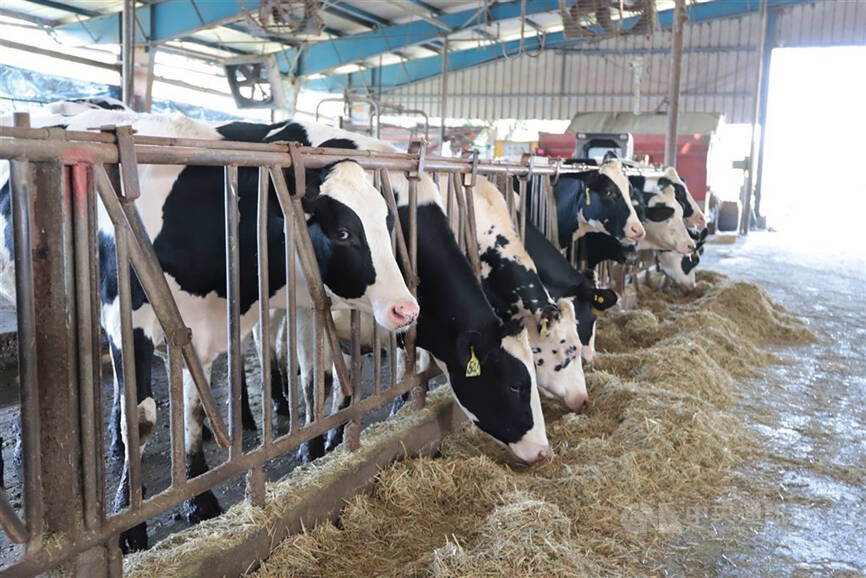
Photo: CNA
With the insurance enforced next year, data on dairy and beef cattle would be integrated into a database to observe the livestock industry more precisely, it said.
As the government would subsidize half of the insurance premium, farmers would bear NT$925 for each dairy cow, the ministry said.
Farmers whose insured cattle is culled can receive NT$30,000 in compensation for the first cow and an additional compensation of up to NT$17,000 each for others, it said, urging dairy farmers to promptly apply for the insurance via local farmers’ associations.
Separately, the ministry’s Taiwan Livestock Research Institute has developed several techniques to help dairy farmers enhance cattle health, increase milk production and reduce required workforce.
Given increasing temperatures due to climate change, dairy cattle tend to have poor appetite and less milk yield, caused by heat stress, the ministry said.
Sprinkling water has been a common approach to lower temperatures, but it can dampen cowsheds and increase the risk of mastitis, it said.
Therefore, the institute developed an infrared thermography inspection technique that can help diagnose mastitis, the ministry said.
The ministry said it had introduced exported milking robots and feces cleaning robot vacuums to the domestic market, and also developed a feces cleaning machine.

The donation of offshore patrol vessel Kinmen to the Philippines includes provisions that protect Taiwanese fishers and facilitate security cooperation across the First Island Chain, officials said yesterday. The comment was made during the Cabinet’s comprehensive administrative report at the legislature after Chinese Nationalist Party (KMT) Legislator Hsu Yu-chen (許宇甄) expressed concerns about the decision to give a ship to a country whose coast guard had in 2013 fired on a Taiwanese trawler and killed its captain without provocation. The Cabinet should lay out the safeguards that have been established to prevent the Philippine government from using the Kinmen to harass, expel
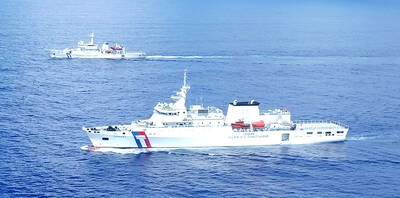
‘FRIENDSHIP FLEET’: A CGA official is scheduled to meet with the president of the Pacific nation, while one of the ships is to host a banquet and National Day event Two Coast Guard Administration (CGA) patrol vessels have docked at Malakal Harbor in Palau as part of an expedition exercise and diplomatic visit, during which a senior official is expected to meet with Palauan President Surangel Whipps Jr, the agency said yesterday. The two vessels, the 4,000-tonne-class Chiayi and the 1,000-tonne-class Penghu, set sail for Palau from Taiwan last week and arrived on Tuesday at Malakal Harbor, the CGA’s Fleet Branch said in a statement. The journey marks the second time the CGA has dispatched a “friendship fleet” to another country, after it sent its first-ever goodwill fleet, comprising the Hualien and
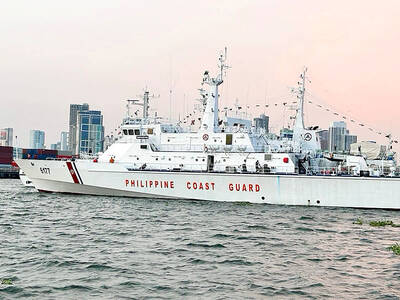
A patrol vessel donated by the Coast Guard Administration (CGA) to the Philippines was commissioned into the Philippine Coast Guard (PCG) on Friday, a Philippine non-governmental organization said. The CGA on Sept. 16 confirmed media reports that Taiwan had donated a retired 500-tonne patrol vessel to the Philippines. The Manila-based We Protect Our Seas (WPS) foundation, which served as an intermediary in the transfer, said that the vessel was formerly the CGA’s 500-tonne petrol vessel Kinmen (CG123). The WPS, in a statement issued on Friday, said the vessel, renamed as the BRP Sarangani, had been commissioned into the PCG the
The Coast Guard Administration (CGA) today said that two of its patrol vessels have docked at Palau's Malakal Harbor as part of an expedition exercise and diplomatic visit, during which a senior official is expected to meet with the Palauan president. The two vessels, the 4,000-tonne-class Chiayi (嘉義) and the 1,000-tonne-class Penghu (澎湖), set sail for Palau from Taiwan last week and arrived at Malakal Harbor yesterday, the CGA's Fleet Branch said in a statement. The journey marked the second time the CGA has dispatched a "Friendship Fleet" to another country, after it sent its first-ever goodwill fleet, comprising the Hualien (花蓮)


 RSS
RSS